
Picture Frame RFQ: Separate Print Size, Mat Opening and Outer Size
Compare paper fit, visible mat opening, supplied components and outside dimensions before choosing a stock frame or requesting a custom opening.
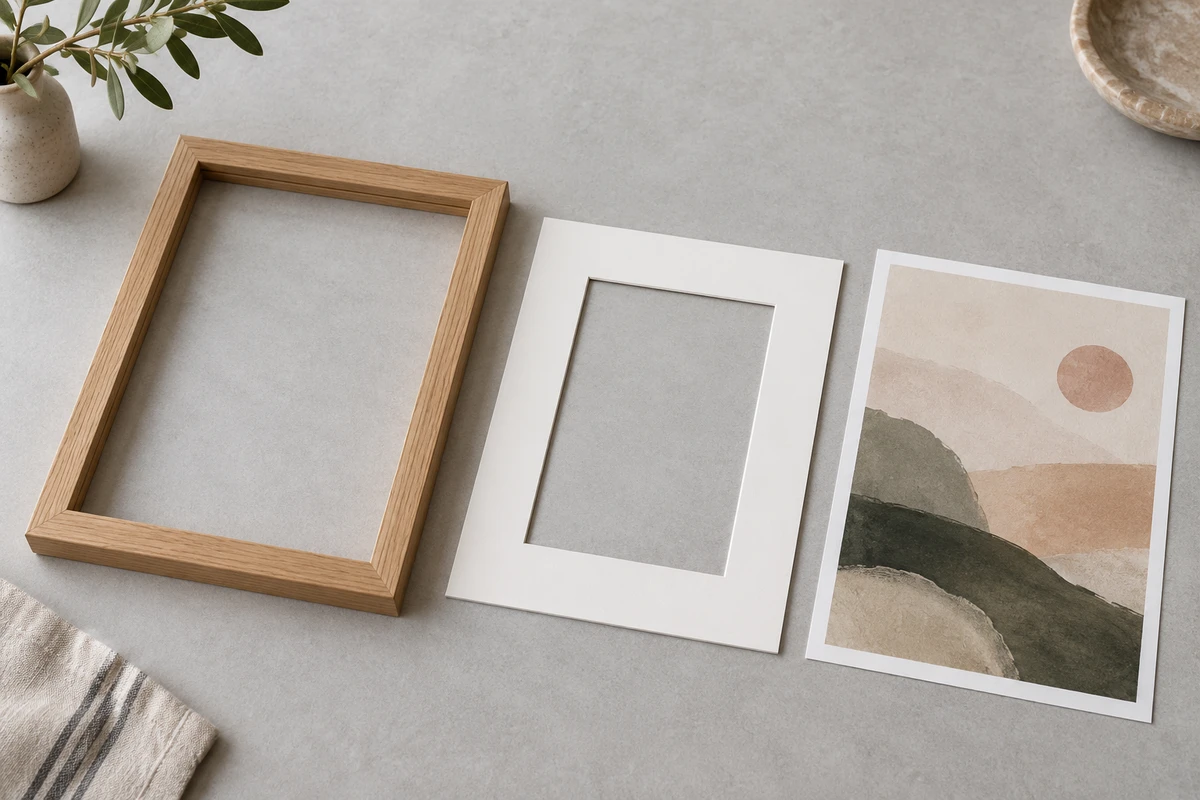
For a homeware shop buying wholesale picture frames, the useful starting point is the print that will go inside. Record its physical sheet size, the image and lettering that must stay visible, and the space available for the finished frame. A quote can match the advertised print format yet conceal a caption behind the mat.
Ask suppliers to price a named frame-and-mat combination. Keep the version without a mat separate if that is also under consideration. This lets you decide whether a stock combination works before paying for a changed opening or a different frame size.
Describe the print before choosing the frame
Measure the actual paper width and height in its intended viewing orientation. Identify the print version, because a revised caption or wider image can change the acceptable opening even when the paper size stays the same. State whether a white border is part of the artwork or may be covered.
On a labelled preview, mark the image, signature and text that must remain visible. Give their positions from named sheet edges. A general instruction such as “show the full picture” can leave the supplier guessing whether that includes the white border and publisher’s line.
Use a representative print for the fit sample. If the proposed product is intended for a thick mounted print rather than a loose sheet, disclose that construction and thickness. Ask the supplier which proposed frame accommodates it; do not approve the combination from width and height alone.
Give each measurement its own name
A useful reference is IKEA’s RÖDALM frame, article 005.488.63. Its UK product page lists the outside frame dimensions, mount opening and picture dimensions with and without the included mount separately. The page also identifies the front material and available display orientations. Those are specifications of that named product, used here to illustrate the questions to ask. They do not establish the construction of a seller’s offer.
For your quote, request the sheet size the frame accepts and the area visible after assembly. With a mat, ask for its outside size, opening width and height, and the opening’s position. Without a mat, ask how much of the print the frame edge conceals. Neither visible opening should be guessed from the nominal product name.
Keep the frame’s outside width, height and depth in separate fields. They answer whether the finished object occupies the intended display space. For a standing frame, ask for the depth occupied with the supplied support in use as well. A narrow shelf may accommodate the frame body but leave the proposed standing arrangement unresolved.
Compare one complete configuration per worksheet
Copy the following worksheet for each print format and frame option. Enter units once, use them consistently and ask the supplier to return actual values or an explicit unanswered point. Where acceptable variation matters, agree it for that dimension rather than adding an arbitrary allowance to every edge.
| Requirement | Buyer’s entry to complete | Supplier reply or unresolved point |
|---|---|---|
| Print or artwork sheet size | Print reference, width, height, orientation and supplied thickness | Accepted sheet size and any construction limitation: ___ |
| Area that must remain visible | Image and caption boundaries measured from named edges | Proposed visible area and any covered content: ___ |
| Mat supply and opening | Mat included or excluded; desired appearance; centred or deliberately offset | Mat outside size, opening size and opening position: ___ |
| Fit with and without a mat | Identify which version is the base request and which is optional | Separate fit and visible-opening dimensions for each: ___ |
| Outer frame dimensions | Maximum display width, height and depth where restricted | Actual outside dimensions and standing footprint if applicable: ___ |
| Front, backing and orientation | Required front material; backing; portrait or landscape; standing or hanging | Supplied components, support arrangement and exclusions: ___ |
| Quote and decision | Quantity by print/frame variant; stock or revised opening | Configuration reference, separate change cost, sample reference and remaining question: ___ |
Ask for a clear reply against the opening-position row. The same opening width and height can show different content when placed higher, lower or off centre. A supplier’s marked preview should identify both the paper outline and the visible window so that the buyer can review that relationship.
State what comes in the frame price
Have the quote name the frame, front panel, backing, mat and any supplied standing or hanging fittings. Identify whether a display print is merely a sample illustration or part of the delivered item. If the shop will insert its own prints, state whether frames are supplied empty and ready for that agreed task.
Specify the front material by the supplier’s description. Keep a material choice separate from promises such as UV protection, archival suitability or resistance to breakage. Those properties need their own relevant evidence if the buyer requires them; this size comparison establishes none of them.
State the intended orientation and whether customers will stand or hang the frame. Request the product’s instructions and the included-component list. Wall-specific fixing selection and installation remain separate from this RFQ; an accessory pictured beside a frame should not silently enter the quoted contents.
Fictional decision with a caption close to the edge
Consider a fictional shop ordering frames for a portrait print on a 200 × 250 mm sheet. All figures and supplier replies in this example are invented. The protected content lies between 12 and 188 mm from the left edge and between 12 and 244 mm from the top edge. The caption therefore needs the visible window to reach at least 244 mm down the sheet.
Offer A is described as fitting the 200 × 250 mm paper and includes a centred 180 × 230 mm mat opening. On the proposed drawing, the opening begins 10 mm from the left and top edges: (200 − 180) ÷ 2 = 10 and (250 − 230) ÷ 2 = 10. Its lower edge reaches 240 mm. That leaves 4 mm of the protected content beyond the visible window.
Offer B uses the same stated paper format without a mat. Its returned drawing identifies a centred visible opening of 196 × 246 mm, running from 2 to 198 mm across and from 2 to 248 mm down the sheet. That proposed window contains the protected content. These are fictional drawing dimensions, not recommended frame allowances.
The buyer takes B forward for a fit sample and keeps A on hold. If the mat appearance is important to the range, the buyer asks A for a revised opening and a separate quote instead of agreeing to trim the caption. B still needs sample review and confirmation of its external display footprint. Neither offer is approved merely because the arithmetic works.
Review the crop before approving a custom run
Review the proposed window at the print’s actual size, then inspect the agreed sample with that print in the intended orientation. Record which print, mat and frame were used. Check the caption and border from the normal front view, and compare the outside dimensions with the intended display location.
An on-screen preview helps resolve the layout but leaves physical fit and final appearance open. Ask for a revised sample when the mat opening, backing arrangement or front construction changes. Keep the accepted opening position with the order so that a later substitution does not inherit an unrelated approval.
Use the home décor and ceramics category for the wider product context. For this inquiry, the most useful outcome is a returned sizing sheet that shows which stock option preserves the print and which changes still need pricing.
Send the print dimensions, quantity by frame variant, destination and a concise crop requirement through the homeware sourcing page. The form supports marketplace HTTPS links, descriptions of 8–1200 characters, or up to five PNG, JPEG, WebP or GIF images, limited to 10 MiB each and 20 MiB combined. A labelled image preview can show the proposed opening; arrange any original artwork or other document exchange separately. Do not assume the initial form is a confidential artwork-transfer channel.
Frequently asked questions
Is picture frame size the photo size or the outside size?
The label alone does not settle that. Ask the supplier to identify the paper size accepted, the visible opening and the frame’s outside width, height and depth. If a mat is included, request the picture fit both with and without it. Use the outside dimensions for the display footprint and the opening dimensions to check what the customer will actually see.
What mat opening should I request for a known print?
Start with the paper dimensions and the image, caption or signature that must stay visible. Ask for a proposed opening size and its position relative to the sheet edges, then review that proposal at actual size. There is no allowance prescribed here: a centred opening that suits one bordered photograph may cover important content on another print of the same paper size.
Does a wholesale frame quote include the mat and front panel?
Treat both as explicit supply questions. Ask the quote to name the mat, front panel, backing and display fittings, including their materials or relevant descriptions. Price with-mat and without-mat versions separately when both are options. A styled photograph, accessory suggestion or product-family name does not establish the contents of the offered variant.
How do I avoid cropping artwork when ordering custom frames?
Give the supplier a labelled preview that distinguishes the physical sheet from the area that must remain visible, with an orientation and print reference. Review the returned opening position and a physical sample using that print before approving the custom configuration. If content is covered, ask for a revised opening or frame option; changing the artwork or removing a caption requires the buyer’s own decision.
Sources
Discuss a sourcing request related to this article.Picture Frame RFQ: Separate Print Size, Mat Opening and Outer Size