
Pack Curtain Hardware Without Losing the Panel Pair
Choose a defined location for approved loose curtain hardware while keeping its containment separate from the fabric and connected to the correct panel pair.
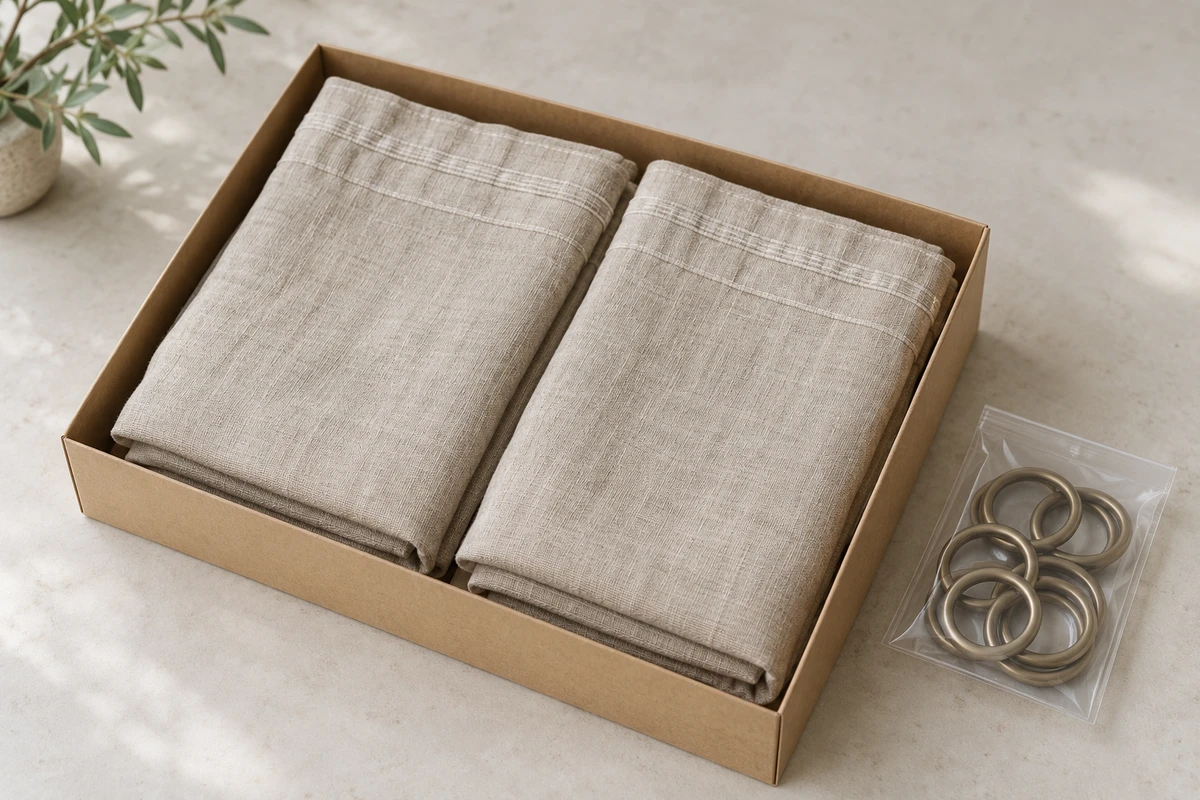
Loose curtain hardware needs a defined home in the pack. A pair of panels can be correctly supplied while its approved hook pouch is hidden among the heading folds or separated from the pair during unpacking. Choose a location that makes both relationships explicit: how the contained hardware is kept apart from the fabric, and how it remains connected to the correct pair.
Start after the panel pair, header and loose parts have been approved. The buyer is selecting their packing relationship, not choosing hooks, calculating curtain fullness or designing an installation. If no loose hardware is included, record that exclusion and avoid creating an unnecessary hardware compartment.
Separate sewn features from loose contents
Name the approved pair and both panel references where the product record distinguishes them. Identify the header construction as part of the fabric article. List the approved loose set independently, including its reference and the source of its agreed contents. “Header included” does not identify a bag of hooks.
IKEA’s DYTÅG listing illustrates the distinction: it describes a pair, per-panel width and heading-tape mounting options. Those details do not establish that hooks or rings are included with a different order, or that any particular loose item should travel against its fabric. IKEA DYTÅG product details
Use the actual proposed loose hardware in the packaging record. A photograph of an empty pouch leaves its filled shape and relationship to the heading unanswered. If the hardware set is still undecided, the placement proposal can remain provisional, but it should not be closed using an unspecified accessory.
Compare location as well as containment
A pouch tucked into the folded heading may appear economical in a drawing because it occupies an existing recess. The drawing must still explain which surfaces surround it, whether the proposed containment permits that contact, and how the pouch becomes visible during opening. A fold is not an approved compartment merely because there is space in it.
A separate identified position alongside the paired panels makes the hardware easier to distinguish from sewn heading features. This alternative may suit a buyer who wants the panels to remain together while the accessory set is recovered separately. Its suitability still depends on the specified containment and arrangement; “alongside” says nothing about contact during handling.
A third possibility groups the hardware away from the individual curtain pairs. That creates an allocation step. Ask who performs it, using which approved references, before the pair reaches its recipient. Do not accept “all accessories included” as an answer to a pair-specific handover requirement.
| Proposed position | Fabric relationship to explain | Pair association to preserve | Main unresolved question |
|---|---|---|---|
| Within the heading folds | Pouch against or between named fabric areas | Pair remains identifiable while folds open | Is that location permitted for the actual filled pouch? |
| Separate position beside the pair | Defined boundary between hardware containment and panels | Pouch remains connected after the outer wrap leaves | Which cue or grouping survives separation? |
| Common hardware group for several pairs | Hardware held outside individual panel bundles | Explicit allocation to each approved pair | Does the buyer accept and provide that allocation step? |
These are comparison concepts. No pouch material, separator thickness or clearance is prescribed here.
Use a pair-and-hardware placement sheet
Give each curtain pair variant its own row set. A single sheet can cover repeated identical pairs only when the buyer’s approved pairing basis allows it. Where two panels form a specifically matched pair, preserve that exact relationship rather than mixing them by general colour name.
| Placement field | Record for the proposed pack | Follow-up if unclear |
|---|---|---|
| Approved panel pair | Pair reference and panel identities as required | Ask the product owner which pair this represents |
| Loose hardware actually included | Approved hook/ring set reference or explicit exclusion | Resolve supply scope before placement approval |
| Contained hardware reference | Actual pouch or other containment and closure proposal | Request the filled configuration, not an empty stand-in |
| Header and fabric relationship | Named adjoining areas and permitted contact basis | Refer the ambiguity to the packaging owner |
| Pair-specific location | Position before and after common wrap removal | Show how the accessory remains attributable |
| Owner response to contact ambiguity | Decision, supporting reference and remaining condition | Keep that placement pending until answered |
The sheet should describe the first state where fabric and hardware become separate. If the pouch can be removed while both panels remain grouped, state how the pouch’s pair identity remains apparent. If panel removal occurs first, explain what prevents the next person confusing the pouch with one left by another opened pair.
A fictional pouch hidden in the heading
Suppose fictional curtain pair C1 contains two approved panels and hardware set H1 in proposed pouch P1. A second pair, C2, uses hardware set H2. The cloth appearance is similar, but the hardware references are not interchangeable in the buyer’s approved records. All references and responses here are invented.
Proposal A places P1 within C1’s folded heading. The illustration names the pouch but does not show its filled state or identify the fabric it touches. The buyer cannot decide whether that location follows the relevant contact requirements. A clear outer label does not answer that internal question.
Proposal B gives P1 a separate identified position alongside C1, with the panel pair kept in its own approved grouping. The buyer prefers B for development because the hardware can be distinguished without searching through the heading folds. The preference is conditional on the packaging owner returning the actual containment and contact review.
The first revised B drawing then shows H1 and H2 together in one common accessories area. Although every item remains listed, that revision reintroduces pair allocation. The buyer asks for the pair-specific location to be restored or for a separate, explicit decision on bulk allocation. Moving all pouches to one convenient corner is not a neutral implementation detail.
The outcome is a selected pair-specific layout awaiting its stated technical answers. There is no claimed snagging test, successful shipment or approved installation in this example.
Record a change before repeating it
Keep the selected location, containment reference and panel grouping in the same handover record. A change to the pouch contents, closure, position or adjacent fold may affect the relationship that was reviewed. Ask the responsible owner which evidence needs renewal rather than calling the new arrangement equivalent because the outside bundle looks unchanged.
Do not open contained hardware or spread loose hooks across the textile simply to create a clearer photograph. Review only within the actual instructions and agreed handling scope. If ordinary handling is uncertain, leave the affected question open for the responsible owner instead of improvising a demonstration.
For the wider range, see Homeware textiles. A Homeware sourcing request can identify the approved pair, loose-set reference and proposed separate position. Use a supported marketplace HTTPS link, an 8–1200 character description or permitted image references. The image option allows up to five PNG, JPEG, WebP or GIF files, 10 MiB each and 20 MiB total; it does not accept PDF, CAD or ZIP documents. Agree the actual review scope and file-exchange arrangements before relying on a provider to carry out the plan.
Frequently asked questions
Does heading tape mean curtain hooks are included?
No. A sewn heading feature and supplied loose hardware are different parts of the scope. Begin the packing decision with the approved contents list for the actual curtain pair. If it excludes hooks or rings, do not add them because a manufacturer’s page describes a mounting option or a styled image shows hardware.
Is putting curtain hardware in a pouch enough?
A pouch identifies a containment concept, but its name does not establish suitability. The proposal still needs the actual hardware-set reference, pouch identity, closure, position and relationship to the fabric and heading. The responsible packaging owner must resolve permitted contact and retention; an image of a closed pouch cannot prove that it prevents snagging.
Can hardware travel outside the individual curtain pair?
It can be considered only as an explicit alternative with a clear pair-specific association and an agreed recipient allocation step. A common bag for several curtain pairs introduces a different handover job. Keep that decision visible, particularly where two pairs have visually similar fabric but different approved hardware sets.
What should change when the hardware pouch moves?
Review the affected relationship with the heading, fabric faces and pair grouping. Moving a pouch from a separate position into the panel folds changes more than the picture’s appearance. Keep the revised location, relevant containment details and owner response together, and do not transfer the previous location’s approval automatically.
Sources
Discuss a sourcing request related to this article.Pack Curtain Hardware Without Losing the Panel Pair