
Cutting Board RFQ: Compare Working Area, Handles and Usable Faces
Separate clear preparation space from a board’s overall envelope, then compare face-specific features and household space constraints.
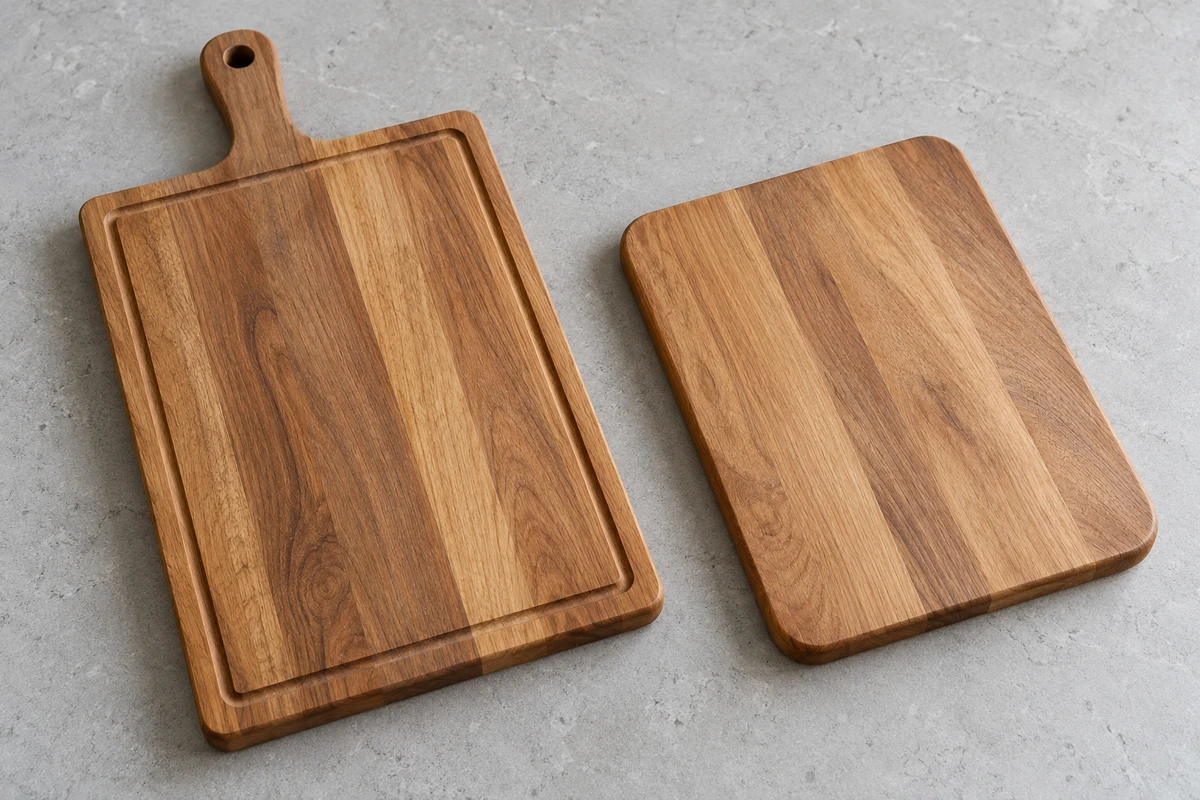
Ask a cutting-board supplier for the clear preparation area as well as the overall size. A long handle, perimeter groove or raised edge can occupy part of the quoted envelope. Two boards with similar outside dimensions may therefore offer different space for the buyer’s intended task.
The purchase decision should connect the required working surface to the counter, storage and cleaning-space limits. It does not require declaring a material winner or assuming that a feature visible in a photograph improves hygiene, grip or durability.
Begin with the preparation task and the space around it
Describe the ordinary preparation task the board is intended to support and the area the buyer wants available. If a clear rectangular region is important, state its required length and width. If the task needs another shape, identify that region instead of reducing it to a single area number.
Record the maximum overall envelope the buyer can accommodate on the counter and in the intended storage position. Include relevant height or thickness limits and any protruding handle. A board’s working surface can meet the task while its overall shape conflicts with the buyer’s available space.
Add cleaning-space constraints without inventing care permission. For example, the buyer may need the board to fit within a particular sink arrangement, but dimensional fit does not establish that the proposed cleaning method is permitted. Request the exact product’s applicable care information separately.
Keep published cutting area and overall dimensions distinct
Joseph Joseph’s Chop2Pot Plus page lists cutting area separately from overall dimensions for its regular and large variants. That is a useful manufacturer example of two different fields on one product page. The unexplained overall-height field should not be recast as flat board thickness or proof of a particular measurement state. Joseph Joseph Chop2Pot Plus specifications
For the quoted stock board, ask the seller to mark the overall envelope and the relevant clear working region on the same identified drawing or photograph. Request actual stated dimensions, with units and measuring points, rather than estimating them from the image scale.
If the design changes shape or includes a movable feature, ask which configuration each dimension describes. Keep the in-use and storage descriptions separate where relevant. This purchasing request should identify the seller’s own lawful stock product; it is not a request to reproduce a named manufacturer’s proprietary mechanism.
Map each face before counting it as usable
Ask whether one or both faces are intended as working surfaces, and request a view of each relevant face. Identify grooves, raised edges, feet, handles, cutouts and other areas that affect the buyer’s required working region. Do not assume the underside is suitable merely because it appears flat in a distant photograph.
OXO’s Carving and Cutting Board 11272900 describes distinct solid and grooved faces. The named product illustrates why face-specific information belongs in a quote. Its performance and care claims are not evidence for a different seller’s board. OXO Carving and Cutting Board product details
Keep the proposed benefit of a feature separate from its geometry. A groove can be located and dimensioned without establishing a liquid capacity. A handle can be included in the overall envelope without establishing a grip claim. Ask the supplier to define any additional performance statement the buyer wants, then route its evidence to the appropriate reviewer.
Compare the region the buyer can actually use
The most useful reply shows the required region on the chosen face. For a board with rounded corners or an irregular border, ask whether the stated clear rectangle actually lies within the intended working surface. Do not multiply maximum length and maximum width and call the entire product of those numbers usable area.
A scalar area comparison can also conceal the wrong proportions. The buyer may need a long, narrow region for one task or a broader region for another. Preserve both dimensions and orientation instead of ranking every board by square centimetres.
If a supplier proposes removing a groove or shortening a handle to obtain more space, request a separate customization proposal. Such a change can affect the construction and the evidence attached to the stock item. First ask whether a suitable existing design is available; do not assume the quoted surface can be modified without further review.
Use a face-specific board worksheet
Give each board variant and face its own reference. Keep the following fields together so a promising working region does not hide an oversized product.
| Buying question | Requirement to state | Evidence to request from the supplier |
|---|---|---|
| Preparation surface | Needed region, dimensions and orientation | Marked clear area on the intended face |
| Overall fit | Counter and storage envelope | Maximum dimensions including handle/projections |
| Measurement state | In-use or stored configuration, as relevant | Identified state for every dimension |
| Face A and face B | Which surfaces the buyer expects to use | Face-specific intended-use description and views |
| Features | Wanted or unwanted handle, groove and raised zones | Feature locations and effect on the clear region |
| Cleaning-space fit | Actual spatial constraint | Full product envelope plus separate care information |
| Alternative design | Stock option or authorized change request | Exact proposed variant and changed fields |
Use “not supplied” for an unmarked cutting region. An attractive overall photograph does not fill that row. Where a drawing is insufficient, define a sample review around the specific missing geometry rather than asking for an undefined quality check.
A fictional comparison with equal outside dimensions
Suppose a fictional buyer requests a clear rectangular preparation region of at least 300 × 260 mm. Both candidate boards are quoted at an overall 400 × 300 mm. Candidate A has an extended handle; its supplier states a clear region of 310 × 280 mm. Candidate B has a surrounding groove; its stated clear region is 340 × 240 mm. All dimensions and descriptions are invented, and neither board has been inspected.
| Fictional candidate | Quoted overall envelope | Supplier-stated clear rectangle | Comparison with the requested region |
|---|---|---|---|
| A | 400 × 300 mm | 310 × 280 mm | Both requested dimensions are within the stated region |
| B | 400 × 300 mm | 340 × 240 mm | Shorter clear dimension is 20 mm below the 260 mm requirement |
A can proceed to verification of the stated region and the remaining product requirements. B’s longer clear dimension does not compensate for its insufficient width in this rectangular screening comparison. Rotating a 340 × 240 mm rectangle does not create the missing 260 mm shorter dimension.
The buyer can request another stock B-type design, consider A, or deliberately revise the working-region requirement. It should not call both offers equivalent because their outside dimensions match. Nor does A’s dimensional answer establish hygiene, knife behaviour, non-slip performance or durability.
Quote the selected surface and its complete envelope
The revised quotation should identify the exact variant, intended working face, relevant clear region and maximum overall dimensions. Retain the supplier’s measurement references and any unresolved questions. Keep material, food-contact and requested use-claim evidence with their appropriate review rather than inferring them from a size selection.
For category context, see Kitchenware. Describe the required preparation region and maximum overall size in a Homeware sourcing request. A marked image preview can show the face and excluded feature zones; arrange another accepted method for full technical files instead of treating the image field as a drawing-file upload channel.
Frequently asked questions
Is the catalogue cutting-board size the usable cutting area?
It may describe the maximum outside envelope, including a handle or border. Ask for the clear working region on the intended face and its measuring points. Keep those dimensions beside the overall size rather than deriving usable area from the largest catalogue numbers.
How should handles and juice grooves appear in a board RFQ?
Identify their location and dimensions, and ask how they affect the required preparation region. Include the handle in the maximum overall envelope. Geometry alone does not establish grip or liquid capacity, so any desired performance claim needs its own defined evidence request.
Should I require both faces to be usable?
State that only if the buyer’s use calls for it, then ask the supplier to identify the intended purpose and features of each face. Do not treat an unshown underside as a second working surface. Compare each face with the relevant requirement rather than counting two faces as interchangeable by default.
What measurements matter for a compact board?
Record the clear working length and width, overall dimensions including projections, and relevant thickness or height in the stated configuration. Compare the complete board with counter, storage and cleaning-space limits. Passing those dimensional checks does not establish material suitability or authorize a cleaning method.
Sources
Discuss a sourcing request related to this article.Cutting Board RFQ: Compare Working Area, Handles and Usable Faces