
Ask Where the Cookware Layers Extend
Compare cookware layers by region, clarify base-only versus sidewall coverage, and connect the construction drawing to the exact model and quoted price.
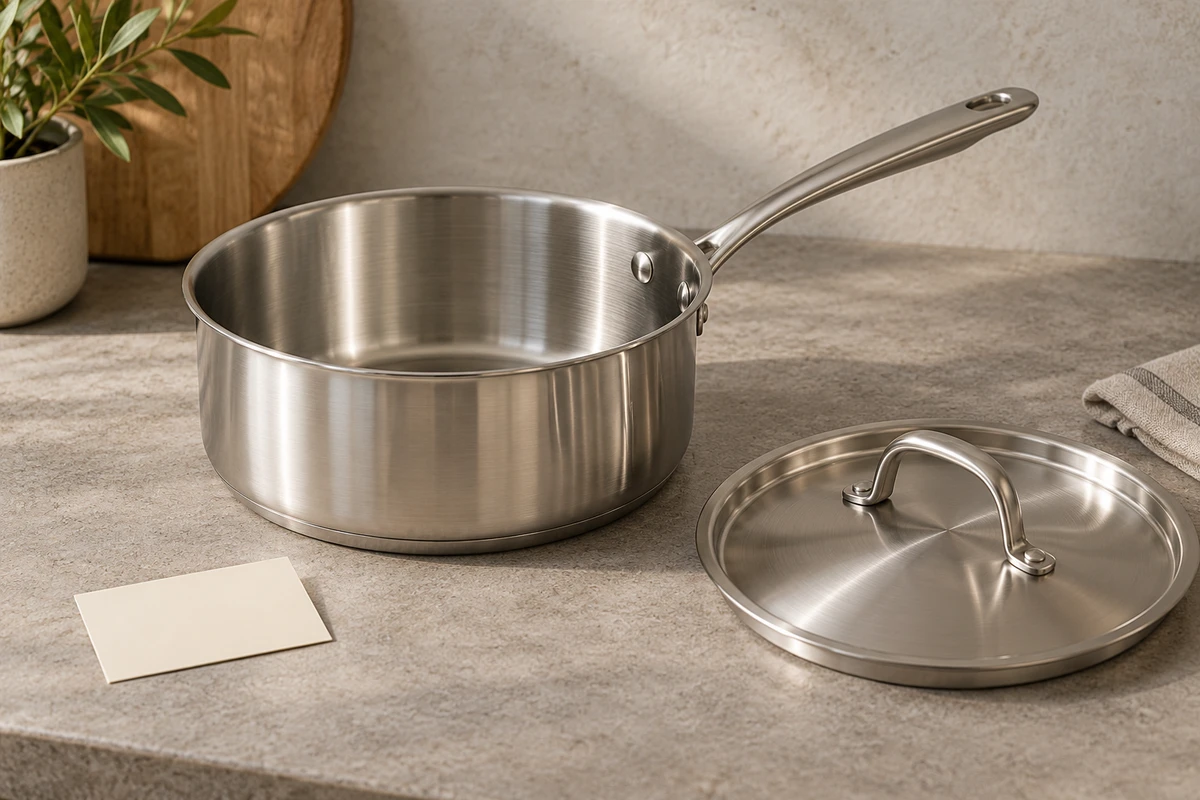
Ask a cookware supplier where each stated layer extends before treating two “three-layer stainless steel” quotations as equivalent. The buyer needs the construction at the bottom and the sidewall, including where any core ends. A layer count without a location leaves the physical product underspecified.
For a cookware RFQ, the first decision is whether the proposed construction matches the coverage you intend to buy. Heating performance, durability and other product claims need their own support; they should not be inferred from the count or from a polished exterior.
Read the location as carefully as the material name
Manufacturer descriptions illustrate two different levels of detail. Le Creuset describes its Tri-Ply Stainless Steel cookware as having an aluminium core between stainless-steel layers, with that core extending up the sides. The important detail for this RFQ is the explicit wall coverage. Le Creuset care and use, Cooking with stainless steel
IKEA’s UK page for the IKEA 365+ saucepan 004.842.29 places its aluminium-between-stainless-steel description specifically at the base. That wording documents what IKEA says about the base; it should not be expanded into an unstated wall construction. IKEA 365+ saucepan product details
These examples show why the location belongs in the question. They do not establish the construction of a similar-looking marketplace pan, and this article makes no performance comparison between the named products.
For your own quotation, keep the supplier’s original construction term and ask for a region-by-region explanation. If the reply says “tri-ply,” “sandwich bottom,” “composite base” or “fully clad,” record that wording without assuming all suppliers use it identically. Have the supplier identify what the term means for the exact model being priced.
Map the bottom, sidewall and upper edge
Start with a simple section drawing supplied by the manufacturer. Ask it to label the material sequence through the bottom and through the sidewall. If a separate base assembly is proposed, the drawing should distinguish that assembly from the pan body. If layers continue into the wall, ask where that coverage ends and how the upper edge is described.
Keep three questions separate: which materials are stated, how many layers the supplier counts, and where those layers occur. A sequence such as stainless steel/aluminium/stainless steel describes an order through a section. It still needs a labelled location. Ask the supplier to use the same inside-to-outside direction for each region so the comparison does not reverse one proposal’s sequence.
Also ask what the count includes. A seller may be referring to the structural body, a base assembly or a surface treatment. Give coatings and finishes their own entries rather than silently adding them to, or removing them from, the supplier’s count. Where the reply is ambiguous, preserve the uncertainty and request a corrected description.
Request material designations and any thickness values that are part of the buyer’s specified construction. Keep unstated values visibly unstated. This worksheet does not prescribe a steel grade, layer thickness or manufacturing method, and a missing proprietary detail should be recorded as a limitation rather than filled with a guess.
Build a regional construction worksheet
Use the following worksheet for each model. The region rows are deliberate: they make it difficult for a detailed bottom specification to conceal an unanswered sidewall question.
| Region or record | Supplier response to collect | Buyer comparison question |
|---|---|---|
| Bottom section | Inside-to-outside material sequence and what is included in the stated count | Does the quoted bottom match the requested construction? |
| Transition into the wall | Drawing showing whether and how the described layers continue | Does the supplier mean base-only coverage or continuation into the body? |
| Sidewall above the transition | Material sequence at a labelled wall position | Is the wall construction explicitly stated? |
| Upper wall and rim | Stated endpoint of the core or other layers, with the edge detail identified | Does the proposed extent match the buyer’s coverage requirement? |
| Model and drawing control | Exact quoted variant, drawing number/revision and any size-specific differences | Does this drawing actually govern the item being priced? |
| Sample and unresolved evidence | What the sample review can address, missing construction evidence and any separate performance claim | Which decisions remain open after the available review? |
Attach the source description or drawing reference to each response. If the supplier returns one family illustration, ask which sizes it covers and whether the construction changes across the range. Do not assume that a saucepan, frying pan and stockpot share the same layer coverage because they appear in one catalogue series.
Give a proposed alternative its own worksheet. A buyer who requested wall-spanning construction may still consider a base-only proposal, but that is a decision to change the requested product. Keeping the alternative separate makes its specification and price difference reviewable.
Work through two fictional three-layer replies
A fictional buyer asks for a saucepan whose stated aluminium core continues from the bottom into the sidewall. The buyer has not yet defined the required upper endpoint. Two invented suppliers initially reply “three-layer stainless steel.” The identifiers and construction descriptions below are invented solely to illustrate the comparison.
| Record | Proposal LC-A | Proposal LC-B |
|---|---|---|
| Bottom description | Stainless steel/aluminium/stainless steel base assembly | Stainless steel/aluminium/stainless steel body section |
| Sidewall description | Supplier states stainless-steel wall without the base’s aluminium layer | Supplier states the three-layer sequence continues up the wall |
| Upper endpoint | Not applicable to the stated base-only aluminium layer | Not shown on the first drawing |
| Initial disposition | Different coverage from the buyer’s requested concept | Potential coverage match with an unresolved endpoint |
The first useful result is that the quotations describe different constructions. Proposal A is a base-only alternative to the buyer’s stated concept. Proposal B answers the sidewall question but leaves another purchasing detail open. Neither becomes the accepted specification simply because both suppliers counted three layers.
The buyer asks B to mark the core endpoint on its model-specific section drawing. Suppose B’s revised drawing identifies that endpoint below the rim. The buyer can now decide whether that documented coverage is acceptable and record it in the requirement. The decision should refer to the drawing and endpoint, rather than reducing the answer back to “fully clad.”
If the buyer instead decides that base-only coverage is acceptable, revise the requirement openly and consider A on that basis. Do not rewrite A’s original description to make it appear that the sidewall was always layered. The change is commercial and technical scope clarification, not evidence that either construction will heat more evenly or last longer.
Finally, connect the chosen drawing revision to the price. If B’s revised drawing describes a different product from its initial offer, obtain a corresponding quote. A better-defined construction is useful only when the supplier confirms which version it is actually offering.
Set realistic limits for the sample review
A finished sample can support a review of its identity and accessible appearance against the proposal. It may also expose an obvious conflict between the supplied item and the drawing that needs explanation. An intact exterior photograph, however, does not document every hidden layer or its continuity through the wall.
State in advance what each review is expected to establish. Keep the sample reference, the applicable construction drawing and the supplier’s written explanation together, while distinguishing supplier statements from independently established findings. If further construction verification is necessary, have a qualified specialist define the evidence and scope. Do not improvise a cut-open inspection or a heating comparison as part of this purchasing worksheet.
The same discipline applies to promotional language. Claims about faster response, even heating, energy savings or durability remain separate questions with their own evidence needs. A higher count, a thicker-looking base or coverage farther up the wall cannot by itself settle those claims.
Make the accepted coverage part of the quotation
A concise request can say: “Quote [exact model/variant] with a construction drawing showing the material sequence through the bottom, sidewall and upper edge. Identify which region your layer count describes and whether coatings are included. Mark where each core layer ends. State the drawing revision covered by the price and identify any alternative construction separately.”
Retain the resulting regional description with the quotation. If the supplier later proposes a different base assembly, body construction or coverage endpoint, compare that change with the approved requirement before letting it inherit the original acceptance. The catalogue’s layer-count label may stay the same while the construction changes.
Browse the Homeware kitchenware category for broader product context, then use the Homeware sourcing page to identify the cookware and the construction question. Send a supported marketplace link, description or permitted image preview. Keep the original technical drawing available and arrange a suitable separate exchange if it is a PDF or another file type the form does not accept.
The comparison is ready for a buying decision when the proposed layer coverage is clear, tied to the priced model and judged against the buyer’s stated requirement. Any remaining performance claim or construction-evidence gap should retain its own unresolved status.
Frequently asked questions
Does “three-layer” mean the same construction at the bottom and the sidewall?
The phrase alone does not say where the layers occur. Ask the supplier to identify the section being counted and describe the bottom and sidewall separately. If the aluminium or other core extends into the wall, have its endpoint marked on the model-specific drawing. Preserve the supplier’s term, but use the regional description to compare the quoted products.
Can a construction photograph prove that the pan is fully clad?
An intact pan photograph can record accessible features, but it cannot establish every concealed layer or its extent. Request attributable construction information for the quoted model and state any remaining evidence gap. A generic cutaway illustration also needs a clear link to that model. If independent verification is necessary, have the responsible specialist define it rather than treating an attractive image as proof.
Should coatings be included in the layer count?
Ask the supplier what it has counted. Keep the structural material sequence and any coating or finish as separately identified entries, then record the supplier’s definition of the advertised total. This avoids comparing a body-layer count with a surface-system count. It does not establish that either counting convention is an industry-wide standard or resolve the coating’s composition and performance.
Is wall-spanning construction always the better buying choice?
This worksheet does not rank constructions by performance. It helps determine whether the proposal matches the buyer’s requested coverage. A base-only alternative can be considered if the buyer deliberately changes or broadens that requirement. Any claimed advantage in heating, durability or other use remains a separate evidence question for the exact product; a larger layer count or wider coverage does not answer it on its own.
Sources
Discuss a sourcing request related to this article.Ask Where the Cookware Layers Extend