
Record Velvet Cushion Marks Before Any Care Treatment
Preserve a velvet cushion cover’s arrival appearance and give surface marks, seams and zip observations separate decisions before any treatment.
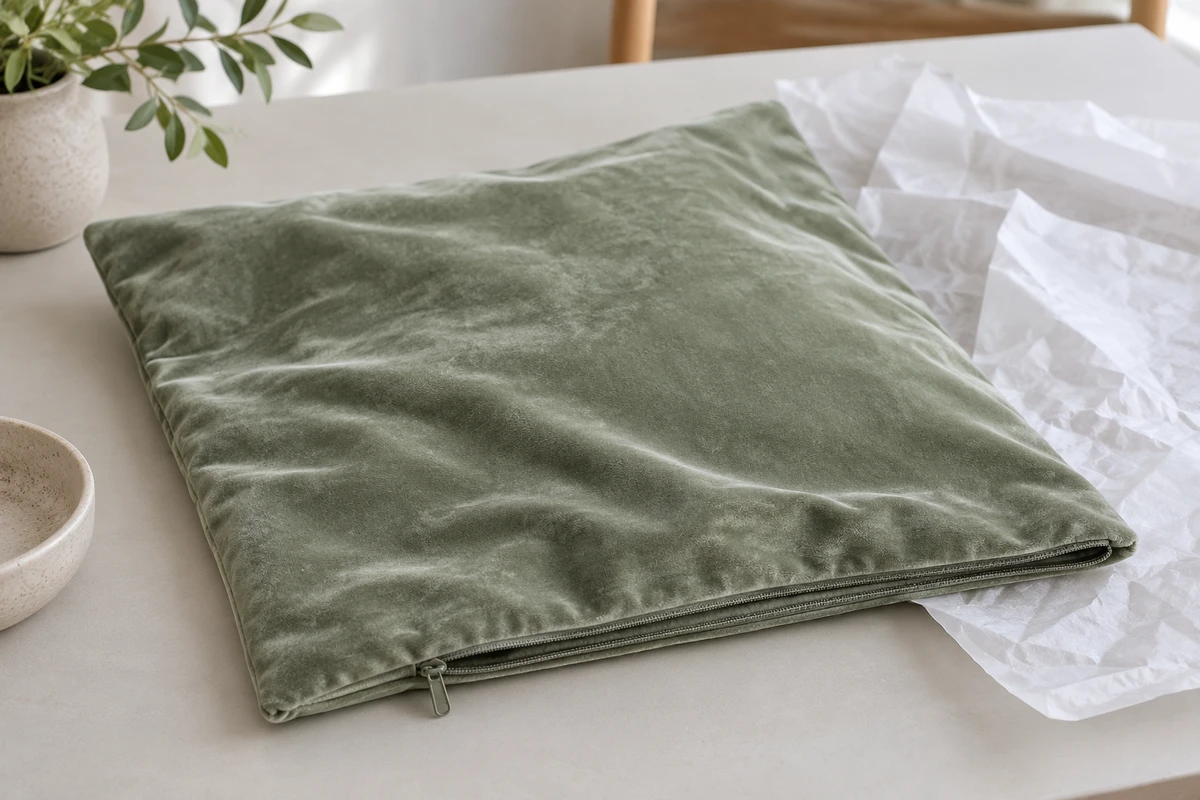
When a velvet cushion cover arrives with a visible mark, preserve its arrival appearance before deciding what the mark means or attempting any care treatment. A broad crease, an open seam and a problem at the zip call for different answers. Combining them under “velvet marks easily” can leave an actual construction problem unresolved.
The buyer needs an account of what arrived, where it is and what decision remains. Receiving is not the moment to make the cover look better for the report. Keep the original condition available to the person who must decide whether the item meets the order or needs another remedy.
Record the first view before rearranging the cover
Retain the link between the cover, its packaging and its receiving reference. Where practical within normal unpacking, photograph the visible condition before unfolding or repositioning it. Note which face was outward and where a fold or packing contact lay. A packing position is context; it is not proof that packing caused the mark.
If the cover has already been unpacked, record the earliest condition actually observed. Do not reconstruct folds and present the result as an arrival photograph. If someone has already treated the fabric, identify what is known and when; the current appearance cannot stand in for an untreated baseline that was never recorded.
Keep the product label and any care instructions with the item. The instructions may matter to a later decision, but they do not authorize a receiving operator to carry out every listed care process. Agree who can approve any alteration, especially when a return or supplier review is still under discussion.
Split surface appearance from visible construction condition
Use a location description that another person can follow: front face near the lower-left corner, a line across the middle fold, or the back face beside the zip. A whole-cover photograph provides orientation; a closer image can show the particular area without losing its relationship to the cover.
Describe a surface mark conservatively. “Broad lighter-looking line visible across the front in this view” is more useful than an unsupported diagnosis such as dye failure, permanent pile damage or removable pressure marking. If the appearance changes when the intact cover is ordinarily repositioned, retain the separate views and say what changed. Do not select only the most favorable angle.
Record accessible seam and zip observations separately. An opening along a seam should have its own location and image reference, even if a surface crease passes nearby. Do not pull a seam apart to demonstrate weakness, remove stitching or repeatedly operate a suspect zip. If visible damage or interference makes normal handling uncertain, stop.
IKEA’s SANELA 005.911.30 page identifies a velvet cushion cover with a zipper and separately discusses marks and creases in its care information. That is a useful distinction between construction and surface-care topics on one named product. It is not evidence that a received supplier cover’s mark will disappear, or that an open seam is acceptable. IKEA SANELA product and care information
Compare appearance on the agreed basis
Identify the order’s appearance reference and the condition it represents. A filled display cushion and an unfilled folded cover are different presentations. Use the actual agreed comparison basis or state that it is unavailable; do not add an insert merely to conceal a fold or change the apparent surface.
Record the viewing location, orientation and whether the buyer is seeing the item directly or only through photographs. Keep original images without retouching the mark, replacing color or smoothing the surface. A cropped detail is helpful when paired with the original context, but it should not be presented as the whole appearance.
The reference may define a presentation range or particular unacceptable conditions. Use what the order actually agreed. If it supplies no criterion for this kind of mark, ask the buyer to resolve that gap instead of inventing a cosmetic allowance after delivery. A supplier’s general statement that velvet can mark does not settle a specific order’s presentation requirement.
Do not turn this comparison into a color-lot investigation. The immediate question concerns the identified cover’s as-received mark and any separate construction observation. Photos alone cannot establish fibre composition, manufacturing cause or the condition of unexamined covers.
Use a two-part condition worksheet
Start with the unit ID, package/packing position, first-observed condition, date, approved reference and viewing basis. Then give each distinct location an entry, keeping surface appearance and construction observations in different rows.
| Observation type and location | Unchanged evidence to retain | Question for the buyer or supplier |
|---|---|---|
| Surface mark on a named face | Whole-cover orientation and close view; fold/contact context stated only as observed | Does the agreed appearance criterion address this mark, or is a decision still needed? |
| Accessible seam opening or other visible seam issue | Separate location and image; no seam pulling or unpicking | What disposition is proposed for this construction observation? |
| Visible zip issue, if present | Zip location and observed condition; stop reason if normal handling was inappropriate | Is further authorized review needed before deciding? |
| Reference unavailable or condition unlike the receipt | Identify the missing reference or condition difference | Who will establish a valid comparison basis? |
Finish with two separate decisions: appearance and construction. State what remains unresolved in each and who will answer it. This is an original editorial worksheet, not a damage grading standard, care procedure or acceptance percentage.
Separating the rows also prevents a practical counting error. Two observations on one cover remain one identified cover with two issues. Rephotographing that same crease does not create another affected item, and a seam problem elsewhere does not make every photographed surface mark a seam defect.
A fictional crease beside an unrelated open seam
Suppose fictional cover V8 arrives folded in sleeve P8. Its first recorded view shows a broad line at the front fold. Ordinary unpacking also reveals an open section along a side seam away from that line. The receiver takes an orientation photo, a view of the fold line and a separate seam detail. The item, package and events are invented; this is not a customer complaint about a named product.
The appearance entry says that the line remains unresolved against the agreed display reference. The construction entry identifies the open seam. Neither entry assigns a production cause. No steaming, ironing, brushing, washing or repair takes place.
The supplier replies that velvet sometimes shows marks after packing and sends general care advice. That reply may be relevant to the appearance discussion, but it does not address the seam. The buyer asks for two explicit responses: a disposition for the marked presentation and a disposition for the open seam on V8.
If the supplier proposes a care trial, the buyer must first decide whether to authorize a change and what question it is intended to answer. Keep any later result separate from the arrival record. A changed appearance would not close the original seam question, and a repaired seam would not by itself settle the mark.
Alternatively, the buyer may seek an agreed replacement or other remedy without changing V8. The actual commercial terms determine what is available; this example grants no return right or guaranteed supplier response. Keep the received item identifiable while the decision remains open.
Ask for the decision that the evidence can support
A useful supplier message identifies the cover, both locations, the unchanged photographs and the two unanswered questions. Avoid asking simply whether the item is “normal.” That wording invites a general material explanation when the buyer needs a decision about this particular presentation and construction.
If a proposed remedy changes the cover, record the authorization, affected item and resulting condition separately. Do not relabel a treated or repaired item as having arrived without the issue. Equally, do not call a mark permanent when no competent assessment supports that conclusion.
The Homeware textile category is the relevant starting point for a sourcing inquiry. Through the Homeware sourcing page, send a concise description and selected image references that keep the mark and seam questions distinct. Any physical review, care assessment or supplier coordination needs an agreed scope; no particular inspection or repair service is promised here.
Frequently asked questions
Can a photograph tell me whether a velvet mark is permanent?
A photograph can record the visible area and its viewing context, but it cannot establish permanence or a manufacturing cause by itself. Keep the original image, the unit identity and the comparison reference. Ask for an appropriate assessment or disposition rather than labeling the mark permanent or guaranteed to disappear.
Should the cover be steamed or brushed before sending the supplier photos?
Preserve and report the untreated arrival condition first. General care advice is not a receiving instruction or permission to alter a disputed item. If a later care trial is proposed, the buyer should authorize its scope and keep its result separate from the arrival evidence. This article supplies no treatment procedure.
What if the cover was already unfolded before anyone took a photo?
Record the earliest condition actually observed and say that the original folded view was not captured. Keep the packaging link and any known handling history. Do not refold the cover and present that scene as an original arrival record; a truthful limitation is more useful than reconstructed evidence.
Does accepting a surface crease also accept an open seam on the same cover?
No. Keep appearance and construction decisions separate, even when they concern one unit. State the location and disposition of each observation. A buyer may reach different decisions on the two questions, and any proposed treatment or repair needs its own authorization rather than inheriting approval from the other issue.
Sources
Discuss a sourcing request related to this article.Record Velvet Cushion Marks Before Any Care Treatment