
Rolled Rugs and Underlays: Preserve the Supplied Forms
Compare rug-and-underlay grouping proposals without changing the supported rug roll, and keep the separate underlay recoverable at handover.
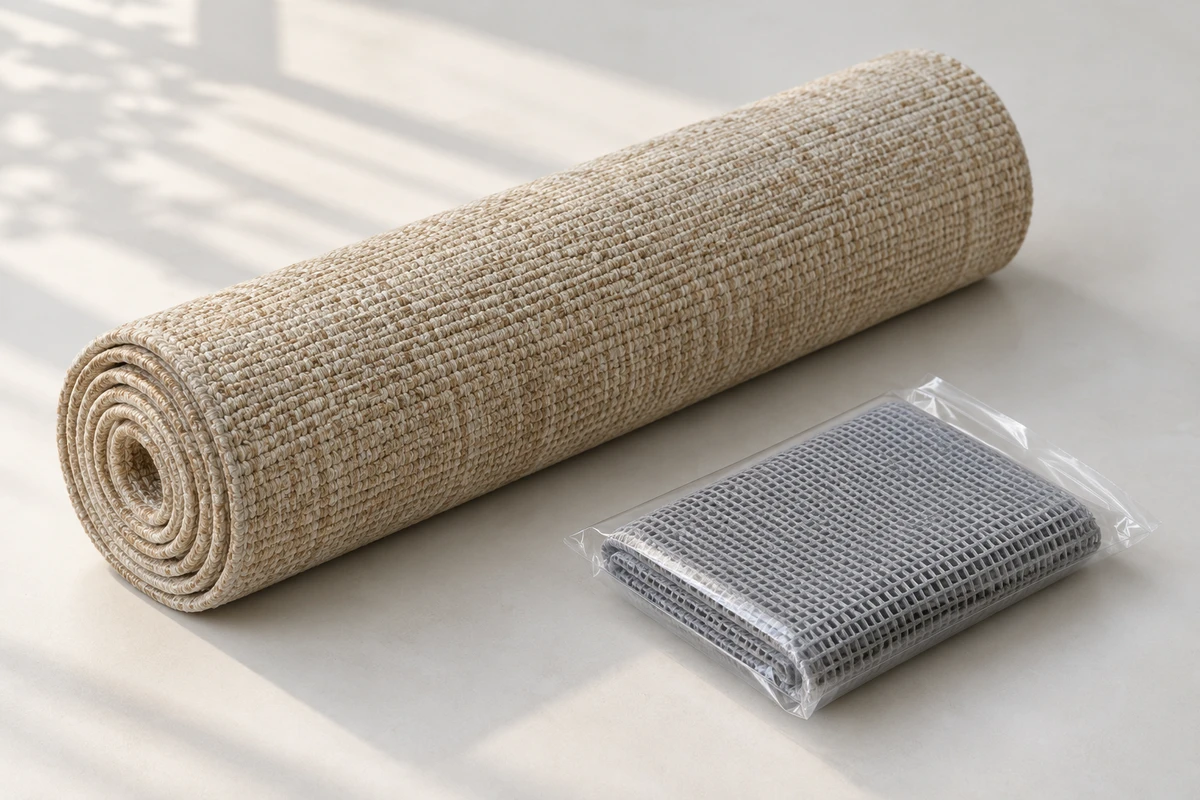
A separately purchased underlay can belong to the same household delivery as a rolled rug without dictating the rug’s package shape. When a proposed combined pack requires folding, tightening or otherwise changing the rug’s supported roll, stop that assumption before comparing the grouping’s convenience.
The buyer’s decision is how to preserve the approved rug form while handing over the correct underlay as a separately recoverable item. Begin with the rug and underlay already selected. This article does not choose their sizes, establish anti-slip performance or prescribe how to roll, flatten or care for a rug.
Treat the supported rug roll as an input
Record the exact rug and the maker-supported supplied form. Keep the actual pack reference beside the rug variant, so a supplier’s proposal can be compared with the correct item rather than with a similar roll from a catalogue image.
IKEA’s named LOHALS jute rug lists package length and diameter fields and offers an underlay separately. This is a concrete example of a rolled form and a distinct accessory. It does not establish a roll radius, permission to fold or a packing method for another rug. LOHALS product and package details
For the chosen rug, ask which supplied form the product owner supports. Preserve that basis in every candidate. A drawing that shortens the roll, changes its orientation or places the underlay inside it needs an applicable product-owner answer; do not infer permission from the desire for one convenient package.
The underlay also has its own confirmed supplied form. Keep it distinct rather than treating its smaller package as a template for the rug.
Compare association without reshaping the rug
Ask for proposals that represent both items as they are actually supplied. One might retain separate identified packs within an owner-reviewed outer grouping. Another might keep the rug and underlay as separately handled packs linked by approved references. These are grouping concepts, not instructions for bands, wrapping or restraint.
A third proposal may try to create a single compact shape by changing the rug roll to match the underlay pack. If that change lacks a supported basis, it is not yet comparable to the other two. Return the form question before assessing whether the drawing looks easier to carry or store.
| Candidate | Rug form | Underlay recovery | Buyer decision to make |
|---|---|---|---|
| Separate supplied packs in a proposed outer grouping | Preserves the confirmed roll as represented | Underlay has its own identified pack and approved access stage | Is that grouped handover wanted, with outer-pack design still to review? |
| Separately handled but associated packs | Preserves each item’s confirmed supplied form | Underlay can be identified independently at handover | Does the actual receiving process retain the approved match? |
| Combined shape requiring an unexplained rug change | Different from the supported roll reference | May depend on opening or altering the rug pack | Keep pending until the product owner resolves the form change |
No option is automatically cheaper or more protective. Obtain comparable costs only after the actual permitted configurations are established; this worksheet supplies neither a freight estimate nor a retention result.
Identify the rolled rug without opening it merely to guess the variant
Where several rug sizes are delivered together, preserve the exact variant reference on the pack record and use an approved identification method for the actual package. Roll length, diameter or appearance alone should not become an improvised substitute for the approved product identity.
Ask how the receiver can connect the still-packed roll to its record at the intended handover stage. If the only identifying cue is removed with an outer grouping, request an approved way for the separate rug pack to remain identifiable. Do not direct the recipient to unroll a rug solely to discover which underlay belongs to it.
Any added physical identifier needs approved wording and placement. Keep product information visible and do not improvise adhesive on the rug. The packaging owner should determine the permitted implementation; the buyer specifies the identification outcome.
Keep the underlay independently recoverable
Confirm that an underlay is actually included in this purchase, whether as part of the order or as a separate approved item. An accessory offered on a product page is not automatically supplied.
For each candidate, identify when the recipient can locate the underlay pack and which approved outer packaging must be opened. Keep that step separate from changing the rug’s supported roll state. If recovering the underlay depends on an undocumented rug-opening or repacking action, return the proposal for revision.
The practical worksheet combines form, identity and access rather than only counting pairs:
| Field | Exact information to record |
|---|---|
| Rug reference | Model and approved variant tied to the still-packed roll |
| Supported roll state | Applicable maker/product-owner basis and actual proposal view |
| Underlay supply | Included or separately purchased reference; exclusion if none is ordered |
| Underlay pack form | Confirmed supplied state, represented independently |
| Grouping relationship | Outer grouping or separately handled packs, without an assumed rug change |
| Identification at handover | How the closed rug pack and separate underlay lead to the approved match |
| Underlay recovery stage | Applicable opening reference and whether the rug remains in its supported state |
| Open decision | Unsupported form change, hidden reference or packaging evidence and owner |
A fictional compact combination that changes the rug
Suppose fictional rug R-L is approved in its supported rolled form and underlay U-L is a separate approved pack. The buyer wants them handed over together. All references and observations in this example are invented.
Proposal C redraws the rug as a folded rectangle to fit beside U-L inside one compact outline. The supplier provides no applicable permission for that change. C does not merely improve association; it replaces the supplied rug form. Keep C pending and request a proposal that preserves the supported roll, rather than asking the packer to try the fold.
Proposal S retains the identified roll and shows U-L in a separately recoverable pack within a proposed outer grouping. It also preserves a reference for the still-packed rug after that grouping is opened. S answers the buyer’s form and handover intent more directly, while leaving the actual outer packaging, restraint and protection to responsible review.
If the buyer instead prefers separately handled packs, proposal P can retain the same roll and underlay references without a common outside group. The receiving process must still preserve the approved match. The choice between S and P concerns the intended handover; neither requires reshaping the rug merely to resemble the accessory.
The bounded outcome is a preferred proposal that preserves the supported supplied forms and makes the underlay recoverable. It is not a claim about floor compatibility, anti-slip performance, curl recovery or damage-free transport.
Request the form-preserving proposal
Use Homeware textiles for category context. Through the Homeware sourcing enquiry, describe the supported rug roll, the separate underlay and the proposed grouping change that needs resolution. Ask which coordination and packaging-review work can be provided.
The form supports eligible marketplace links, descriptions and supported images, rather than PDF/CAD/ZIP uploads. An enquiry does not authorize a different rug form, a product substitution or an order. Keep the exact supplied-state decision visible in the response.
Frequently asked questions
Should a rug be folded to fit beside its underlay?
Do not change the maker-supported rug form to suit an accessory pack without an applicable product-owner basis. Ask for a proposal that preserves the confirmed roll and the underlay’s supplied form. A convenient common outline does not authorize folding, tighter rolling or an improvised restraint.
How can I identify the rug without unrolling it at handover?
Keep the exact model and variant connected to the still-packed roll through an approved identification method. Ask which reference survives removal of any outer grouping. Do not guess from the roll’s appearance or direct the recipient to unroll it merely to find its size; physical identifier wording and placement need responsible approval.
What does independently recoverable underlay mean?
The proposal should identify the separate underlay pack and its permitted access stage without depending on an undocumented change to the rug’s supported roll. This is an access and association requirement, not a universal wrapping technique. The actual outer grouping and protective design still need applicable review.
Does a paired rug-and-underlay pack prove an anti-slip claim?
No. The record preserves an already approved product match through the intended handover. It does not establish underlay performance, floor compatibility or rug-use suitability. Those claims require their own applicable evidence, even when the supplied forms and package association are clear.
Sources
Discuss a sourcing request related to this article.Rolled Rugs and Underlays: Preserve the Supplied Forms