
Keep Separately Packed Pots and Saucers Together
Preserve approved pot-and-saucer relationships across two packages, mixed-size retail handling and an unmatched companion without guessing from appearance.
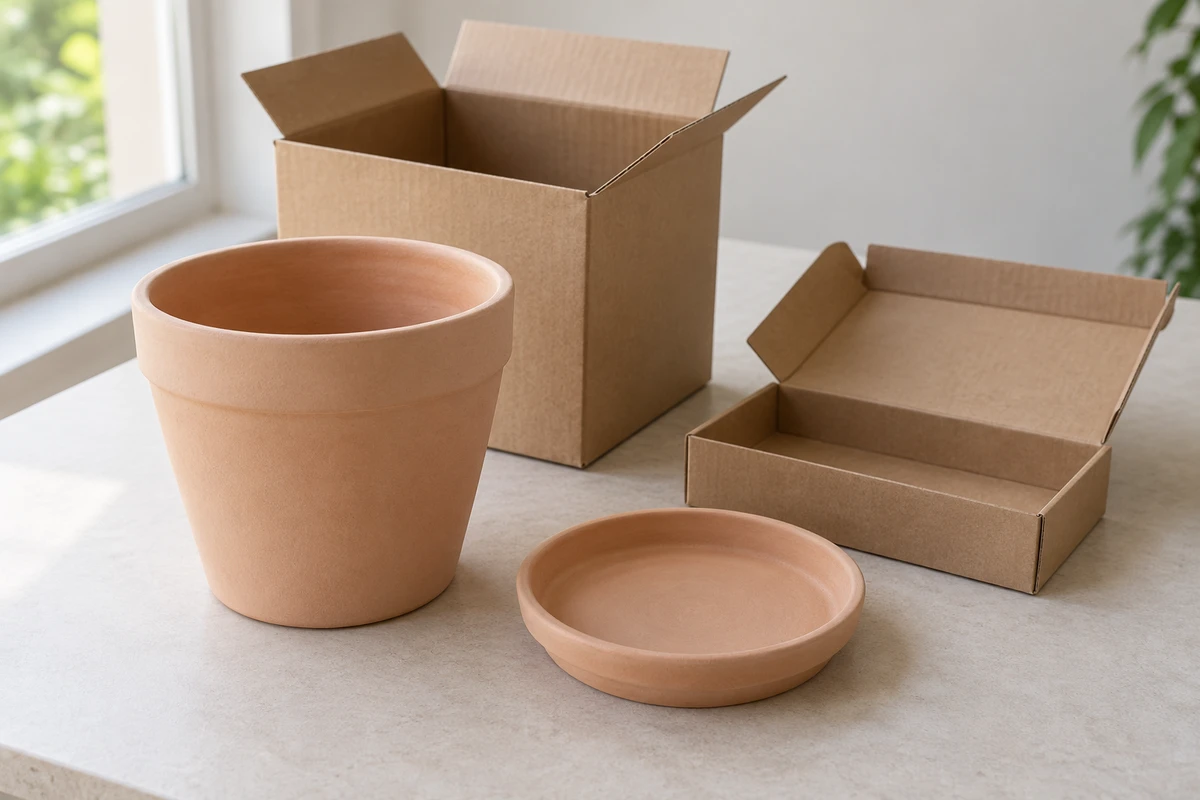
A planter sold with a saucer can occupy separate packages while remaining one saleable set. The retailer needs a pairing rule that survives unloading, split storage and final handover. Counting the same number of pot boxes and saucer boxes does not identify which companions are approved together.
Start with the actual accepted combination, then compare how each proposed label or grouping works at the points where the packages separate. This article controls identity and handover; it does not determine initial fit, approve protective packing or provide a warehouse system.
Test the association at the point the packaging is separated
Ask the receiver to describe the intended handling route. The answer determines where a usable reference must remain; proximity at loading is not enough when the two forms later move to different shelves.
| Separation point | Evidence to retain on each side | Decision if the link is lost |
|---|---|---|
| Shared outer grouping removed | Approved variant or exact-pair reference linked to both packages | Hold the unidentified companion pending the agreed identity check |
| Pots and saucers stored separately | References usable without the original chat or outer carton | Do not infer identity from size or the last box remaining |
| Several variants picked together | Each required pot/saucer relationship and complete-set count | Keep unresolved combinations out of the complete handover |
| One component replaced | New component reference and the owner’s combination decision | Do not treat a replacement as interchangeable without approval |
This original matrix does not require a barcode or prescribe a label standard. If a business chooses standardised logistics identifiers, use the relevant rules and implementation advice; an internal variant code need not be presented as a registered identifier. The important procurement result is a defined reference that survives the buyer’s actual process.
Ask the quote to describe package identities, the permitted matching basis, any approved marking work and the response to a missing companion. Keep label placement and protection as separate approvals. A readable matching cue does not prove that a carton protects ceramics or that a saucer has the required product performance.
Write one set and two packages separately
Give the saleable variant its own reference. Under it, name the pot package and saucer package, including the component reference each is intended to contain. Keep the commercial unit separate from the number of physical packages. A purchase described as one set can still require two identified packages to be complete.
Ask the actual seller how its two-package proposal is represented on the component and packing records. Avoid a single entry reading “planter, complete” if the recipient cannot tell which companion package makes it complete. Equally, do not count the pot box and saucer box as two saleable planter sets.
Choose the pairing rule before the cue
A variant-level rule allows components to be paired within an expressly approved combination. For example, the owner may approve pot reference P-S with saucer reference D-S across the defined variant. That does not authorize D-L from another size or a visually similar saucer from another finish group.
A unit-specific rule requires a particular pot and saucer to remain paired. Preserve that narrower relationship if the approved records require it. The packing team should not downgrade it to variant-level matching simply because repeated cartons look identical.
Ask the product owner to settle any missing rule. A trial placement of a pot on a saucer cannot supply the authorization. The packing decision records the accepted relationship; it should not create a new compatibility claim on the shop floor.
| Association proposal | What identifies the companion? | Suitable only when | Question to resolve |
|---|---|---|---|
| Variant reference on both package records | Approved pot/saucer variant | Matching within that defined variant is authorized | Can either package be traced after separation? |
| Specific pair reference carried by both packages | Exact approved pot and saucer pair | Unit-specific association is required or chosen | Does the cue remain with each package? |
| Shared outer grouping only | Both packages are together initially | The buyer’s process preserves the grouping until handover | What happens if the outer grouping is removed? |
Physical proximity may be useful, but it is a fragile identification method if the retailer routinely separates the two package forms. Do not choose a cue that disappears before the stage it is meant to support.
Work backward from the retail handover
Describe when the customer or next handler receives a complete set. Does staff retrieve one pot carton and one saucer carton from separate locations? Are the two kept as an identified pair until both are handed over? Use the actual intended process rather than assuming every retailer opens or stores the packages in the same way.
For each separation point, ask what reference remains available on each physical package. An outer transport-carton list may establish an intended assortment while leaving an individual saucer carton unidentified. A product photograph can illustrate the variant but may not distinguish nearby sizes. Record the cue’s location and purpose, with any new physical marking subject to the applicable content and placement approval.
Keep identification and protective construction as separate decisions. Adding a reference does not validate the carton, and keeping two packages together does not prove they protect one another. Do not improvise straps, nesting or direct ceramic contact to preserve the pairing. Have the packaging owner assess the actual grouping proposal.
Build a two-package pairing worksheet
Use one row per approved saleable variant, or per exact pair when required. Add actual package references once known rather than inventing warehouse identifiers on behalf of the provider.
| Worksheet field | Entry to complete | What it prevents |
|---|---|---|
| Approved pot-saucer variant | Product combination and applicable issue | Pairing by a general size name |
| Pot package reference | Package identity and intended pot component | Losing the larger package’s product link |
| Saucer package reference | Companion identity and intended saucer component | Treating similar flat boxes as interchangeable |
| Permitted pairing basis | Variant-level or unit-specific authorization | Unapproved swaps during retail handling |
| Retail grouping after separation | Surviving cue and intended complete-set handover | Assuming the original outer grouping always remains |
| Missing companion decision | Actual unmatched reference and responsible owner | Declaring a partial set complete from totals |
The worksheet is an editorial planning aid, not an inventory system or a receiving standard. It can expose an unresolved association without deciding the condition of the ceramic or prescribing a replacement-stock policy.
A fictional mixed-size delivery arrangement
Imagine fictional approved variants Small and Large. Small consists of pot P-S and saucer D-S; Large consists of P-L and D-L. Each component has its own package. The buyer permits matching within each named variant, but has not authorized crossing between variants. All references and events below are invented.
Proposal A distinguishes the pot cartons by variant but describes the saucer cartons only as “saucer.” Two pot cartons and two saucer cartons appear in the plan. The aggregate count is consistent with two sets, yet the retailer cannot select the correct companion from the package references. Counting again will not identify the missing relationship.
Proposal B connects each saucer package to its approved variant and carries that same variant reference on the pot package record. The buyer prefers B for the intended split-shelf handling because either package can be connected back to its approved combination. Any physical cue still needs approved content and placement, and protective suitability remains a separate question.
Now suppose the fictional handover has identifiable P-S, P-L and D-S packages, plus one saucer package with an unreadable reference. The Small combination can be identified from those references. The Large combination remains unresolved; the unknown package should not be called D-L solely because it is the last box left. Ask the responsible owner to establish its identity through the agreed records.
This decision leaves the unmatched package visibly pending. It does not demand a new order, prescribe a refund or invite staff to try the saucer under several pots. The chosen method is valuable because it distinguishes an identifiable complete combination from an unresolved companion.
Keep the association through revisions
Preserve the chosen pairing rule and the points where packages separate. If a supplier combines several saucers in one package, the prior one-companion-package record no longer describes the handover. Revisit allocation before accepting the new arrangement. Likewise, a changed saucer reference needs product-owner approval before it enters the packing worksheet.
Explore Home décor and ceramics for broader category context. A Homeware sourcing request can describe the approved combinations, two-package proposal and retail separation point. Use supported marketplace HTTPS links, an 8–1200 character description or up to five PNG, JPEG, WebP or GIF images, limited to 10 MiB each and 20 MiB combined. The form does not accept documents. Confirm the actual coordination scope; no packaging-protection, leak, frost or furniture-protection result follows from a successful pairing record.
If barcodes are chosen, GS1’s quality checklist explains why placement and packaging matter to reading. This supports checking the chosen cue in its actual handling context; it does not require a barcode or approve the product combination.
Keep the approved combination in the home-decor buying brief. If keeping companions together changes the outer grouping, reopen the separate ceramic packing and delivered-cost decision; identity and protection are different approvals.
Frequently asked questions
Does “one planter set” mean one physical package?
No. A commercial set can occupy more than one physical package. Identify the package containing the pot and the package containing its approved saucer, then connect both to the saleable variant. Record package totals separately from complete-set quantities so two boxes are not mistaken for two sets or one box for a complete set.
Can any saucer of the same nominal size complete the set?
Only the approved product relationship can establish which components may be paired. A nominal size, similar glaze or apparent fit is insufficient. Where variant-level interchangeability is expressly allowed, record its boundary; where unit-specific pairing is required, retain that exact pair. Packaging should not introduce a new fit decision.
Is a matching colour code enough to pair two packages?
An approved colour cue may assist identification, but it should point to an unambiguous pot-and-saucer reference and remain usable at the intended separation stage. Similar finishes, copied labels or a cue present only on discarded outer wrapping can leave the relationship unclear. Agree identification content and placement without covering required information.
What should a retailer do with an unmatched pot package?
Keep the package’s actual reference and missing companion status visible, and ask the named owner to identify the correct association. Do not mark the set complete from aggregate totals or try a visually similar saucer as a substitute. This is a pairing decision; any replacement, remedy or product-fit approval is separate.
Do matching package totals establish complete planter sets?
No. Confirm the approved component relationships and usable identities as well as counts. An unidentified saucer remains unresolved even if it is the last box beside an unmatched pot.
Must the association be a barcode?
No. Agree a method that survives the actual handling route. If standardised identifiers are chosen, apply their relevant rules; do not present an arbitrary internal code as a registered identifier.
Sources
Discuss a sourcing request related to this article.Keep Separately Packed Pots and Saucers Together
Prepare a clearer buying request
Keep this page as context. Add what you know; review everything before sending. No purchase is made at this step.
Edit the checklist below before continuing. It stays a planning note; it does not approve a product or order.
- Approved pot-saucer variant
- Pot package reference
- Saucer package reference
- Permitted pairing basis
- Retail grouping after separation