
Storage Bin RFQ: Check Shelf Fit and Usable Interior Separately
Match a closed storage bin to the shelf and its usable opening and interior to the objects it must hold.
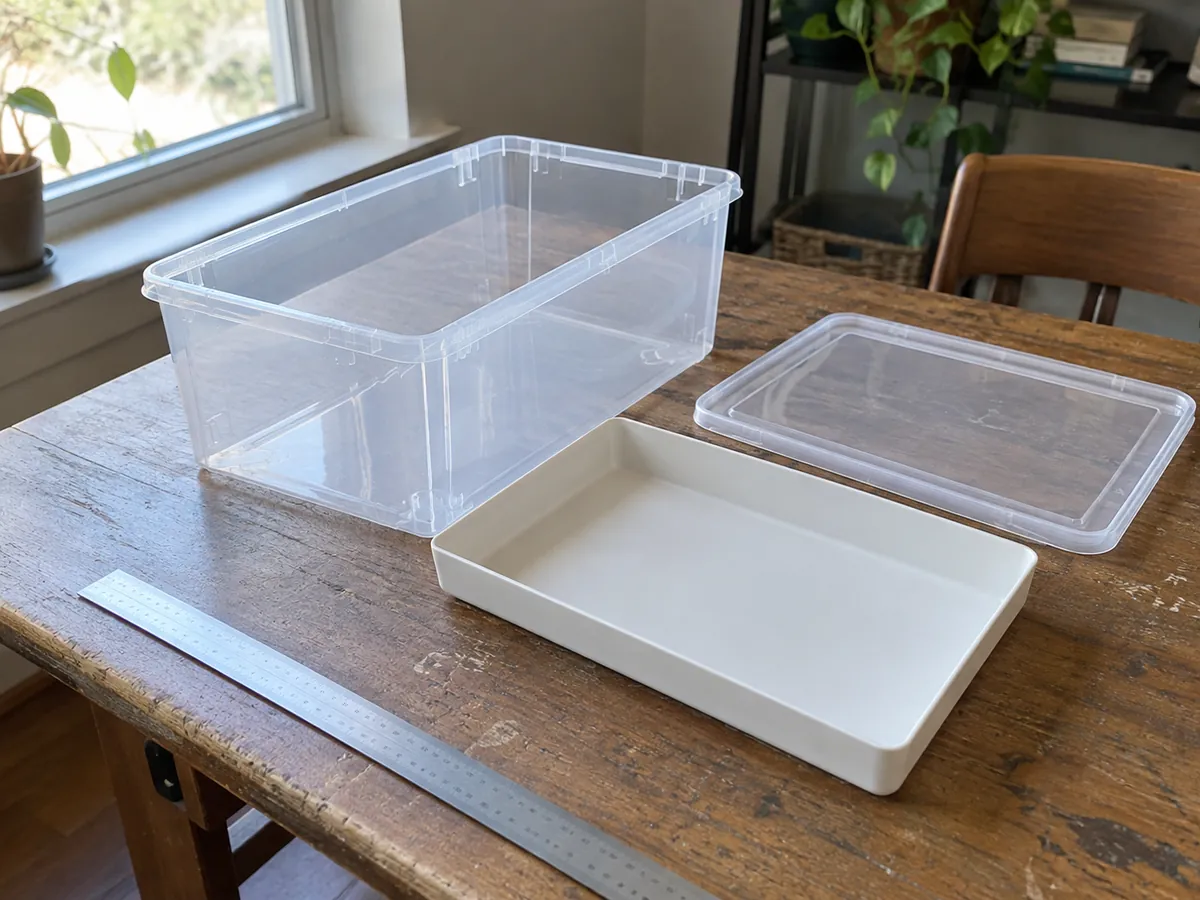
A storage-bin RFQ needs both the closed outside envelope and the usable space for the intended contents. A box can fit a shelf while a rigid tray cannot lie flat inside it. Nominal capacity, widest-rim dimensions and nested shipping dimensions are not substitutes for those two requirements.
Send a shelf sketch and an object reference, with the intended orientation and lid condition. Use the evidence ladder below to decide which candidates merit a labelled sample; do not turn a drawing screen into a practical-fit or load-capacity approval.
Move from catalogue screening to the actual fit decision
Ask the supplier to identify the measurement location and the proposed bin-and-lid combination. A complete answer can rule out an unsuitable candidate before paid sampling without pretending to settle every practical question.
| Evidence received | Useful for | Still unresolved |
|---|---|---|
| Nominal capacity | Identifying the marketed size family | Outside envelope, bottom footprint and opening |
| Dimensioned outside drawing | Screening the stated shelf envelope | Handling path, actual sample variation and usable interior |
| Interior/bottom/opening dimensions | Screening the required rigid object and orientation | Practical entry, closure and access not represented by the drawing |
| Identified sample with agreed object | Recording the specific fit observations performed | Stacking, load, water resistance and unexamined use claims |
| Nested shipping data | Pricing the empty transport configuration | The closed in-use geometry; do not copy nesting dimensions into the fit row |
If the supplier changes the lid, repeat the questions affected by its shape and closing arrangement. Retaining the same nominal litre label does not establish the same closed height or opening. A proposal to tilt the tray or leave the lid off is a changed use for the buyer to approve, not a pass against the original brief.
For a concise quotation, name the model, quantity, required shelf space, least-flexible object and intended closed state. Request the measurements the supplier can actually confirm and identify the remaining sample questions. No universal clearance, tolerance or shelf modification is prescribed here.
Measure the shelf space the bin can actually occupy
Record the clear shelf width, depth and height in the intended position. Use the available space between obstructions rather than the furniture’s outside dimensions. A front rail, door opening or projecting hinge may affect the route into that space even when the shelf itself is wider.
Ask whether the bin will be removed to open it or whether the buyer expects to reach inside while it stays on the shelf. Those are different access requirements. For the first, the owner needs a practical removal route and room to use the handles. For the second, the proposed lid and opening action need their own space. Do not assign a universal clearance from a photograph.
Request the bin’s maximum closed outside dimensions, including its quoted lid, handles and other projections. State the orientation that places its width across the shelf and its depth toward the back. Keep a body-only measurement separate; it may omit precisely the feature that limits the fit.
Ask where the interior was measured
A manufacturer example shows why the distinction is worth requesting. Sterilite’s model 2244 page lists exterior dimensions and interior-at-bottom dimensions in separate fields. It therefore gives the buyer two different measurement descriptions for one named box. That does not establish the interior or shelf fit of a bin sold by another supplier. Sterilite 20 Qt. Storage Box dimensions
For the proposed bin, request the usable bottom length and width, the opening dimensions and interior space at any height relevant to the stored item. Ask the supplier to identify taper, rounded corners, ribs or other features that reduce the region the object needs. A measurement across the broadest part of the rim should not be substituted for a bottom measurement.
Closed height also needs a reference. A shaped lid may occupy some of the space above the rim, or the contents may project into a permitted upper region. Ask for the relevant interior section or an identified sample observation. Do not add the lid’s outside height to the body’s inside height and assume the result is usable space.
Describe the object and its intended orientation
Name the largest or least flexible item that drives selection, and record its actual envelope in the orientation the buyer expects to store it. For a rigid household tray that must lie flat, the bottom footprint matters. For folded textiles, the buyer still needs to define the intended bundle rather than treating the entire nominal volume as freely usable.
The entry path deserves a question of its own. An object can be smaller than the available interior region yet be difficult to introduce through a narrower opening or past the lid arrangement. Ask how the proposed configuration will be assessed with the actual object or an agreed representative. A drawing is useful screening evidence; a practical fit observation should identify what was tried.
Avoid changing the use just to make a candidate appear suitable. If the requirement is flat storage with the lid closed, a suggestion to leave the tray tilted or the lid off is an alternative for the buyer to consider. It does not answer the original request.
Use a two-way fit worksheet
Place the shelf sketch and object reference above this worksheet. Complete it for each exact bin-and-lid option, not simply each nominal capacity.
| Fit question | Requirement to supply | Supplier information needed |
|---|---|---|
| Shelf position | Clear space and orientation | Maximum closed outside envelope |
| Getting the bin in and out | Relevant front opening and handling route | Handle positions and projecting features |
| Object at rest | Largest item, orientation and storage condition | Usable interior at the relevant height |
| Narrow bottom | Required flat footprint | Bottom length, width and corner shape |
| Entry through the opening | Object envelope and permitted handling | Clear opening and lid arrangement |
| Closing the lid | Required contents in their intended position | Relevant closed interior height or section |
| Practical review | Exact shelf, item or agreed representative | Labelled sample and recorded fit questions |
Keep each answer in the correct row. A capacity statement belongs with the product description; it does not replace an unanswered opening size or bottom footprint. Multiplying three outside dimensions likewise does not calculate the interior available to the household object.
Two real 20-quart bins: a capacity label is not a fit measurement
These are manufacturer-published dimensions for two named products, checked 27 October 2026. They are comparison examples, not products offered by this site or measurements of a 1688 supplier’s stock. The manufacturer’s stated dimensions are in inches.
| Manufacturer’s model | Advertised capacity | Outside L × W × H | Interior at bottom L × W × H |
|---|---|---|---|
| Sterilite 2244, storage box | 20 qt | 16⅜ × 11¼ × 9 in | 13¾ × 9 × 8⅜ in |
| Sterilite 2392, hinged lid | 20 qt | 18¼ × 13 × 8 in | 13½ × 10⅜ × 6¼ in |
For an illustrative rigid tray 13.6 × 8.75 in, oriented lengthwise in the box, the stated bottom dimensions do not rule out model 2244 on those two numbers. Model 2392’s 13.5 in bottom length is shorter than the tray in that orientation. This is a dimensional screen, not a confirmed fit: corner radii, insertion, closed height and tolerances still require a drawing or sample. A different orientation may change the result. The example does not establish whether either model fits your shelf.
A buyer ordering from another seller should obtain measurements for that seller’s exact bin and lid, then verify the unresolved questions with the proposed sample. Neither product’s dimensions certify another model.
A fictional bin that passes the shelf screen but fails the object screen
Suppose a fictional shelf has 34 cm clear width, 46 cm depth and 30 cm height. Candidate B1 is described as 31 cm wide, 43 cm deep and 27 cm high with its lid closed. Its outside numbers fall within those three shelf measurements, although removal access and any required clearance remain to be assessed.
The buyer also needs a rigid tray, 29 cm wide and 35 cm long, to lie flat inside. B1’s supplied bottom dimensions are 26 cm wide and 38 cm long. All these figures and identifiers are invented for this example.
| Fictional comparison | Result on the stated numbers | Decision |
|---|---|---|
| Closed B1 against shelf space | 31 < 34; 43 < 46; 27 < 30 cm | Exterior screen satisfied; access still open |
| Tray width against bottom width | 29 > 26 cm | Specified flat orientation fails this dimensional screen |
| Tray length against bottom length | 35 < 38 cm | Length alone does not resolve the width mismatch |
A larger litre label would not repair that width mismatch. Ask for another stock bin with the needed bottom region and check its outside size against the shelf again. A larger interior may come with a larger exterior, so the two decisions stay linked. Do not assume the tray can be bent, the bin altered or the shelf widened.
Review the useful configuration before the shipping configuration
Ask a labelled sample review to address the remaining household questions: insertion, intended storage orientation, lid closure and removal from the defined shelf space. Record observations only for the reviewed arrangement. This does not establish load capacity, stacking suitability, water resistance or any other unexamined property.
Once a candidate meets the buying brief, request its separate packing information. Empty bins nested for shipment are in a different state from lidded bins in use. Keep those dimensions apart when the supplier returns the quotation.
Copy a supplier-ready fit request
Please quote [quantity] bins and matching lids for [destination], required by [date]. The shelf clear space is [width × depth × height and units]; its entrance or door opening is [dimensions]. The least-flexible item measures [length × width × height] and must be stored [orientation], with [lid closed / other requirement]. Please provide the exact model and lid revision, maximum outside dimensions with projections, usable bottom dimensions and corner shape, clear opening, and relevant closed interior height. Quote stock and any custom option separately, including per-variant minimums, sample cost, unit and packaging prices, carton dimensions, and lead times. State which measurements are supplier drawings and which can be checked on a labelled sample.
Compare quotations only after the same fit requirements and packing scope have been answered. If a supplier cannot state a dimension, leave it open for a sample check; do not fill the gap from a catalogue photograph.
The Baskets and storage category gives broader buying context. Send a Homeware sourcing request describing both jobs: the available shelf space and the object that must fit. A labelled image preview can show orientation; agree separately how to exchange a longer dimension sheet.
A fitting stock bin and a custom-sized proposal are different supply routes. Put the dimensional requirement into the first homeware-order brief, then check the stock, colour and new-shape minimums before treating a resized alternative as orderable.
Frequently asked questions
Are the dimensions in a storage-bin listing inside or outside?
Ask the seller to identify the basis. Request the closed exterior with the quoted lid and projections, then separately request the interior region your object will occupy. A listing that gives only three numbers should remain incomplete for this comparison until the measuring points and configuration are clear.
Why can a high-capacity bin fail to hold a smaller-looking object?
The object may be too wide for the bottom, too tall under the closed lid or unable to pass the opening in the intended orientation. Nominal capacity does not describe those shapes. Compare the relevant dimensions and use an identified sample review for questions the drawing does not settle.
Should I buy the largest bin that fits the shelf’s outside measurements?
Use the shelf’s clear usable space, then check access and the intended opening or removal action. Furniture outside dimensions do not identify that space. A bin can pass a simple size screen yet leave the buyer without the handling room required by the actual arrangement.
Which measurement is most useful for a tapered storage box?
It depends on what must fit. For a rigid item lying on the base, request bottom dimensions and relevant corner shape. Also record the opening and interior dimensions at the item’s height. One measurement at the widest part of the box should not stand in for all three regions.
Can I use nested shipping dimensions to check shelf fit?
No. Keep the empty transport arrangement separate from the closed in-use bin-and-lid dimensions. Ask which state each measurement describes.
What if the tray fits only with the lid removed?
Record it as an alternative use requiring the buyer’s decision. It does not satisfy an RFQ requiring flat storage with the lid closed.
Sources
Discuss a sourcing request related to this article.Storage Bin RFQ: Check Shelf Fit and Usable Interior Separately
Prepare a clearer buying request
Keep this page as context. Add what you know; review everything before sending. No purchase is made at this step.
Edit the checklist below before continuing. It stays a planning note; it does not approve a product or order.
- Shelf position
- Getting the bin in and out
- Object at rest
- Narrow bottom
- Entry through the opening