
Nested Kitchen Prep Sets: Separate Storage Order from Shipping
Compare a mixed bowl, colander, sieve and measuring-cup set’s actual shipping proposal with its cupboard nesting arrangement.
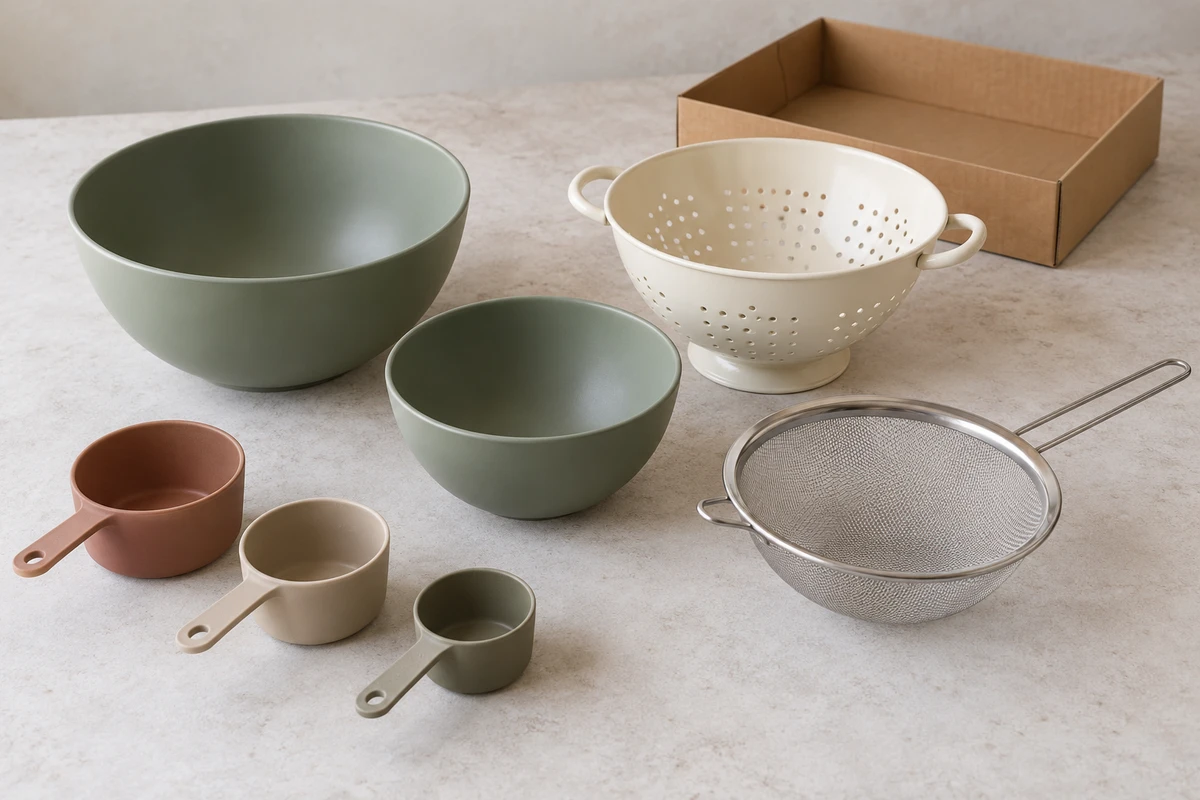
A mixed kitchen preparation set may nest neatly in a cupboard while its shipping arrangement remains unspecified. Ask for the actual shipping-pack proposal before accepting the storage photograph as a complete answer. The key is how the unlike components are represented, including the parts hidden inside the group.
Begin with the approved assortment. This packing decision does not select bowl capacity, establish food-contact suitability or promise to protect sieve mesh. It compares the proposed supplied arrangement with the storage arrangement and identifies the evidence still missing.
Name the unlike components
Joseph Joseph’s named Nest 9 Plus set contains two mixing bowls, a colander, a mesh sieve and five measuring cups. Its component forms include handles and a pouring spout. Calling it simply “nine bowls” would lose the differences that matter to a packing proposal. Nest 9 Plus product details
The maker’s nesting description is a storage claim for that product. It is not a tested shipment configuration for an unknown set. Your own supplier’s assortment may differ, so identify each actual component role and reference before comparing arrangements.
Keep the existing set composition fixed. If a proposed shipping pack omits a small cup or substitutes a different sieve, resolve the product change rather than redesigning the worksheet around it.
Put storage and shipping in adjacent columns
Request a component-by-component account of both arrangements. The shipping proposal may preserve parts of the storage order, alter an owner-permitted relationship or place a component separately. Any difference needs to be explicit, with the applicable product basis where required.
| Component role | Storage reference | Shipping proposal to obtain | Hidden relationship to resolve |
|---|---|---|---|
| Outer mixing bowl | Named maker storage position | Exact supplied position and surrounding pack | Base, rim and adjacent components |
| Other mixing bowl | Named order and orientation | Actual proposed order and any permitted change | Pouring spout and handle relationships where present |
| Colander | Actual storage location | Its proposed supplied position | Handles, rim and neighbouring shapes |
| Mesh sieve | Actual storage location | Position in the shipping proposal | Mesh region and proposed support/contact |
| Measuring cups | Exact approved cup group | Count, order and supplied location | Small components and permitted first access |
These are questions, not instructions to rearrange a sample. Use the actual product’s features; do not add a spout, handle or removable part because it appears on the named example.
Look beyond the outside silhouette
A top view can show a complete-looking nested group while hiding the sieve mesh or the small bowl’s spout. Ask for the specific view that answers the missing relationship. A second image of the same outer bowl does not help if the unresolved area remains concealed.
The proposal should distinguish intended contacts from unanswered ones. It should also show any required existing packaging rather than depicting bare parts and leaving the reader to imagine the transport pack.
Avoid assuming that every component acts as protective packaging for the next. The outer bowl is a purchased product with its own surfaces and instructions. A cavity is not automatically an approved place to restrain another piece during shipment.
If the supplier proposes a separator or a separate position, identify it as a candidate with its own material, support and retention questions. No generic “soft insert” establishes suitability for the mesh, spout or any working surface.
Account for the first permitted access
Ask which component the recipient encounters first in the proposed shipping state and which applicable instruction governs ordinary removal. Storage order may help explain the product’s intended organization, but it does not replace the supplied pack’s opening reference.
Keep the review within permitted handling. Do not press the sieve, lever nested rims, pull harder or use tools to prove the arrangement is removable. If the intended state cannot be reviewed by the authorized method, return the proposal to its owner.
A usable decision sheet records what has actually been represented:
| Decision field | Record |
|---|---|
| Approved set | Every component role, reference and count |
| Storage arrangement | Exact maker source and its limited storage scope |
| Proposed shipping arrangement | Identified layout revision for the supplied pack |
| Sensitive geometry questions | Mesh, spout, handles, rims and other actual hidden features |
| Permitted access | Applicable handling reference and first-removal question |
| Outstanding evidence | Product permission, material/contact or transport decision and owner |
The sheet is an editorial decision aid. It does not select a test standard or certify the pack.
A fictional storage photo submitted as the pack plan
Suppose fictional set K-N contains the approved mixed preparation components. Proposal S is a cupboard-storage photograph of the complete group. It gives no shipping-pack reference and hides the sieve mesh and the small bowl’s spout. All references and observations here are invented.
The buyer should ask for the actual shipping arrangement rather than approve S as a pack. The missing information is specific: where the sieve and spout sit, what surrounding packaging is proposed, and how the first permitted access is represented.
Revision T provides a shipping drawing but still uses a generic circular silhouette for the sieve. T has added a box without resolving the mixed-component geometry. Request T2 with the actual sieve and neighbouring features represented in the same configuration.
If T2 supplies those relationships and the applicable product basis, the buyer can choose it as the candidate to develop. Keep material compatibility, retention and protective performance open for their responsible reviewers. The selection does not establish that the storage order was wrong, that the sieve would be damaged, or that the revised pack has passed transit testing.
The practical result is a complete mixed-component proposal with named decisions, rather than a general instruction to “nest carefully.”
Ask for the shipping state by name
Use Homeware kitchenware for category context. In a Homeware sourcing enquiry, distinguish the maker’s storage image from the shipping proposal you need. Identify the exact component relationship that is hidden and ask for the available review scope.
Submit an eligible marketplace link, description or supported image. The form does not accept PDF/CAD/ZIP files through its image field. No supplier capability, product conformity, test result or shipment release follows from this planning worksheet.
Frequently asked questions
Does a storage-nesting claim approve a shipping arrangement?
No. The storage description concerns the named product’s intended storage arrangement. Shipping adds an actual pack, contact and retention proposal that needs applicable review. Ask for the precise shipping configuration instead of treating a cupboard photograph as a transport assessment.
Why list the components of a nine-piece prep set separately?
They may have different roles and shapes: mixing bowls, a colander, a mesh sieve and measuring cups are not interchangeable containers. Handles, a pouring spout and mesh can be hidden by a simple count or outer silhouette. Separate component references make the missing relationships clear without changing the approved assortment.
What should I ask when the sieve mesh is hidden?
Request a matching view or responsible review that identifies the sieve’s proposed position and its relationship to adjacent components. Do not press on the mesh or add an unnamed pad to close the question. The packaging owner needs to resolve the actual support/contact basis for the exact configuration.
Can I approve a nested set because the parts come apart in a photo?
A photograph can show an illustrated arrangement but cannot establish a permitted removal method, force or shipping protection. Obtain the exact maker-supported handling reference and the intended shipping proposal. If an ordinary authorized review cannot separate the items as permitted, stop and return the arrangement rather than improvise levering or pulling.
Sources
Discuss a sourcing request related to this article.Nested Kitchen Prep Sets: Separate Storage Order from Shipping