
Bulk or Retail-Ready Textiles: Compare the Cost of the Finished Assortment
Price home textiles to the same retail-ready endpoint, including confirmed local sorting, labels and repacking when comparing bulk-grouped delivery.
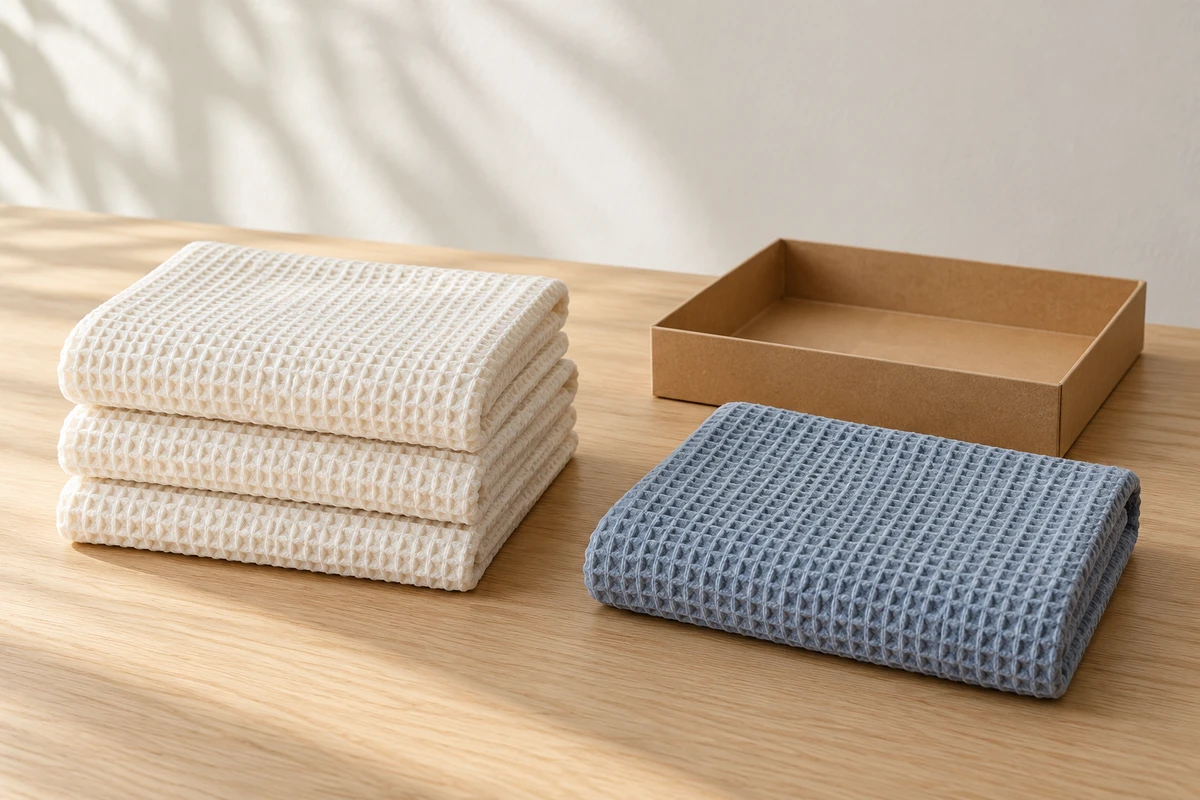
Compare bulk-packed and retail-ready home textiles at the same finished assortment and physical handover point. A lower inbound freight amount may leave sorting, pairing, approved labels and packing work unpaid. The buyer needs an available route to sale-ready units, not just cheaper cartons.
Use the completion comparison below before dividing totals by pieces. Keep covers, pairs and sets as distinct units, and retain existing product information through any authorised local preparation. This is a commercial worksheet, not approval to alter fibre labels, compress products or promise local repacking service.
Make both offers finish at the same handover
A valid comparison names the party doing each remaining job and the basis of its actual offer. “Buyer to arrange” is an open responsibility, not a zero-cost line.
| Endpoint row | Origin retail-ready route | Bulk plus local-preparation route |
|---|---|---|
| Variant identity | Finished size/colour and saleable unit specified | Identity retained when bulk groups are opened |
| Required information | Existing approved labels and agreed retail material included | Responsible owner confirms retained labels and authorised additions |
| Preparation work | State the origin provider’s actual included tasks | Name the local provider, output unit, materials and quoted work |
| Physical destination | Exact receiving/handover point | Preparation point plus any onward journey to the same endpoint |
| Completion evidence | Finished counts by variant and unresolved items | Same output reconciliation after local work |
If a curtain offer counts panels but the retail requirement is pairs, reconcile that unit before comparing labour rates. A low per-panel handling price can still omit pairing and checking the required finished unit. Likewise, a bulk price ending at a preparation warehouse cannot be ranked against a ready-to-sell shop delivery without pricing the remaining handover.
Keep the offered packing states unchanged during comparison unless the relevant owner approves a revision. Ask for actual carton dimensions and weights for both states, not an estimated saving from removing layers. Select the route only after mandatory work, ownership and charges are resolved; unidentified amounts stay conditional rather than being entered as zero.
Define one finished retail unit
Name the exact article, size, colour and quantity in each customer-facing unit. A cushion cover sold individually is one unit; a specified curtain pair or duvet-cover set has its own component count. Do not compare all three through an unexplained “per piece” labour rate.
Describe the approved retail state: the required wrapping or container, the information that stays with the product, and any approved stock tag or other customer-facing material. Distinguish existing product labels from new presentation material. The responsible owner must establish applicable label requirements; this budget supplies no compliance determination.
Use the same retail endpoint for both proposals. If the origin-ready option excludes a required stock tag, it has a remaining preparation task too. A supplier’s phrase “retail packing included” is not a complete description of what arrives.
Separate bulk grouping from the assortment sold
Ask how the bulk shipment groups the articles. They may be separated by size, colour or another approved variant, but the actual grouping must be confirmed. Record the units in each inner pack and master carton, including mixed or partial packs.
Then ask the local provider what it receives and what it returns. Opening transport groups, separating sizes, identifying variants, adding approved retail packaging and reconciling finished quantities are distinct possible tasks. Obtain the provider’s actual scope instead of assuming a generic bagging price covers all of them.
Preserve the product-to-variant connection during any authorized preparation. A shared carton label cannot identify every loose cover once groups are separated. Request a workable identity and count method from the responsible provider without inventing new fibre, origin or care wording.
Price two permitted transport arrangements
Obtain the final packed data for origin retail-ready goods and for the approved bulk grouping. Include outer dimensions, gross weights, carton counts and the actual units represented. A bulk carton should not inherit the retail-ready carton’s measurements simply because the sewn articles match.
UPS discusses dimensions and actual package weight, with the relevant service determining its billing treatment. Use that bounded measurement principle; request a quote for each actual textile arrangement instead of predicting savings from loose fabric volume. UPS dimensions and weight guidance
Keep any new compression or fold proposal outside the cost comparison until its product-specific review is complete. Removing approved layers or pressing a velvet cover flatter is not a valid way to manufacture a favourable freight input. Both options need real, permitted packed states.
If bulk goods go to a local preparation provider before the shop, price that actual destination and any required onward movement. Do not compare a shipment ending at that provider’s premises with a retail-ready offer ending at the shop and call them the same endpoint.
Ask for an output-based local offer
Give the provider the incoming pack description and the required finished assortment. Request prices for the actual quantity and ask which materials are supplied by whom. If the offer includes a setup charge or minimum, retain its stated basis; do not invent one or assume a simple per-unit multiplication covers it.
Clarify what happens to shortages, unclear variants or articles whose condition is unresolved at opening. Such goods should remain identifiable rather than being counted as finished retail output. Any additional work needs its own authorization and actual commercial response, not a guessed rework allowance.
| Comparison worksheet | Entry for each proposal |
|---|---|
| Approved assortment | Article references, sizes, colours and quantities |
| Retail unit | One cover, matched pair or defined set; exact component count |
| Incoming transport groups | Pack references, contents and measured shipping data |
| Information retained | Approved product labels and other required information |
| Retail preparation | Actual provider, permitted scope, materials and charge unit |
| Physical endpoint | Receiving location, preparation location and shop handover |
| Completion record | Required finished counts by variant and unresolved-unit treatment |
| Cost boundary | Included charges, separate offers and unpriced tasks |
The worksheet is a commercial decision aid. A photograph of a neatly wrapped sample does not establish batch completeness, label compliance or transport performance.
Work through sixty fictional cushion covers
Imagine an approved assortment of 60 covers: 20 small cream, 20 large cream and 20 large blue. Each is to be sold individually in the same approved sleeve with its existing required information retained. These quantities and configurations are fictional.
Proposal R supplies the identified retail-ready units from origin. Proposal B supplies the same covers in size-and-colour bulk groups. B’s transport quote looks lower, but its scope ends before local sorting and sleeving. The comparison therefore has a named gap rather than a demonstrated saving.
Let CR be R’s complete quoted cost to the required endpoint. Let CB cover B’s goods and transport to the preparation provider, L its actual local preparation offer, and O any separately quoted onward delivery. Compare CR with CB plus L plus O, adding any other required nonduplicated costs to the appropriate side. If an amount is unknown, leave the total conditional; do not enter zero.
If L is quoted per incoming bulk pack, confirm what the charge includes for all 60 individual sleeves. If the provider offers a per-cover charge, check its actual scope and any stated additional terms. A “per set” response remains ambiguous until the unit is defined.
Once both routes cover the same 60 planned retail units, dividing their complete totals by 60 can support the purchase decision. It is not a measured cost per accepted saleable cover. The actual completion record must still reconcile 20 of each specified variant and identify any unresolved units separately.
Choose where the work will really happen
Select the route whose complete, available scope meets the buyer’s assortment and budget. If local preparation cannot be confirmed, retain origin retail-ready supply as a candidate rather than assigning the unowned task to shop staff by default. If the buyer accepts staff preparation, record that responsibility and its known resource demands explicitly.
The Homeware textiles category provides broader context. Through the Homeware sourcing page, describe the final retail unit and request bulk-grouped and origin-ready alternatives using supported links, text or images. The useful answer identifies both the packed goods and the work needed to deliver the same finished assortment.
Keep the home-textile material specification constant while comparing packing locations. Use the homeware shipping-cost guide for the actual carton and endpoint inputs rather than treating a change of packing location as a change of textile quality.
Frequently asked questions
Is bulk-grouped textile delivery cheaper than retail-ready supply?
It can only be compared after the bulk route includes the actual work needed to reach the same final assortment. Obtain separate measured packing and complete quotes for both routes, including any confirmed local sorting, materials and repacking. A lower transport subtotal alone does not establish a lower retail-ready cost.
What must a local textile repacking quotation describe?
Name the exact articles and variants, incoming grouping, quantity, finished retail unit and approved packaging references. Ask the provider to define receiving, sorting, label or tag handling, packing materials, output counts and exclusions. Confirm whether its charge is per piece, retail set, incoming pack or another stated unit.
Can required textile labels be removed to simplify repacking?
Do not remove, replace or cover required information as an improvised packing shortcut. Have the responsible owner establish what must remain with the actual product and approve any new customer-facing information. This cost comparison does not determine label compliance, and a locally added stock tag does not automatically replace a product label.
How do I compare mixed textile sizes without overstating ready-to-sell stock?
Reconcile each size and colour from incoming bulk groups to the approved retail unit. If a unit is a pair or set, count complete matched units rather than loose pieces. Report unresolved, missing or unprepared goods separately; before actual completion, the denominator is planned retail-ready units, not observed saleable output.
Is “buyer to arrange local packing” a comparable zero-cost option?
No. Identify the actual provider, permitted work, materials, output and handover. Until the required offer is available, the route has an unresolved cost and responsibility.
Can per-panel curtain handling be compared with a per-pair retail offer?
Only after converting both to the same finished unit and including pairing, required checks and all other agreed work. Preserve the original charging basis alongside the converted comparison.
Sources
Discuss a sourcing request related to this article.Bulk or Retail-Ready Textiles: Compare the Cost of the Finished Assortment
Prepare a clearer buying request
Keep this page as context. Add what you know; review everything before sending. No purchase is made at this step.
Edit the checklist below before continuing. It stays a planning note; it does not approve a product or order.
- Approved assortment
- Retail unit
- Incoming transport groups
- Information retained
- Retail preparation