home decor, kitchen and household goods / Buying guide
Ceramics shipping: compare packaging by usable delivered cost
Last updated
Published by 1688 Homeware · Review method
Key takeaways
- Compare the same ceramic article in divided, fitted-insert and individually boxed packs using actual built dimensions and complete quotes.
- The three-pack USD comparison is illustrative only; no physical test, damage rate or passing result is claimed.
- Commission a route-appropriate test, keep its evidence separate from delivery outcomes and divide actual cost by the observed acceptable-unit count.
The cheapest carton is not necessarily the cheapest way to receive saleable ceramics. Compare the same product in three fully specified packs, obtain measured freight quotes and test the actual product-and-package combinations before choosing.
For a ceramic shipping comparison, provide item dimensions and fragility concerns, quantity, proposed inner and outer packing, measured carton details if available and destination. Keep assumed damage allowances separate from actual packing or test evidence, and agree any verification method and fee.
No physical test or delivery result was supplied for this guide. The figures below are clearly labelled illustrative arithmetic. The testing section is a plan for collecting real evidence, with outcomes left unknown rather than invented.
Turn this guide into a buying request
Keep this page as context. Add what you know; review everything before sending. No purchase is made at this step.
Continue to request →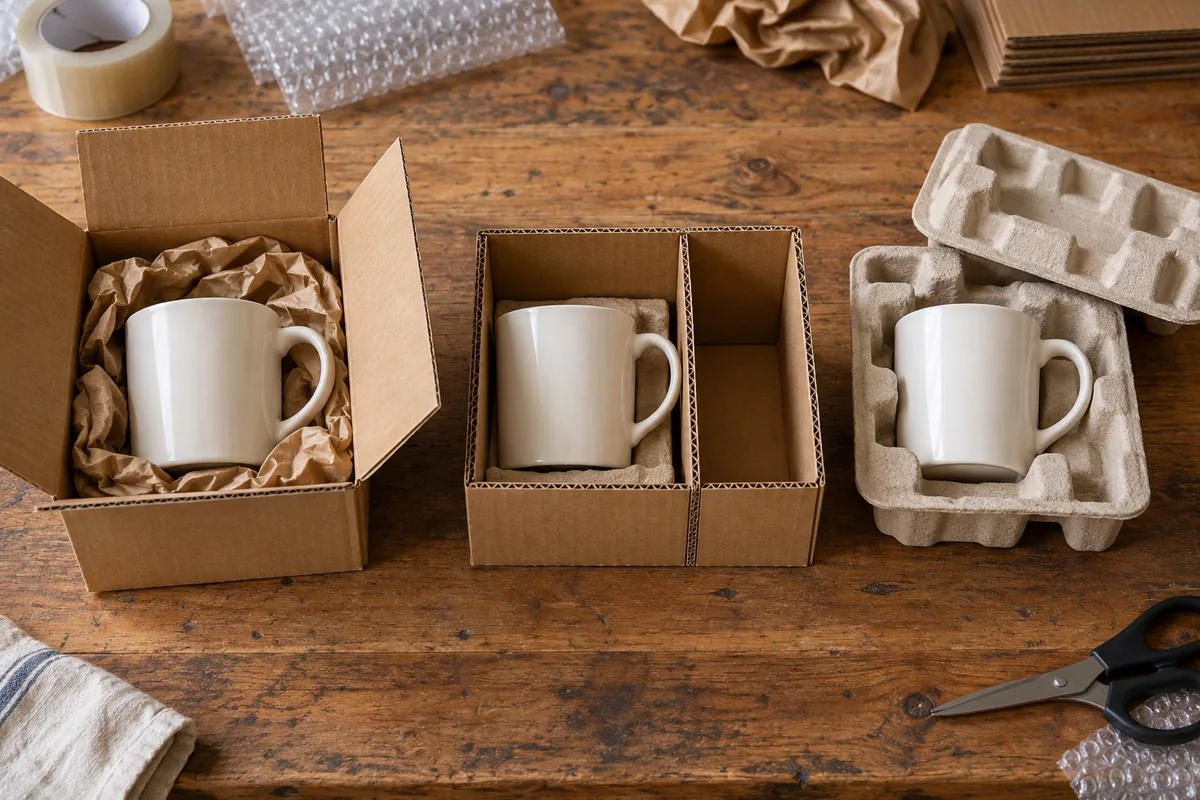
-
A, divided master carton
bowls isolated with suitable sleeves and separators, 12 per outer carton. Quote separator design, cushioning, carton board and sealing. Check whether bowl rims or feet can touch under load.
-
B, fitted inserts
shaped pulp or other specified inserts support and separate each bowl inside a master carton, 12 per carton. Confirm insert fit, material, moisture response and any tooling or minimum order.
-
C, individual boxes inside an outer carton
each bowl has a specified protective inner box and cushioning, 6 boxed bowls per master carton. Useful presentation or handling features must justify the extra materials, labour and volume.
-
No approach is declared safer here. “Double-wall”, “export carton” or “moulded pulp” is not a complete pack specification or a test result.
In this guide
Keep the ceramic product and delivery job constant
Illustrative scenario dated 2 October 2026: 120 identical glazed bowls, nominal 160 mm diameter and 70 mm high, bare weight 0.35 kg each, intended for adult table use. Destination is one London shop with no onward individual-parcel dispatch in the base scenario. Currency is USD. The body, glaze, decoration, supplier and quantity stay unchanged across all three packs.
These dimensions and weights are assumptions. Food-contact and intended-use assessment must be completed for the actual article. Packaging performance does not establish chemical safety, and a report on a different glaze does not resolve it.
If the retailer will later post one bowl at a time, add that distribution stage and price its individual shipping pack. A master-carton test does not establish the protection of an untested consumer parcel.
Three candidate packs to quote and test
- A, divided master carton: bowls isolated with suitable sleeves and separators, 12 per outer carton. Quote separator design, cushioning, carton board and sealing. Check whether bowl rims or feet can touch under load.
- B, fitted inserts: shaped pulp or other specified inserts support and separate each bowl inside a master carton, 12 per carton. Confirm insert fit, material, moisture response and any tooling or minimum order.
- C, individual boxes inside an outer carton: each bowl has a specified protective inner box and cushioning, 6 boxed bowls per master carton. Useful presentation or handling features must justify the extra materials, labour and volume.
- No approach is declared safer here. “Double-wall”, “export carton” or “moulded pulp” is not a complete pack specification or a test result.
Show the carton and freight assumptions
For this arithmetic only, assume billing at the larger of actual and dimensional weight, a divisor of 5,000 cm³/kg, an invented $5/kg freight charge, no rounding and no minimum or surcharge. This is not a quotation from any carrier.
A: 10 cartons × 12 bowls; each 40 × 30 × 25 cm and 5.3 kg gross. Total volume 0.300 m³; gross mass 53 kg; dimensional mass 60 kg. Model freight: $300.
B: 10 cartons × 12 bowls; each 45 × 35 × 30 cm and 6 kg gross. Total volume 0.4725 m³; gross mass 60 kg; dimensional mass 94.5 kg. Model freight: $472.50.
C: 20 cartons × 6 bowls; each 40 × 30 × 30 cm and 3.2 kg gross. Total volume 0.720 m³; gross mass 64 kg; dimensional mass 144 kg. Model freight: $720.
Measure built packs rather than reusing these dimensions. Apply the quoted service’s own chargeable-weight rules; the linked carrier guidance explains one real dimensional-weight method, not the invented freight rate above.
Build a complete comparison, with unknowns visible
All costs here are invented planning inputs, not supplier offers. Common costs per alternative: 120 bowls × $3 = $360; China delivery $45; handling/QC $75; food-contact document/testing allowance $100; packaging-validation allowance $150; clearance $60; final delivery $60; duty/tax cash allowance $100. Common model subtotal: $950.
Add assumed packing materials and labour of $60 for A, $100 for B or $180 for C, plus their respective freight. The model totals are A $1,310; B $1,522.50; C $1,850. These totals assume no separate insert tooling, storage, insurance, examination charge, redelivery, refund or rework.
The test and tax allowances are placeholders, not laboratory prices or calculated tax liabilities. Confirm the required tests, actual tax base and each route charge. If any omitted line is necessary, add it before deciding.
With all 120 units accepted, the hypothetical costs would be about $10.92, $12.69 and $15.42 per usable bowl. Those are zero-rejection scenarios, not predicted arrival yields. No damage rate is available for any pack.
Commission a real test of the production-intent pack
Ask a competent packaging laboratory to select the procedure for the actual distribution chain. ISTA differentiates screening tests from transport simulations; Procedure 3A addresses individual parcel delivery within its scope, while palletised or other routes need an appropriate different assessment. Do not label an improvised warehouse drop an ISTA test.
Send the same ceramic revision and production-intent packaging for all candidates. Ask the lab to specify sample count, conditioning, test sequence, loads and acceptance criteria. The procedure and risk determine sample needs; this article does not prescribe a universal number of cartons.
- Before testing: record product batch, pack revision, carton/material specifications, contents, dimensions, gross weights and photographs. Inspect the pieces before packing so pre-existing defects are not counted as transit failures.
- Define failure before seeing the results: broken or cracked ceramic, rim/foot chips, unacceptable glaze abrasion, lost components, and any packaging damage that prevents the intended sale.
- During testing: retain the complete method and version, equipment and conditions, deviations, sample selection and dated observations. Test each candidate as specified rather than changing weak packs mid-sequence.
- After testing: unpack and inspect every tested piece. Log each failure type, affected unit and carton. Keep the denominator for units and cartons explicit.
- If a pack changes: document the revision and have the lab decide what retesting is needed. A result for one insert thickness or carton layout does not automatically cover another.
ISTA: transport test procedures and their different scopes ↗
Results worksheet: fill it with evidence, not estimates
- Pack A / B / C and revision: blank until confirmed; product batch and sample-selection method: blank.
- Test laboratory, report number, procedure/version, date and sample count: blank until testing is completed.
- Units inspected before and after, broken, cracked, chipped, abraded and accepted: blank; no result is claimed.
- Observed failure locations and agreed corrective action: blank. Include photographs and report references.
- Production match: record who checks that shipped goods use the tested materials, layout and carton specification.
- Arrival record: shipment/lot, receipt date, cartons and units examined, damage and nonconformity counts, and claim evidence. Keep laboratory results and actual delivery outcomes separate.
Use the observed usable count to calculate the result
Usable delivered cost = actual attributable cost ÷ units accepted for the intended sale or use. Deduct a claim credit only when it is confirmed and attributable; include actual rework or replacement transport that you paid. If no units are usable, there is no finite usable-unit cost.
A threshold calculation can help before evidence arrives: with the model totals, B costs less per usable bowl than A only when A’s usable count divided by B’s is below $1,310 ÷ $1,522.50, about 0.8604. If B were to deliver 120 acceptable bowls, A would need 104 or more acceptable bowls to remain cheaper in this model. This is algebra, not a forecast of either pack’s performance.
Do not select A by assuming no losses, or B by inventing a reassuring breakage percentage. Test evidence and an actual pilot shipment can inform the decision, but a small successful test does not guarantee every future shipment.
Agree the receiving and remedy plan before release
- Specify who inspects on arrival, the deadline for reporting damage and the required carton, label and product photographs. Confirm whether packaging must be retained for a claim.
- Separate supplier responsibility for nonconforming goods or packing from carrier liability and insurance. A “fragile” label does not define compensation.
- Ask whether the remedy is a refund, credit or replacement, who pays replacement freight and whether the timing meets the shop’s needs.
- Request a quote through this site with bowl dimensions, quantity, destination, sales channel, receiving date and all three packing proposals. Ask for a test quotation separately and keep unconfirmed results blank.
Before interpreting a pass, check the chain of custody
Give each candidate pack and tested product a unique revision. Record who selected and sealed the samples, when the laboratory received them and whether it changed any materials or arrangement. Obtain the complete report and specimen photographs, not only a certificate cover.
Hypothetical hold: Pack B’s report describes twelve undecorated bowls with thicker inserts, while the shipment uses twelve decorated bowls and reduced insert thickness. Ask the laboratory to assess the changes and retest where needed. The original result cannot simply be relabelled for the cheaper configuration.
Use the downloadable pack-and-route worksheet to connect the lab-approved revision to the warehouse packing record and the arrival inspection. If no candidate has relevant evidence, retain that gap in the comparison instead of awarding the lowest modeled cost a safety advantage.
Download the homeware pack and route worksheet (plain text) ↗
Prepare a clearer buying request
Use the relevant worksheet to keep product requirements and unanswered questions with your enquiry.
Questions & answers
Common questions
- Which of the three packs passed the test?
- None has been tested for this article. The guide supplies an evidence-collection method and illustrative cost inputs, not a laboratory result or performance ranking.
- Does double boxing guarantee fewer broken bowls?
- No. Fit, cushioning, carton strength, handling and product shape all matter. Test the actual product-and-package system for its intended distribution.
- Can I publish a zero-breakage claim after one successful test?
- A test result describes the specified samples and conditions. It does not establish a universal zero-breakage rate for future production and routes.
- Should I remove the retail box to cut freight?
- Only if the replacement protection is approved and the product remains saleable in the intended channel. Include receiving labour and replacement presentation packaging in the comparison.
Your next step
Have a link you want checked?
Send a 1688 or Taobao product link and you get back the specification in English, the supplier check, and the landed cost to your country before you commit to anything.
Get a quote