
Check a Planter, Inner Pot and Saucer as a Dry Set
Separate inner-pot seating, pot-to-saucer contact and visible drainage openings before accepting the received planter configuration.
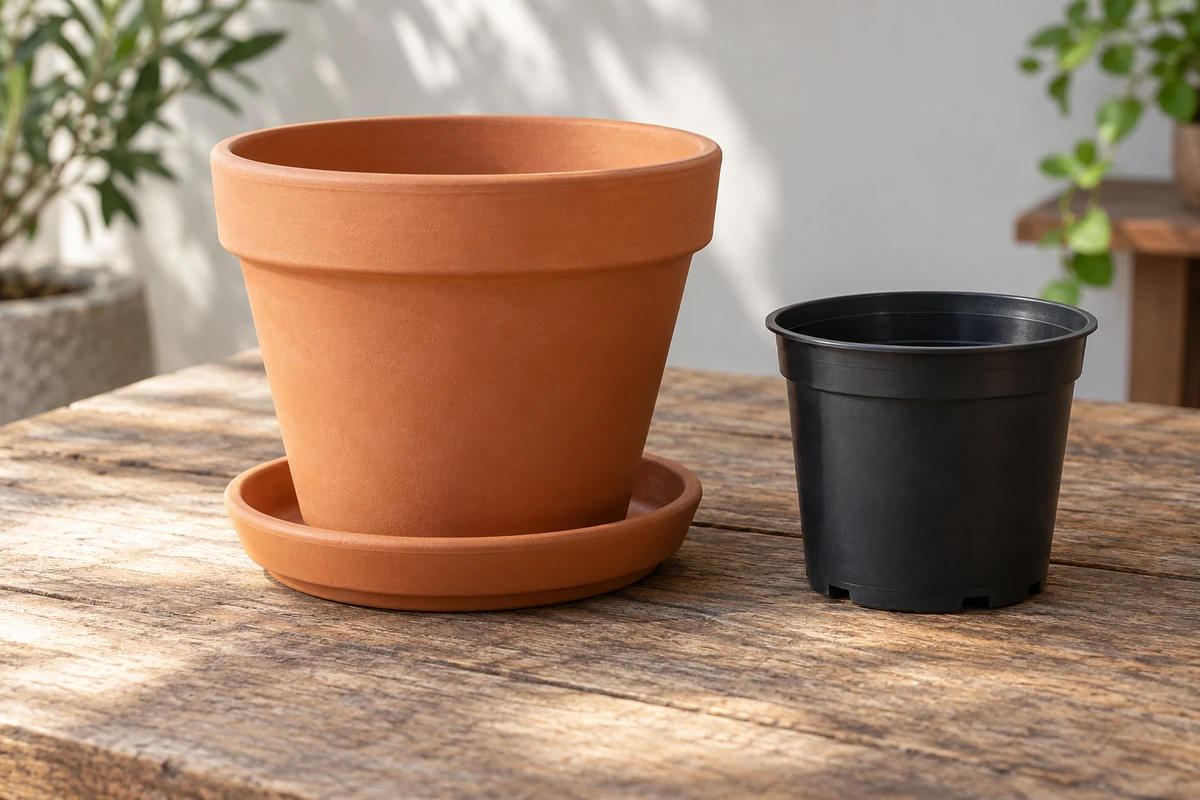
Check a received planter as the combination the buyer intends to use: the outer pot, the actual inner pot and the supplied saucer. Review their dry seating separately. A saucer that accommodates the outer pot leaves the inner-pot fit unanswered, while an inner pot that enters the opening may still sit at the wrong height.
This receiving decision concerns the agreed configuration and visible obstructions. Keep water, soil and plants out of the observation. It does not establish drainage performance, leakproofness, frost resistance or protection of the surface underneath.
Put the intended inner pot beside the delivered set
Find the order’s actual configuration before bringing the pieces together. Was the buyer expecting a direct-planting pot or a decorative vessel around a removable inner pot? Was the inner pot supplied, or does the buyer provide it? A change between those arrangements can explain why a set looks complete but does not answer the original purchase.
Use the identified empty inner pot where ordinary handling is permitted. A convenient pot with the same nominal size is a different reference if its rim, taper, base or height differs. If the correct reference is absent, record that the inner-pot interface has not been observed. Do not substitute another pot and leave the result headed with the original reference.
Keep each saucer with its delivered pot variant. Use accessible labels, packing references and the supplier’s component list rather than pairing solely by glaze colour. A missing saucer is a contents issue before it becomes a seating issue.
Use three separate views of fit
IKEA’s KLARBÄR pot with saucer, article 405.084.26 provides a named-product example of distinct dimensions and components. Its retrieved Qatar page describes drainage holes and a supplied saucer, and separates inner-pot-related dimensions from the outside diameter. This older product-page snapshot illustrates the distinctions only; it is not a statement of current availability or evidence for another seller’s planter.
For the received configuration, answer three narrower questions. First, does the intended inner pot enter and occupy its specified position in the outer pot? Second, does the outer pot sit in the intended part of its own saucer? Third, are the expected drainage openings visibly present and free of an apparent obstruction from the accessible view?
A positive answer to one should not be copied into the others. The relationship between two rims is different from the contact between a pot base and saucer. An opening that appears clear when the pieces are apart may be hidden once they are together; “not visible in the assembled view” should stay a limitation rather than becoming a drainage result.
Notice where the inner pot stops
For intact, light, stable components, follow the supplied instructions for ordinary dry placement. Keep the pieces supported on an appropriate work surface. Stop if the inner pot catches, becomes difficult to retrieve or requires pressure to continue. Do not twist or push it into a tight ceramic opening.
Describe the stopping point using the product’s features. Does the inner-pot rim rest on the outer-pot rim? Does the body appear to meet a narrower interior before reaching the intended level? Is the inner pot visibly tilted? These observations identify the question for the supplier without establishing the unseen cause.
Compare the result with the approved arrangement. A rim-supported design may be intentional in one product and a mismatch in another. The receiving article cannot create a universal rule that every inner pot must rest on the bottom or disappear below the outer rim. Use the agreed seating reference and the applicable instructions.
If normal placement succeeds, note the visible relationship of the rims and whether ordinary removal is possible under the instructions. If removal becomes uncertain, stop instead of pulling on a fragile outer rim or lifting the entire assembly. Large, heavy or unstable sets need an appropriate handling plan; do not move them merely to improve a photograph.
Look at the saucer contact without creating a stability test
With the pot and saucer supported safely, observe whether the pot occupies the intended seating region. Note obvious interference at the saucer edge, a base perched on a raised detail or an unexpected overlap. A side view can explain a mismatch that a top-down photograph conceals.
Keep the wording close to what is visible. “Pot base overlaps the saucer’s raised edge” gives the buyer a concrete interface question. “Unstable in all uses” would claim far more than this dry placement establishes. Do not rock, load, stack or otherwise challenge the set to produce a performance verdict.
Check any visible supplied pads or removable components against the instructions and contents list, without attaching extras to conceal the discrepancy. Adding a spacer, changing the saucer or using packing material as support creates a different arrangement. Such proposals require an explicit buyer decision and any relevant product review.
Observe drainage openings without attempting drainage
Where the expected base openings are safely accessible before placement, record their visible presence and any apparent obstruction. Follow the product instructions for removable pieces; do not poke through a hole, scrape glaze, drill or remove something of uncertain purpose. If the base cannot be viewed safely, state that limitation.
A clear-looking hole supplies only a visual observation. It does not establish water flow in the assembled set, the amount a saucer can hold or whether moisture reaches furniture. Keep those requested use claims with the product’s appropriate evidence and instructions. A dry receiving observation cannot substitute for them.
Where a seller explains an unexpected plug or raised base feature, request the exact product reference and intended configuration. Do not turn the explanation into a repair instruction or alter the received condition while the buyer is deciding what was ordered.
Use an interface worksheet rather than one overall fit box
This original worksheet keeps the three product relationships visible. It is a buyer decision aid, not a laboratory method, dimensional tolerance or sample-selection plan.
| Interface or question | Observation to enter | What remains to decide |
|---|---|---|
| Delivered set identity | Outer pot and saucer references; supplied parts | Correct matched variant or unexplained pairing |
| Inner-pot reference | Actual model and empty condition; buyer or seller supplied | Correct reference available or fit still unobserved |
| Inner pot within outer pot | Entry, stopping point and visible rim relationship | Matches approved seating or needs clarification |
| Outer pot on saucer | Intended contact region and visible interference | Agreed seating achieved or different saucer proposed |
| Drainage openings | Accessible visual condition, including obscured areas | Configuration question or separate use evidence needed |
| Combined decision | Which interfaces were observed and which were not | Accept stated dry fit, hold a mismatch or review an alternative |
Keep any proposed substitute as a new entry. Otherwise a smaller inner pot can make the worksheet look complete while leaving the original nursery-pot requirement unresolved.
Fictional example where the saucer fits but the inner pot does not
A fictional shop receives outer pot P8 and saucer S8 for its existing inner pot N2. The approved arrangement shows N2 seated with its rim below the outer rim. All identifiers, observations and supplier replies here are invented.
P8 sits within S8’s intended seating region without visible edge interference. The accessible drainage openings show no apparent obstruction. When the empty N2 is placed normally, however, its projecting rim comes to rest on P8’s rim before reaching the approved position. The receiver stops there and records the high seating position. No water is added and no pressure is applied.
The first decision is therefore specific: outer-pot/saucer dry seating observed, inner-pot seating unresolved against the agreed reference. The appearance of the saucer cannot accept the whole combination. Nor does the rim contact alone establish a manufacturing defect; the product identity and approved arrangement still need comparison.
The fictional supplier suggests a smaller N3. That may be a workable alternative, but the retailer’s existing stock uses N2. The buyer asks for a pot option that accommodates N2 or a clearly identified alternative proposal, rather than accepting N3 without accounting for that change. A claim that “both are the same nominal size” does not answer the seating discrepancy.
Make the next request about the unresolved interface
For home décor and ceramics, the useful receiving question is often which pair does not match, not whether the whole product looks satisfactory. Give the supplier the relevant component references and a safe view of the contact point.
Use the homeware sourcing page to describe the intended set and any observation scope you want to discuss. Actual inspection and reporting arrangements need agreement for the order. The form accepts supported marketplace HTTPS links, descriptions of 8–1200 characters, or up to five PNG, JPEG, WebP or GIF images at 10 MiB each and 20 MiB total; arrange other file types separately.
Frequently asked questions
If the saucer fits the outer pot, can I accept the whole planter set?
Only for the saucer relationship actually observed. The intended inner pot may still stop at the outer rim, sit higher than approved or be difficult to remove. Keep those interfaces separate and compare each with the agreed configuration. A matched-looking saucer also establishes no water-containment or furniture-protection result.
Is an inner pot resting on the outer rim automatically a defect?
No. The intended seating arrangement controls the decision. Rim support could be part of one design and conflict with another approved configuration. Record the actual stopping point and visible rim relationship, then ask the supplier to explain any mismatch. Do not push the inner pot deeper or create a universal bottom-seating rule.
Can I add water to confirm that the drainage holes work?
Water is outside this dry receiving observation. Record only the safely accessible visible openings and apparent obstructions, leaving any hidden areas unobserved. Drainage performance, saucer capacity, leakage and surface protection need appropriate product evidence and separately agreed assessment. A clear-looking opening does not establish those outcomes.
What should I do if the buyer’s actual inner pot is unavailable?
Leave that pairing unobserved and retain its exact reference. A substitute with the same nominal size can have a different rim, taper or height. If the buyer authorizes an alternative reference, identify it clearly and limit the conclusion to that combination. Do not enter the substitute result as confirmation that the original inner pot fits.
Sources
Discuss a sourcing request related to this article.Check a Planter, Inner Pot and Saucer as a Dry Set