
Woven Basket Handover: Match the Housekeeping Routine
Resolve a woven basket’s actual care limits against its intended contents and cleaning routine before assigning it to a housekeeping task.
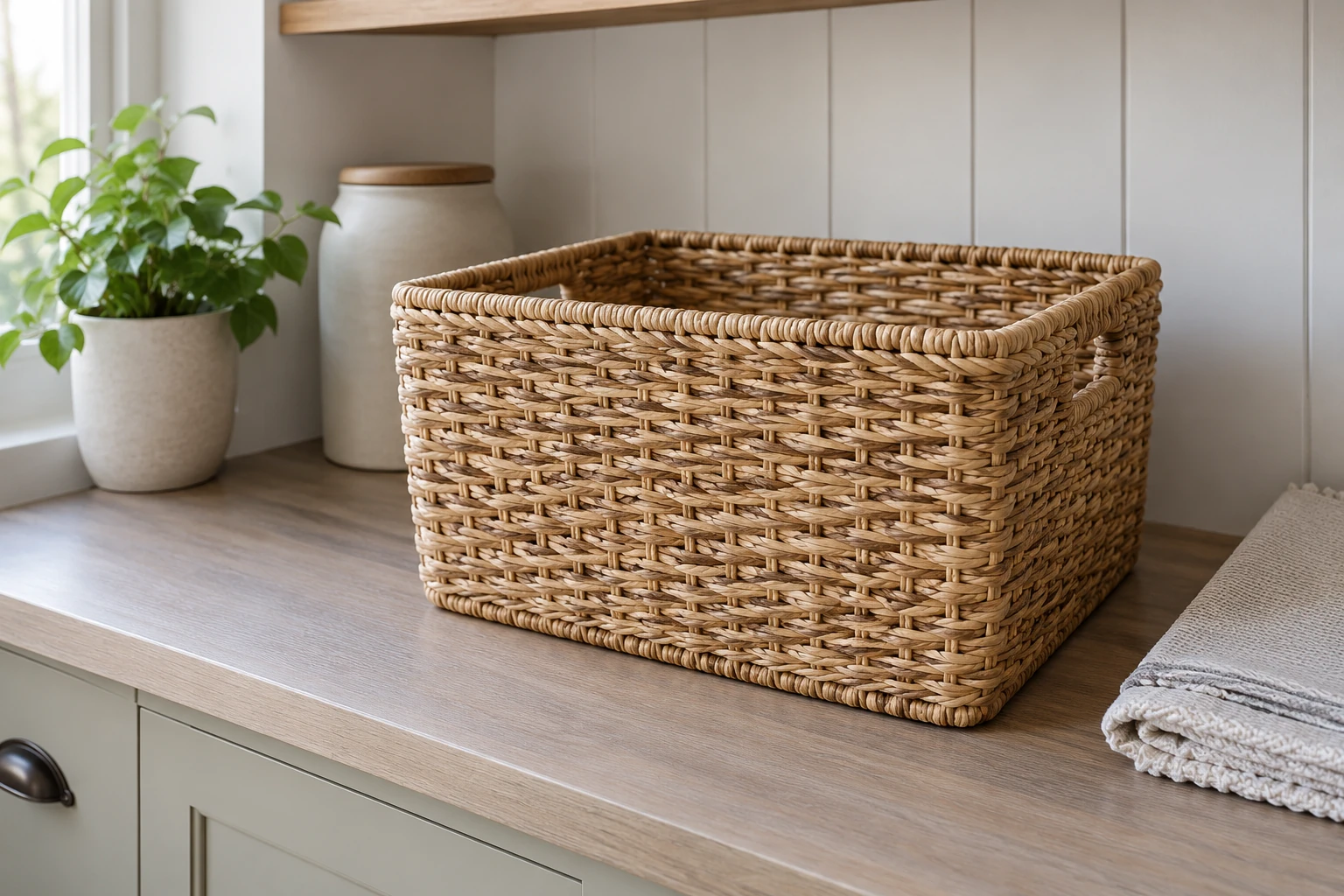
Choose a woven basket’s housekeeping route before assigning it to a routine that washes every container the same way. The basket may suit the intended storage appearance while its actual care guidance leaves the proposed wet-cleaning task unsupported. Resolving that mismatch at handover avoids asking the next person to invent a treatment.
Begin with the approved basket and an honest description of the work around it. The useful decision is whether the intended storage task and cleaning routine can be supported together, or whether the routine, assignment or product choice needs to change.
Describe the routine as an actual task
Ask the household or housekeeping recipient what happens to the container in normal use. What articles are stored? Are they returned dry, or is the basket expected to receive damp items? Does the existing process wipe each container, rinse it or soak it? Record the proposed actions without assuming the basket can undergo them.
Keep storage and cleaning as separate questions. A basket intended to hold folded items is a different assignment from one used to collect items awaiting washing. Even when both sit in the same room, the contents and expected handling can differ. Name that difference so the product owner can answer the real requirement.
A phrase such as “bathroom basket” supplies too little information. It can describe a room-styling choice, dry storage or a wet-use expectation. Do not infer suitability from the room label or from a catalogue photograph in a similar setting.
Read care for the finished construction
Use the exact basket variant’s current instructions. Keep any lining, frame, surface finish or other relevant component tied to the actual supplied construction. A description of the visible weave alone may omit parts that belong to the finished product being handed over.
IKEA’s BRANÄS 001.384.32 page lists rattan with lacquer, a wood frame and other components, and specifies cleaning with a dry cloth. This named example illustrates whole-product construction and a bounded care direction. It does not establish washability, wet-laundry suitability or a care method for another woven basket. BRANÄS materials and care
Read any conditions with the instruction rather than shortening it to “wipe clean.” If the actual source specifies dry care, the word dry matters when the receiving team proposes a wet routine. Conversely, do not invent a prohibition or treatment for a different product whose applicable guidance has not been obtained.
If the label and seller’s message conflict, request clarification for the finished basket. “Natural material” and “easy to clean” are not sufficiently precise answers to a question about soaking the supplied article. Keep the task unresolved until an applicable source addresses it.
Decide which part of the assignment can change
There are three practical directions to consider when care and workflow do not match. First, ask whether the housekeeping owner can accept a routine that follows the actual product guidance and still meets the purpose of the assignment. That requires an explicit decision; the buyer should not silently remove a required task from someone else’s workflow.
Second, consider a different assignment for the basket, with its own reviewed contents and care expectations. Moving a basket from one room label to another does not by itself resolve wet-use assumptions. State the proposed new task clearly and obtain the applicable product answer where needed.
Third, retain the required housekeeping process and seek a different product with evidence for that task. This is a product-selection decision. A basket chosen for its appearance does not have to be forced into a process that its information cannot support.
If no supported combination is available, keep the assignment pending. There is no need to try the disputed process on a sample merely to complete the handover. Any separate assessment would need an appropriate scope and authorization; this article does not supply a trial method.
A routine-to-basket worksheet
Use this original editorial worksheet with the person responsible for the actual housekeeping job. It compares tasks and supported information rather than grading weave appearance or counting supplied parts.
| Assignment question | Actual information to record | Decision the answer supports |
|---|---|---|
| Which finished basket? | Model, variant, construction and matched care source | Whether the instruction belongs to the supplied article |
| What will be stored? | Intended articles and their expected condition on return | The real dry-use or wet-use question to ask |
| What routine is proposed? | Named cleaning actions expected by the recipient | Whether the care requirement is fully described |
| What does the applicable guidance permit or require? | Complete relevant wording with its qualifications | The product-specific boundary for the proposed task |
| Where is the conflict? | Exact action or use assumption not supported | A targeted supplier or manufacturer question |
| What may change? | Routine, storage assignment or product, subject to the responsible decision | Available alternatives without improvised treatment |
| What is handed over? | Selected task, matched guidance and any unresolved limit | A usable instruction scope for the recipient |
Do not replace the conflict row with “care checked” while the recipient still expects a different process. Record which choice resolves the mismatch and which questions, if any, remain outside it.
Fictional decision: a soaking routine meets a dry-care basket
In a fictional household project, basket W6 is selected for a storage station. Its actual matched guidance calls for dry-cloth care. The housekeeping plan expects all containers at that station to be soaked after use. The basket reference, setting and replies are invented; this is not a report about the named retail product.
The buyer identifies the conflict before assigning W6 to the station. The cleaning source and the routine are both understandable, but they do not describe the same task. The handover therefore cannot say the station is ready under its existing process.
One suggested solution is to add a removable liner and keep the soaking instruction. No applicable evidence has been provided for the changed assembly or for soaking the outer basket. The buyer leaves that suggestion unresolved. A new inner layer does not supply missing guidance for the whole construction.
The housekeeping owner then confirms that soaking is an essential part of this particular station’s requirement. The buyer retains that requirement and seeks another product whose actual guidance can be reviewed against it. W6 is not assigned there, and no wet-cleaning experiment is performed.
In another possible outcome, the owner could accept a different, product-supported care routine that still meets the station’s purpose. That decision would need to be recorded explicitly with W6’s task and guidance. It should not be inferred from silence or from a preference for the basket’s appearance.
A proposed move of W6 to dry storage elsewhere remains a new assignment to review, not an automatic approval. The useful result is a resolved choice about the station and a clear status for W6, with neither its limits nor the housekeeping requirement concealed.
Keep the limits useful during everyday handover
Give the recipient the selected task and the complete matched guidance together. Include any instruction needed to keep the basket out of an unresolved routine in the buyer’s task record, without attaching improvised labels or making product claims. A new cleaning request should come back to the same product-specific question.
Do not add claims about mould resistance, sanitation, humidity tolerance, liner performance or handle loads to make the care route sound more complete. Those are separate matters requiring relevant evidence. Arrival appearance and delivered assembly form also remain separate from permission to undertake a cleaning task.
For category context, see Homeware baskets and storage. A Homeware sourcing enquiry can describe the exact basket, intended contents and proposed routine using a supported link, concise text or images. Ask what product-specific information and coordination are actually available. The first useful answer is whether the real housekeeping assignment can be supported, and what must change if it cannot.
Frequently asked questions
How do I choose a woven basket housekeeping route?
Identify the finished basket, expected contents and actual cleaning actions, then compare them with its matched care guidance. Decide with the housekeeping owner whether a supported routine can meet the assignment. If it cannot, consider a reviewed change of assignment or product rather than inventing a treatment.
Can a dry-care basket use the same soaking routine as other containers?
Where the actual applicable guidance calls for dry care, do not treat a general soaking workflow as an established method for that basket. Ask the responsible owner to resolve the conflict. If soaking is essential to the task and no applicable support exists, keep that assignment pending and seek a product that can be reviewed against it.
Does adding a liner resolve a basket cleaning conflict?
A liner introduces a different component or assembly to review. Its presence does not supply care permission for the outer basket, establish wet-use suitability or validate soaking. Obtain the relevant product-specific answers for the proposed combination, or leave the suggestion unresolved. Do not improvise a liner treatment to close the handover.
Can I move the basket to another room instead of changing the routine?
A different room may offer a different assignment, but the room name alone does not answer the product question. State the new contents, their expected condition and the proposed care routine, then obtain the applicable answer. Preserve any unresolved wet-use assumption rather than carrying the previous basket approval into a new task.
Sources
Discuss a sourcing request related to this article.Woven Basket Handover: Match the Housekeeping Routine