
Nonstackable Drinking Glasses: Reject the Nested Pack Premise
Use the exact glass model’s no-stacking instruction to reject a conflicting nested layout and request an individual-position proposal.
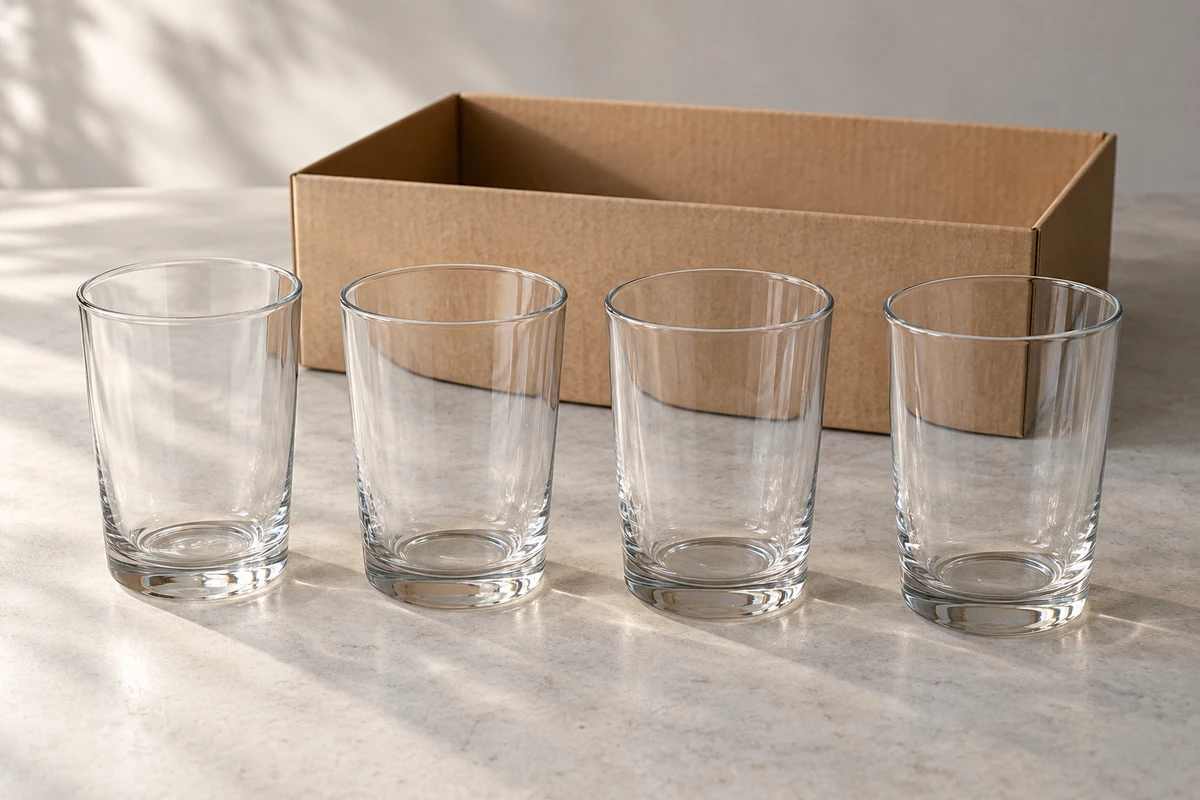
When the exact drinking-glass model says it is not designed to be stacked, reject a packing proposal that nests those glasses together. Do this before comparing the proposed carton’s compactness. The product instruction is the starting constraint, not a question to settle by trying the arrangement.
The next useful request is an individual-position alternative for the actual glasses, with protective details still subject to responsible review. This is a packing-layout decision. It does not diagnose arrival damage or calculate savings from a smaller box.
Read the instruction for the selected glass
Confirm the full model reference and the applicable manufacturer guidance. Similar-looking tumblers can have different intended relationships, so keep the instruction attached to the exact product in the approved assortment.
IKEA’s named POKAL glass 102.704.78 is described as not designed to be stacked. Its page also warns against using damaged, scratched or chipped glass. These are bounded statements for that model, not a finding about the condition of another seller’s goods. POKAL product guidance
If the supplier’s drawing shows one selected glass inside another, identify the conflict directly. Do not soften it into a request for a better-looking nested sketch or a thicker sheet between the glasses. Those changes do not resolve permission for the underlying relationship.
Separate three different cases
A clear prohibition, missing guidance and positive model-specific permission are different evidence states. Keep them distinct in the comparison rather than treating every uncertainty as approval or every glass as universally nonstackable.
| Exact-model evidence | Proposed relationship | Buyer response |
|---|---|---|
| Applicable instruction prohibits stacking | One glass nested inside another | Reject that premise and request a permitted alternative |
| Applicable guidance is missing or unclear | Nesting proposed | Keep permission unresolved; obtain the exact product answer |
| Another model is described as stackable | Selected model’s guidance unchanged | Do not transfer the other model’s permission |
| Individual positions proposed | No nesting in the represented layout | Review the complete support/contact/protection proposal separately |
This decision can be made from the instruction and proposal without physically stacking the glasses. Do not touch rims together, force a fit or conduct an improvised impact or heat exercise.
Request individual positions without prescribing a cell design
Ask the packaging owner to show each glass in a separate proposed position, including the actual rim, body and base. The point is to remove the prohibited nested relationship from the proposal. It is not to select a universal divider arrangement or separator thickness.
A top view of circles may omit the glass profiles and their relationship to the surrounding pack. Request the relevant profile or section information so the owner can evaluate the intended support and contacts. Keep unknown dimensions unknown rather than estimating them from perspective images.
Do not approve a material because it appears soft, thick or clean in a picture. Exact material identity and applicability to the actual glass and intended conditions remain separate questions. Nor does a row of individual positions prove retention or transit performance.
Use a restriction-to-proposal worksheet
| Worksheet field | What to record |
|---|---|
| Exact glass | Model and variant tied to the approved order |
| Applicable instruction | Source, relevant restriction and applicability |
| Conflicting proposal | Exact layout revision and the prohibited relationship shown |
| Required revision | Individual-position or other explicitly permitted alternative to be supplied |
| Revised geometry | Rim, body, base and surrounding pack in the proposed state |
| Outstanding evidence | Support, materials, protection and responsible owners |
| Change trigger | New model, changed guidance or changed relationship requiring review |
Write the immediate decision plainly: “Nested proposal rejected for this model because it conflicts with the applicable instruction.” Keep the later decision separate: “Individual-position proposal received; protection review pending.” This prevents a resolved handling conflict from becoming an unqualified pack approval.
A fictional smaller inner pack
Suppose a fictional packer proposes placing two glasses of model G-N inside one another to reduce the apparent inner-pack outline. The approved model reference includes a no-stacking instruction. All names and observations in this example are invented.
The buyer should reject the nested premise and request separate positions. There is no need to test whether the two glasses happen to fit. A successful-looking trial would not supply authorization and would not prove the arrangement protective.
Revision I gives each glass its own position but leaves the glass profiles and proposed support unspecified. I has addressed the nesting relationship at the level shown, while leaving the protective design incomplete. Ask for the complete proposal and the packaging owner’s applicable review rather than marking I “safe.”
Now suppose the packer suggests another model, G-S, advertised elsewhere as stackable. That is a product substitution, not a packing clarification for G-N. Return it to the buyer’s product-selection process. Do not swap models or carry the old approval into the new assortment simply to preserve a compact proposal.
The outcome for the original order is a permitted layout candidate for G-N, with the precise remaining evidence recorded. No breakage rate, cost saving or transport result is assumed.
Keep condition concerns out of improvised packing work
If damaged, scratched or chipped glass is identified during an authorized review, stop the proposed handling and refer it to the responsible owner. Do not use a suspect piece for a trial or treat packing changes as a repair. The exact product’s warning and the actual condition record belong together.
This article does not define a batch acceptance rate or infer that damage is present. Its focus remains the conflict between a proposed relationship and a product instruction. Receiving decisions need their own actual evidence.
Send the restriction with the enquiry
Use Homeware kitchenware for category context. In a Homeware sourcing enquiry, identify the selected glass, the applicable instruction and the proposal that conflicts with it. Request an individual-position alternative and confirmation of the available packaging-review scope.
The form supports eligible marketplace links, descriptions and supported images, rather than PDF/CAD/ZIP uploads. The enquiry does not authorize a new glass model, promise a test result or release a shipment. Keep the specific layout restriction visible until the selected proposal actually answers it.
Frequently asked questions
Can I try nesting nonstackable glasses to see whether they fit?
No. When the exact model’s instructions prohibit stacking, do not perform a trial to see whether the restriction matters. Reject the conflicting nested premise in the proposal and request a permitted alternative. A compact-looking fit would not override the instruction or establish protection.
Does adding a separator override a no-stacking instruction?
No. An unspecified sheet or sleeve does not cancel the exact product’s handling restriction. The first question is whether the proposed glass relationship is allowed at all. Ask for an individual-position alternative without choosing a separator thickness or claiming it makes a prohibited arrangement acceptable.
What should an individual-position proposal show?
Show each actual glass in its own proposed position, with the complete rim, body and base relationship to the surrounding pack represented. Ask the responsible packaging owner to resolve support, material compatibility and protection evidence. Separate positions answer the nesting conflict only; they do not constitute a transit pass.
Can packing permission transfer to a similar-looking glass?
No. Keep each model’s instruction and applicability separate. A stackable description for another product does not amend the selected glass’s restriction, and an absent instruction does not establish permission. If the model changes, obtain the new exact guidance and reopen the relevant layout questions before reusing the decision.
Sources
Discuss a sourcing request related to this article.Nonstackable Drinking Glasses: Reject the Nested Pack Premise