
Check Both Towel Faces Before Judging the Delivery
Confirm the towel’s intended two-face construction, then assess local loops and hems separately without inferring absorbency or fabric composition.
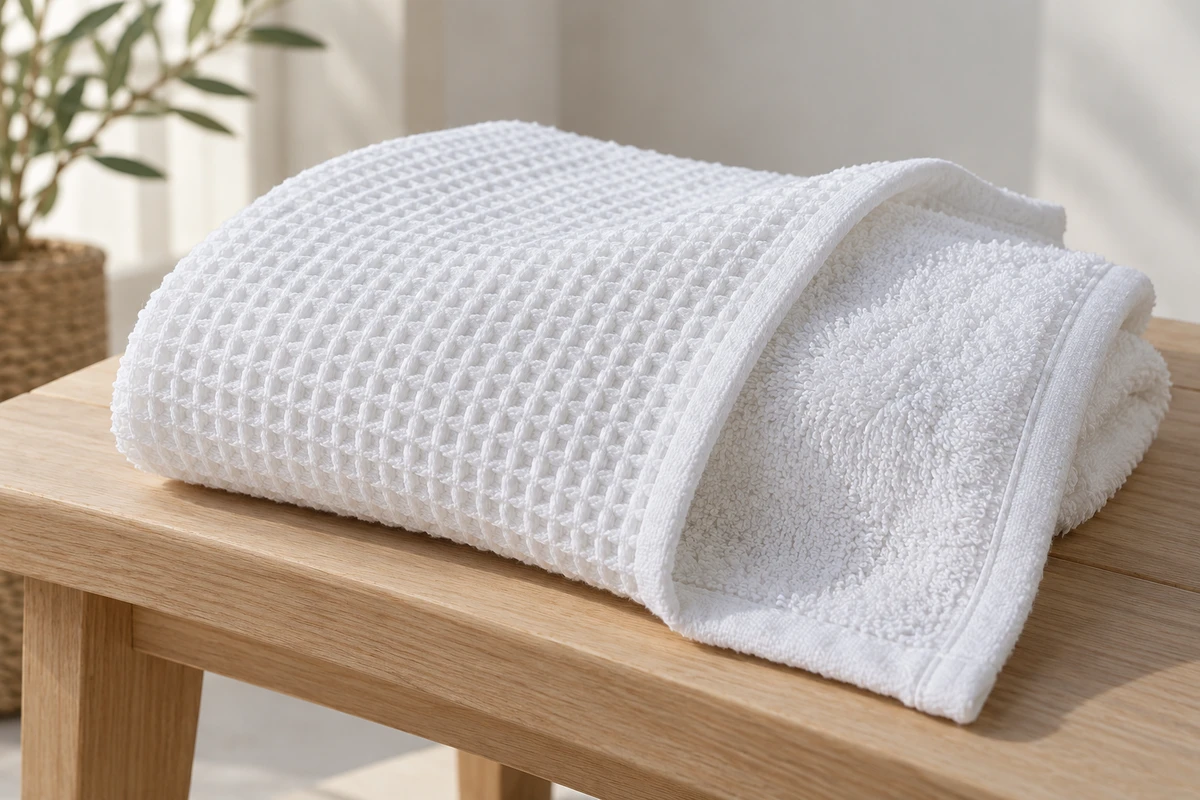
A towel with two visibly different faces may have arrived exactly as ordered. Check the approved construction before calling a waffle-like face and a looped face inconsistent. Then look separately at localized loop and hem condition: an intended face difference does not answer whether a particular edge has arrived with an open section.
The receiving decision is whether the reviewed towel has the specified face arrangement and visible finish. It does not establish absorbency, fibre composition, fabric weight or how the towel will behave after washing. Keep the towel in its as-received condition while those questions are distinguished.
Find the reference for both faces
Use the exact towel variant and construction reference approved for the order. Identify the expected appearance of each face, any border arrangement and the specified edge finish. A presentation image of a folded towel may show only one surface, so ask for the other face if the reference is incomplete.
IKEA’s SALVIKEN bath towel gives a concrete manufacturer example: its product details describe a waffle-structured face and a terry face. That contrast is part of the named product’s design. It does not identify another supplier’s towel or prove the absorbency of a towel with a similar appearance. IKEA SALVIKEN construction details
For your own receipt, distinguish supplier terminology from what can be seen. If the order uses the terms waffle and terry, preserve them as the specified construction and describe how the visible faces compare. If the order is vague, do not fill the gap by declaring a structure from a distant image. Ask the supplier to identify the intended arrangement for that variant.
Map the two views to one towel
Give the reviewed towel an external receiving identifier and keep it with both face views. Use stable names, such as “face A: specified waffle” and “face B: specified terry,” instead of “front” and “back” that may reverse between photographs. Do not mark the towel itself merely to make the report easier.
Where ordinary handling is permitted, view each face without stretching the fabric or pulling loops. Record whether the whole face follows the expected pattern and whether a particular region differs. Keep the orientation understandable by identifying a consistent edge or corner in the image sequence.
An overview and a local view answer different questions. The overview connects the appearance to the towel’s construction. The close view locates a specific loop or hem concern. A photograph of one attractive folded edge cannot establish the state of the unseen face or of hems hidden inside the fold.
If the receiving scope permits only a packaged view, say so. Do not describe hidden faces as checked, and do not open a retail pack simply because a general checklist mentions both sides. Request authorization or another agreed evidence route for the missing view.
Distinguish a whole-face design from a local discrepancy
An intentional two-face design repeats its expected construction across the relevant face. A localized irregularity needs its own location and description. Compare that region with the approved construction rather than allowing either observation to determine the other.
For example, the buyer may record that face B has the expected visible looped appearance overall, while a particular loop near one edge appears longer than its neighbours. That local observation does not prove its cause or establish a durability result. Conversely, a looped face that matches the reference should not be rejected merely for looking different from the specified waffle face.
Keep an unexplained whole-face change visible as a configuration question. If the order specifies waffle on one face and terry on the other but the supplied evidence appears to show the same construction on both, first confirm that two different face views were actually provided. If they were, ask for clarification of the received variant. Do not treat a duplicated photograph as proof of a product substitution.
Colour or light reflection can also distract from the structural question. This review is about the approved face construction and local finish; it is not a colour-lot assessment. If colour is disputed, retain that question separately instead of changing the construction finding to accommodate it.
Review hems without turning a concern into a test
Observe accessible hems and corners in the towel’s ordinary relaxed state. Locate a visibly open section, loose-looking thread or other difference from the approved finish. Specify which edge and where along it the concern appears so it can be found again without tugging on the fabric.
Do not pull a thread to see whether stitching unravels, stretch the hem, trim a loop or sew an opening closed. Do not wash, soak, rub or perform a lint or absorbency experiment as part of the receiving comparison. These actions introduce a changed condition or an unagreed test rather than clarifying what arrived.
A thread end and an open hem are not interchangeable descriptions. If the image only shows a thread, record that limited observation. If it shows a gap in the folded edge, describe the location and the visible gap without diagnosing the stitching process. Let the responsible reviewer apply the agreed finish requirement.
Use a two-face and edge worksheet
Enter the towel identity, approved construction reference and observation scope before completing the sheet. This original worksheet organizes a visual receiving decision; it supplies no defect tolerance, sample size or performance method.
| Field | What belongs in the entry | Decision it supports |
|---|---|---|
| Towel and construction reference | Exact received variant and approved two-face description | Are the correct goods and reference being compared? |
| Face A observation | Whole-face view, expected structure and any localized difference | Does this face match its specified role? |
| Face B observation | Separate view linked to the same towel | Is the second intended construction actually represented? |
| Local loop condition | Identified region and visible observation without pulling | Does a local concern need clarification or a hold? |
| Hem and corner condition | Edge location, accessible view and apparent opening or other difference | Does the finish match the agreed reference? |
| Whole-face versus local decision | Which design question is resolved and which local question remains | Prevent one finding from clearing or condemning the other |
| Unproven performance claims | Absorbency, fibre, fabric weight and care behaviour still requiring evidence | Stop appearance findings becoming unsupported sales claims |
Keep unviewed areas explicit. “Both face constructions match in the reviewed views; one hem concern remains open” gives the buyer a more useful result than either “towel passed” or “faces inconsistent.”
A fictional towel with the right faces and an open hem
Imagine fictional towel T3 supplied against construction reference C2. C2 specifies one waffle face, one terry face and a continuous finished hem of the approved form. Ordinary permitted views show both expected face constructions. A local view also shows an open section along one short edge. This is an invented receiving example, not a report about IKEA or a real supplier.
Record two separate outcomes. The visible face arrangement matches C2 in the reviewed scope. The edge-finish question remains held because of the identified open section. Neither outcome says whether the towel absorbs water well or survives its claimed care cycle.
Suppose the supplier responds that different textures are normal for this design. The buyer can agree with that explanation of the faces while asking the supplier to address the hem. A useful reply identifies T3, the short edge and the image showing the opening, then requests a proposed resolution against C2.
If the supplier offers a replacement, record that proposal separately. The received T3 remains associated with its original observation. Any replacement needs its own identity and applicable review, including both faces and the affected finish requirement. A new folded product photo is not evidence that the hem question has been closed.
Keep the final decision at the level the evidence supports
Do not infer fibre or GSM from hand feel, apparent thickness or a construction name. If these properties, absorbency or care performance matter to the purchase, request the appropriate product-specific evidence and a separately agreed assessment. This article supplies no home experiment for establishing them.
For wider buying context, see Home textiles. In a Homeware sourcing request, state the approved two-face arrangement and the specific local discrepancy, with a supported product reference, text or image preview. Clarify the scope of any additional receiving work. The useful result is a towel-specific decision that recognizes the intended design while keeping its unresolved edge or loop condition visible.
Frequently asked questions
Should a waffle face and a terry face look the same?
Only the approved construction can answer what each face should look like. Some named towels intentionally have those two different faces. Compare the received towel with its own specification rather than a general expectation of symmetry, and keep any local loop or hem discrepancy as a separate question.
Can I judge absorbency from a thick or fluffy-looking face?
No. This visual comparison addresses construction and local condition, not absorbency. Apparent thickness and hand feel do not establish fibre composition or GSM either. Request evidence tied to the actual towel and have any required performance assessment agreed separately; do not improvise a soaking or washing test during receiving.
What if the supplier sent two pictures but I cannot tell whether both faces are shown?
Ask for clearly identified face views tied to the same towel and variant. Two photographs may show the same face in different folds or orientations. Until their identities are clear, keep the missing-face question open rather than calling the product correct or accusing the supplier of changing its construction.
Can a small hem opening be ignored if the rest of the towel matches?
Apply the actual agreed finish requirement and obtain a scoped decision about the identified opening. An otherwise matching construction does not resolve that local issue. Preserve the visible condition without pulling, trimming or sewing it, and keep any proposed repair or replacement separate from the original receiving observation.
Sources
Discuss a sourcing request related to this article.Check Both Towel Faces Before Judging the Delivery