
Check Drawer-Organizer Adjustment and Closing Clearance
Observe the delivered organizer at its agreed setting, including movable parts, then resolve empty-drawer clearance without force or modification.
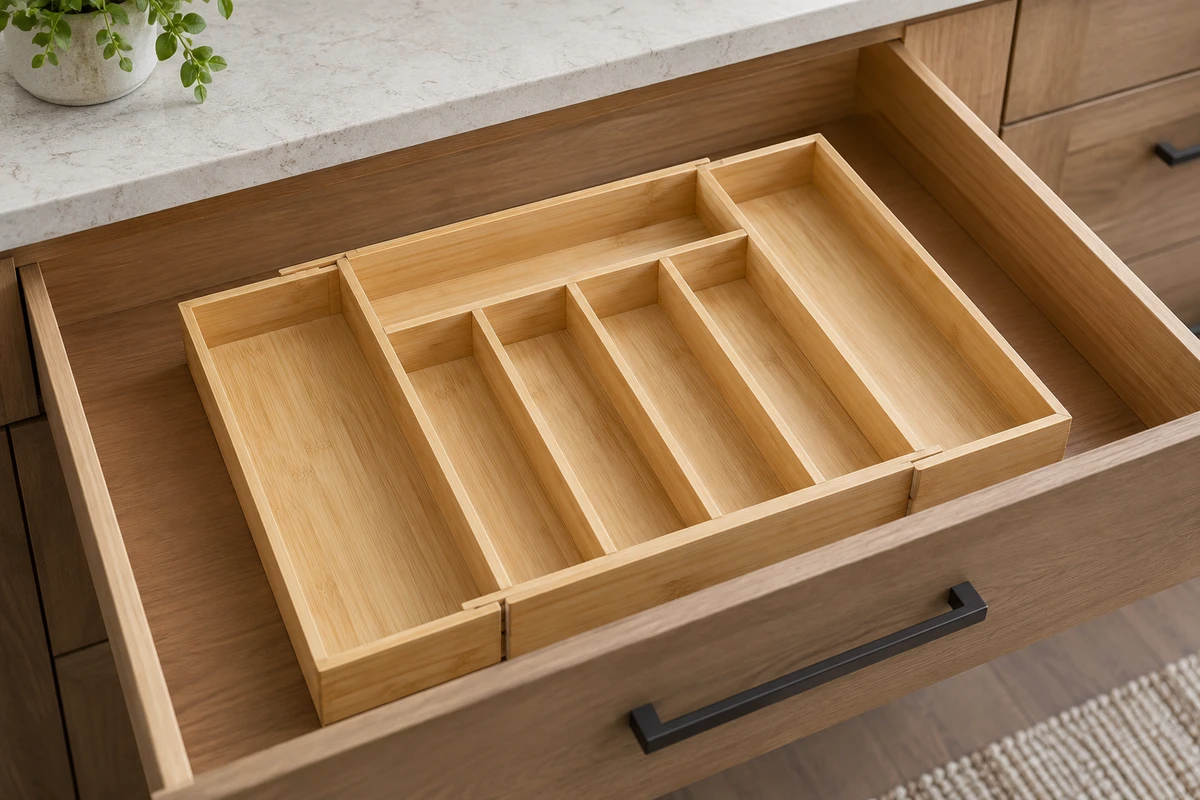
A received expandable drawer organizer needs two separate answers: can it reach and retain the agreed ordinary setting, and can the intended drawer close with that empty configuration in place? Width adjustment alone cannot answer either the position-retention question or the clearance above the tray.
Start with the identified organizer, its supplied movable parts and the intended drawer. Leave utensils out of this receiving observation. The goal is to resolve adjustment and empty closing clearance without forcing the mechanism, altering the cabinet or turning a household fit observation into a durability claim.
Establish the setting the buyer actually approved
Find the agreed working configuration rather than opening the organizer to its maximum span for a photograph. Record the direction of expansion, intended orientation in the drawer and position of any movable dish. If the purchase specifies an intermediate setting, that is the position that needs an answer.
Confirm the drawer reference. Two drawers within one kitchen can have different internal details, and the cabinet’s nominal width does not describe the available space above the organizer. Use the intended drawer in its normal assembled state. Do not remove runners, adjust cabinet hardware or take the drawer apart to accommodate the received tray.
Compare the organizer’s accessible model reference and supplied parts with the approved version. A missing dish, changed divider or different adjustment arrangement may alter the configuration even when the nominal expanded width remains the same. Ask for clarification before quietly borrowing components from another unit.
Understand how the supplied adjustment is meant to work
Joseph Joseph’s DrawerStore expandable cutlery tray, gray model 85042 provides a useful named example. Its description identifies two adjustable halves that lock together and a movable storage dish. Its compact and expanded specifications change width while leaving the listed depth and height unchanged. Those are features of that model, not evidence of how a different delivered organizer adjusts or retains its position.
For the received product, read its own instructions and identify the intended adjustment and retention features. Do not infer a hidden lock from a similar catalogue photograph. If the instructions describe a particular order for releasing, moving or engaging a component, follow that order only within ordinary permitted handling.
If the design is unfamiliar, damaged or resistant to the expected action, stop and request the correct instructions. Pulling the halves apart, pressing tabs of uncertain purpose or adding lubricant would change the received condition. An unresolved mechanism is a useful receiving finding; there is no need to force a complete demonstration.
Observe the selected position without challenging the mechanism
For an intact, safe-to-handle organizer, move the adjustment through the normal action needed to reach the approved setting. Observe whether the described retention arrangement engages and whether the parts remain in that setting during ordinary placement as instructed. Keep the wording limited to those actions.
For example, “halves return toward the compact position during normal placement” describes an event. “Lock too weak” attributes a cause and a performance threshold that have not been established. Where the reason is unclear, request the supplier’s explanation or an appropriately scoped assessment.
Do not pull against the engaged mechanism, add weight or repeat cycles to see when it slips. This article supplies no holding-force value, cycle count or service-life criterion. A position observed to remain in place during one ordinary placement does not establish long-term retention under loaded use.
An organizer that reaches the desired width only while held by hand leaves its free-standing configuration unresolved. Record the setting and the point at which it changes. Do not use the drawer sides as an improvised clamp unless the actual product instructions specify that arrangement and it matches the order.
Include the movable dish in the clearance question
Put any supplied movable dish or insert in the approved, instruction-permitted position. Note whether it sits as intended before considering drawer closure. A dish perched on a divider or placed in a different location can change the observed height and obscure the real question.
Record any allowed alternative separately. Removing a dish may create a lower arrangement, but if that dish was required in the working layout, its removal changes what is being accepted. The same applies to rotating the organizer: the adjustment direction, depth and access no longer describe the original arrangement.
Keep the tray empty. Loaded utensil layout is a later, separately defined use question. This narrow observation does not prove that tall utensils, handles or other contents will clear the drawer above, even when the empty organizer does.
Approach normal closure only while the path is clear
Before attempting ordinary closure, look for obvious interference between the organizer’s fixed depth, raised features and the drawer’s accessible boundaries. If a part already projects into an obstructed path, record that conflict without advancing the drawer to demonstrate contact.
Where placement and the visible path are unobstructed, use the drawer’s ordinary closing action. Stop at the first unexpected contact or resistance; never push past it. Identify the apparent location from a safe, accessible view, without reaching into a narrowing gap. If the cause cannot be seen, state that rather than repeatedly closing to reproduce it.
Separate the possible outcomes. The organizer can hold its chosen width yet leave insufficient vertical clearance. It can also clear the drawer while failing to retain its agreed configuration. Both observations matter to the requested combination. An empty drawer closing normally does not certify cabinet installation, structural strength or loaded operation.
A setting and clearance worksheet
Use this original editorial worksheet for one identified drawer and organizer combination. It contains no universal tolerance or test method. Attach the product instructions and references already applicable to the purchase; no new document is assumed to exist.
| Question | Observation or reference to enter |
|---|---|
| Which drawer? | Intended drawer reference and relevant accessible interior boundaries |
| Which organizer setting? | Delivered model, orientation and approved working position |
| How is position retained? | Instruction-described arrangement and ordinary engagement observation |
| Where is the movable dish? | Required location, seating and any alternative kept separate |
| Does the configuration stay in place? | What happened during ordinary instructed placement, without applied test load |
| Is empty closure unobstructed? | Normal closure observed, visible obstruction before movement or stopping point |
| What decision remains? | Missing instructions, unexplained setting change, clearance mismatch or named alternative |
Use “not observed” where handling stopped. An incomplete observation does not become a defect diagnosis, but it also cannot support acceptance of a question the buyer still needs answered.
Fictional example with a correct width and a raised dish
A fictional retailer receives organizer O4 for drawer D2. The approved arrangement includes a movable dish in the rear section. O4 reaches the agreed width and its described retention feature engages during normal placement. All identifiers, observations and replies in this example are invented.
With the dish in the approved position, its upper edge visibly projects into the clearance occupied by a cabinet crosspiece. The receiver records that interference before trying to close the drawer. No contact force, loading or repeated cycling is needed to explain the unresolved fit.
The fictional supplier replies that O4 fits the drawer’s width. That confirms only the dimension already answered. The buyer sends the dish-position reference and the safe side-view observation, asking whether the supplied dish is the approved component and whether the stated configuration was considered for D2’s available height.
Suppose the supplier proposes moving the dish to a lower permitted location. The buyer first decides whether that arrangement still serves the intended layout. If it does, an authorized ordinary placement and empty closure observation can address the alternative. Keep that result under its own configuration reference instead of rewriting the original one.
If no permitted arrangement answers the approved layout, the buyer can seek a different organizer or the agreed remedy. Cutting the dish, removing cabinet parts or forcing the drawer would transfer an unresolved product-fit question into an unauthorized modification.
Ask for the missing configuration answer
A specific receiving note helps the supplier distinguish unclear instructions, wrong components and a genuine layout mismatch. Ask for the exact model and permitted configuration in its reply. An assurance that the product is adjustable does not answer where the dish sits or whether the empty drawer can close.
For broader selection context, see baskets and storage. Describe the drawer, intended setting and unresolved observation through the homeware sourcing page, with any actual inspection or reporting scope agreed separately. The form accepts supported marketplace HTTPS links, descriptions of 8–1200 characters, or up to five PNG, JPEG, WebP or GIF images, capped at 10 MiB each and 20 MiB total. Arrange longer instructions or other file types through a separate agreed exchange.
Frequently asked questions
Can I accept an organizer because it reaches the ordered width?
Width is one part of the configuration. Confirm how the supplied design retains the selected position during ordinary instructed placement, then consider fixed depth, raised components and empty-drawer closing clearance. Keep unanswered questions open. Reaching the width while someone holds the halves apart does not establish the intended retained configuration.
How should I record an adjustment that moves back during placement?
Describe the setting, the normal action being performed and the observed movement. Do not turn that into an unsupported holding-force or durability diagnosis. Check the applicable instructions and ask the supplier for a model-specific explanation. Pulling against the lock, adding load or repeatedly cycling it would be a different assessment outside this receiving observation.
May I remove the small dish to make the drawer close?
First check whether that is a permitted product configuration and whether the buyer accepts the changed layout. A required dish belongs in the original observation. If removal or relocation is approved, retain it as a separate configuration and review the relevant empty fit again. Do not present the altered tray as fulfilment of an unchanged requirement.
What does an unobstructed empty-drawer closure establish?
It supports only that observed combination of drawer, organizer setting and movable parts without contents. Utensils may introduce different height or layout questions. The observation also supplies no cabinet-installation approval, structural assessment, load capacity or long-term retention result. Identify any further use questions separately rather than extending the empty result.
Sources
Discuss a sourcing request related to this article.Check Drawer-Organizer Adjustment and Closing Clearance