
Expandable Drawer Organizers: Choose the Supplied Pack State
Compare compact and adjusted organizer packs, account for the movable dish, and define the permitted transition from the supplied state.
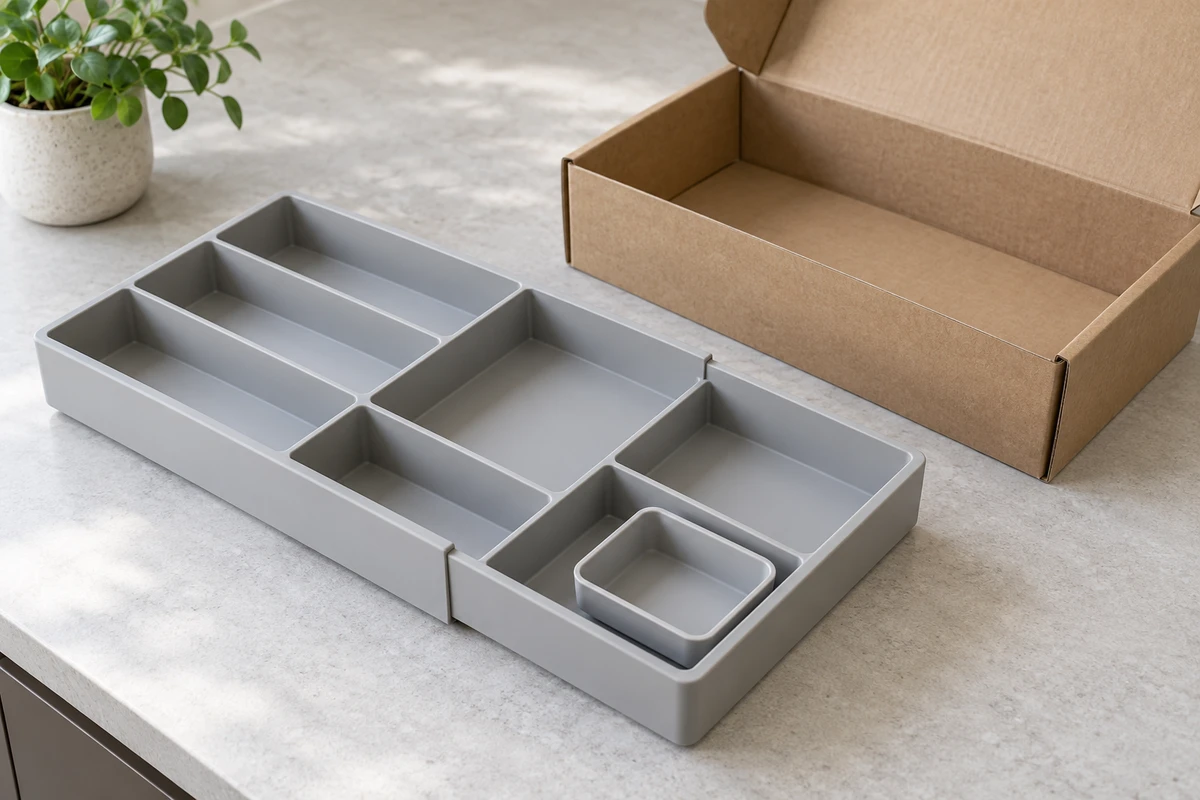
An expandable drawer organizer can arrive contracted, adjusted, or in another manufacturer-supported configuration. Choose the supplied state deliberately. The pack needs to account for the moving halves and any movable dish, then explain how the recipient reaches the ordinary unpacked configuration without an improvised adjustment.
Begin after the organizer model and intended drawer fit have been selected. Recalculating drawer width will not answer whether a loose dish belongs under the contracted tray or how the packaging relates to the adjustment path. Those are different decisions, and the packing proposal should make them visible.
Identify what moves and what remains connected
List the fixed tray features, adjustable sections, removable accessories actually included, and any connection that the product instructions require to remain intact. Use the exact model reference. A similar-looking organizer may have a different stop, locking arrangement or accessory.
Joseph Joseph’s named DrawerStore expanding organizer describes two adjustable halves that lock together and a movable dish. This illustrates why a rectangular outside outline is incomplete: one accessory has its own supplied position, while the principal tray has an adjustment relationship. The description does not establish a permitted transport configuration for another organizer. DrawerStore product details
Keep “movable” separate from “must be removed for shipping.” Ask the supplier which configuration is proposed and which applicable instruction supports it. If the proposal separates parts that ordinarily remain connected, that change needs an explicit product-owner answer before it becomes a pack instruction.
Compare the supplied states by the work they leave
A contracted proposal may make the package look smaller, but it still needs a defined position for every included part. An adjusted proposal may resemble the intended use state more closely, yet it may leave a different moving interface for the packaging owner to address. Neither visual impression establishes retention or protection.
Compare candidates on the same basis: exact tray, exact dish, allowed adjustment state, packaging relationship, and first recipient action. Avoid comparing the bare contracted tray in one image with a complete wrapped adjusted tray in another.
| Candidate state | Product relationship to show | Recipient question | Packaging question left open |
|---|---|---|---|
| Supported contracted state | Both halves and their connection; dish position | Which documented adjustment follows permitted unpacking? | How is the proposed state retained without an unauthorized product change? |
| Supported adjusted state | Named adjustment position and accessory location | Is further ordinary adjustment expected? | What interfaces need review in this wider state? |
| Unsupported separated or forced state | Missing connection or unexplained part removal | No approved transition supplied | Return the proposal before considering its compactness |
Do not instruct the packer to tape the product, defeat a stop, or squeeze the halves together to obtain an attractive carton size. The responsible owners must select any retention method and its contact basis. Carton dimensions can be compared later for an identified, reviewed configuration.
Give the movable dish its own line
The dish is easy to overlook when the main tray dominates the drawing. Record whether it travels in an authorized tray position or in an identified separate location. Show its relationship to the sliding sections in the proposed state, including anything hidden in a top view.
If the supplier puts the dish beneath the organizer, ask for a view that shows that location rather than assuming an empty underside cavity. If it travels separately, keep the dish associated with the organizer variant after the outer packaging is opened. A general accessories photograph is not a supplied-position reference.
This does not prescribe which location is safer. It creates a complete proposal that a packaging owner can evaluate. Unknown contact, containment or access is an open question, not evidence that the dish is defective.
Record the first transition without creating a new procedure
Attach the applicable product instruction to the proposed unpacking reference. Distinguish removing an approved packaging element from adjusting the organizer itself. The recipient should not have to guess whether an unfamiliar piece is packaging, an included dish, or a required part of the mechanism.
Where a permitted ordinary opening review is available, identify the represented sample and record the state before and after that review. Do not turn it into a lock-force assessment or an attempt to discover how far the halves can move. Stop and refer the issue to the product owner if the proposed transition cannot follow the applicable instructions.
A useful worksheet keeps the supplied configuration and its remaining questions together:
| Field | Record for the exact proposal |
|---|---|
| Organizer reference | Model, variant and product revision |
| Fixed and moving elements | Identified halves, connection and any relevant stop shown in the source |
| Packed adjustment state | Named supported position and permission reference |
| Movable dish | Exact included accessory and its proposed supplied position |
| First transition | Applicable unpacking/adjustment instruction and unresolved distinction |
| Decision limits | Preferred configuration, open retention/contact/protection questions and owners |
A fictional compact tray with an unexplained dish
Suppose fictional organizer O-A includes movable dish D-A. Proposal C shows the main tray in its supported contracted state. The dish is pictured separately below it, but no pack position is assigned. Proposal W shows the tray in a supported wider state with the dish in an identified permitted position. These are invented references and observations, not a real supplier assessment.
The buyer cannot select C simply because its main outline is narrower. C has answered the tray-state question while leaving the supplied dish unresolved. W answers more of the contents-location question, but that does not prove it is better protected or more economical to ship.
Ask the supplier to revise C with a defined dish location and the applicable first-transition reference. Call that revision C2. If C2 now represents all included parts and the buyer accepts the work left to the recipient, it can become the preferred configuration for further packaging review. Keep retention, material contact and transport evidence pending under their own owners.
The outcome is a specific supplied-state choice. It is not a drawer-fit approval, a durability result or a promise that the organizer will arrive ready for every drawer.
Send the configuration question with the product reference
For broader category context, use Homeware baskets and storage. Through the Homeware sourcing enquiry, identify the organizer, included dish, proposed packed state and missing instruction or view. Ask which review work can be provided and agree its scope.
The form supports eligible marketplace links, a written description or supported images. Do not treat it as a PDF, CAD or ZIP upload channel. A sourcing enquiry starts a discussion; it does not approve a pack or authorize an order.
Frequently asked questions
Can an expandable organizer always be shipped fully contracted?
No. Obtain the exact model’s supported adjustment and packing instructions. The smallest advertised width describes a product state only within its stated scope; it does not authorize forced collapse, separating connected halves or shipping in that state. Have the product and packaging owners identify the permitted proposal.
Where should a movable dish travel in the organizer pack?
Give the actual included dish a specific supplied position and containment proposal. It might remain in an authorized location in the organizer or occupy a separately identified position, depending on the model and reviewed pack. A dish shown loose beneath the tray leaves its relationship to the moving halves and the opening sequence unresolved.
Does a compact-pack photograph show how the organizer opens?
A single closed or contracted view does not explain the first permitted transition. Request the matching unpacked-state reference and applicable instructions, keeping any packaging-removal step distinct from adjustment of the product. Do not improvise a pulling method, remove a stop or force the halves when the instructions are missing.
What should reopen a previously selected pack configuration?
A different organizer revision, dish, allowed adjustment state, proposed retention method or unpacking instruction can change the decision. Preserve the prior reference and ask the responsible owners which questions need renewed review. Approval of compactness alone should not be carried over as approval of contact compatibility or transport protection.
Sources
Discuss a sourcing request related to this article.Expandable Drawer Organizers: Choose the Supplied Pack State