
Pack a Pan and Lid with the Knob and Handles in View
Compare pan-and-lid packing proposals with every projection represented, and verify permission before accepting an inverted lid arrangement.
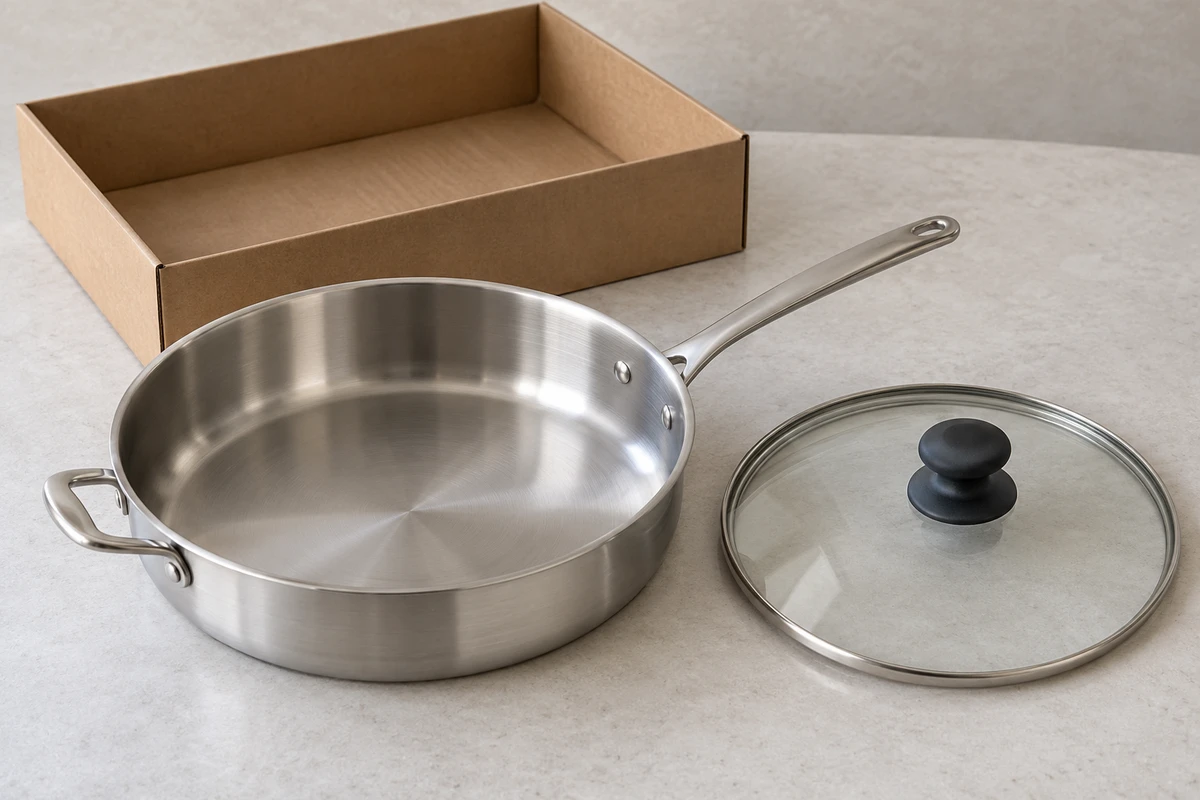
Review a pan-and-lid packing proposal as a complete three-dimensional arrangement. The pan body, projecting handles, lid rim and knob all belong in the decision. A drawing that shows only two circles can conceal the very feature that makes the proposal unresolved.
Begin with the already approved pan and lid pairing. This article chooses a supplied packing configuration; it does not determine cooking suitability, induction performance or whether a different lid fits the pan. Keep those decisions outside the layout comparison.
Establish the exact pair and what is supplied
Record the pan model, the lid model and whether the lid is included in this order or separately purchased. A styled image may show an optional lid beside a pan without making it part of the quoted contents.
Le Creuset’s care-and-use information discusses optional glass lids in particular cookware sections. That makes component scope worth checking, but it does not authorize inverted packing for an unknown pan and lid. Use the exact product’s instructions for your proposed configuration. Le Creuset care and use
Retain the current product and package references. If one proposal uses a knob with a different profile or omits a helper handle, it is not a like-for-like comparison. Resolve that discrepancy before choosing the smaller-looking arrangement.
Draw the features that a top view hides
Ask for the lid knob and rim to appear in a profile of the proposed packed state. Include the pan’s main handle, any helper handle and relevant package boundaries. A circular lid outline lying within a circular pan outline is only a plan relationship; it says nothing by itself about the knob below or above that plane.
The drawing should identify which regions the packaging owner proposes to support and which interfaces remain to be reviewed. Do not infer that the knob is an acceptable support or that the pan coating can contact the lid simply because the parts appear close together.
Use the same proposal reference on the plan and profile. Combining the convenient top view from one concept with the height from another creates an arrangement that nobody actually offered.
Put permission ahead of a smaller outline
An inverted in-pan proposal needs an explicit answer from the responsible product owner. A lid that is intended to seat on a pan during ordinary use is not thereby approved to travel inverted inside it. Packing can create different relationships among the knob, rim, coating and handles.
Where permission is missing, retain the proposal as unresolved on paper and request the applicable instruction or a revised concept. Do not invert a sample, press it into the pan or remove hardware to see whether it fits.
A side-by-side proposal can be considered without making that inversion assumption, but it still needs its own permitted placement and protection review. The decision is between complete proposals, not between a “compact” good option and a “bulky” bad one.
| Proposal | Required product basis | Relationships to represent | Current decision when incomplete |
|---|---|---|---|
| Lid in an owner-authorized in-pan state | Exact permission for that supplied configuration | Knob, rim, inner pan surfaces and projecting handles | Keep pending if permission or any interface is absent |
| Lid beside the pan | Permitted supplied orientation for each intact item | Lid support, pan support, handles and surrounding boundaries | Request missing support/contact information |
| Lid altered to fit the drawing | Applicable instructions and explicit authorization for the change | All separated parts and any approved recipient work | Return unsupported disassembly rather than improvise it |
Use a pan-and-lid proposal sheet
Give each candidate its own row or sheet. Attach the product instruction and the drawing revision, then distinguish the buyer’s preferred arrangement from the packaging owner’s unresolved technical decisions.
| Field | Exact information needed |
|---|---|
| Approved pair | Pan, lid and order inclusion references |
| Supplied orientation | Named state and applicable product-owner permission |
| Lid geometry | Knob profile, rim and both relevant faces in the same state |
| Pan geometry | Body, main handle and any helper handle |
| Proposed support/contact | Identified regions, retained layers and unanswered interfaces |
| Recipient handover | Applicable ordinary unpacking reference; any unauthorized work excluded |
| Decision and limits | Preferred concept, reasons, remaining evidence and responsible owners |
This is an editorial worksheet. It supplies no universal clearance, separator material, compression limit or transport test. Where a safe ordinary mockup review cannot follow the product instructions, stop and return the proposal for clarification.
A fictional drawing with the knob missing
Suppose fictional pan P-C and lid L-C are already approved together. Concept I shows the lid inverted within the pan but represents it as a flat disc. Concept S places the intact lid beside the pan and shows the knob in profile. All references and observations are invented for this example.
The buyer cannot prefer I on the basis of its shorter outline. It has omitted a part of the lid and has not established permission for inversion. Ask the supplier to complete that proposal, including the knob and applicable product instruction, or withdraw it.
S is the more complete candidate for further discussion because its supplied objects are represented. It still leaves the lid’s proposed support and the relationship to the pan handle unresolved. The next request is targeted: show those regions and have the responsible owner review their basis.
If revised S2 provides the missing geometry, the buyer may select its presentation and supplied-state intent while keeping material contact and transport protection open. That is a bounded layout preference. It does not declare S2 safe for transit or establish that I would have damaged cookware.
Avoid turning pack review into cookware modification
Do not solve a drawing conflict by loosening the knob, tightening a screw, bending a handle or asking the recipient to perform an undocumented assembly step. A change to the product’s supplied configuration belongs with the product owner and applicable instructions.
Keep all work cold and within permitted ordinary handling. This article calls for no heating, pressure, impact or handle-loading exercise. If a glass lid is visibly damaged, stop handling it for the proposed review and refer it to the responsible owner; the manufacturer source’s warning about damaged lids is not a repair instruction.
For category context, see Homeware kitchenware. Send the exact pair and the unresolved orientation question through the Homeware sourcing enquiry, using an eligible product link, description or supported image. Ask which checks and evidence can be included in an agreed service scope. The image field is not a PDF/CAD/ZIP channel, and the enquiry does not authorize packing or shipment.
Frequently asked questions
Can I assume a lid may be inverted inside its pan for packing?
No. A matching circular outline does not establish permission to invert the lid or show where its knob, rim and other features would lie. Ask for the exact product owner’s permitted configuration and a complete proposal. Do not try the arrangement physically to discover whether it is allowed.
What should a pan-and-lid packing drawing show?
Show the approved pan and lid references, the lid knob and rim, all projecting pan handles, the proposed support locations and any required protective elements. Use matching plan and profile views when one view hides a relationship. Keep material compatibility and transport evidence as explicit unresolved decisions where they have not been supplied.
Is a side-by-side lid layout automatically safer?
No. It avoids assuming that the lid belongs inside the pan, but it still introduces its own supports, contacts and package boundaries. Compare complete, permitted proposals for the same approved cookware. A larger outline or visibly separate parts is not a substitute for applicable protection review.
Can the lid knob be removed to reduce package height?
Do not remove or tighten a knob simply to make a packing proposal fit. Any supplied configuration involving part separation needs applicable manufacturer instructions and responsible approval for the exact product. If those are absent, request a layout that represents the intact approved lid rather than inventing disassembly or recipient reassembly.
Sources
Discuss a sourcing request related to this article.Pack a Pan and Lid with the Knob and Handles in View