
Mixed-Size Woven Baskets: Cost per Usable Basket
Compare the packed carton quote and post-unpacking inspection for the exact size mix. Use the accepted basket count alongside the cost of protection and any reshaping work.
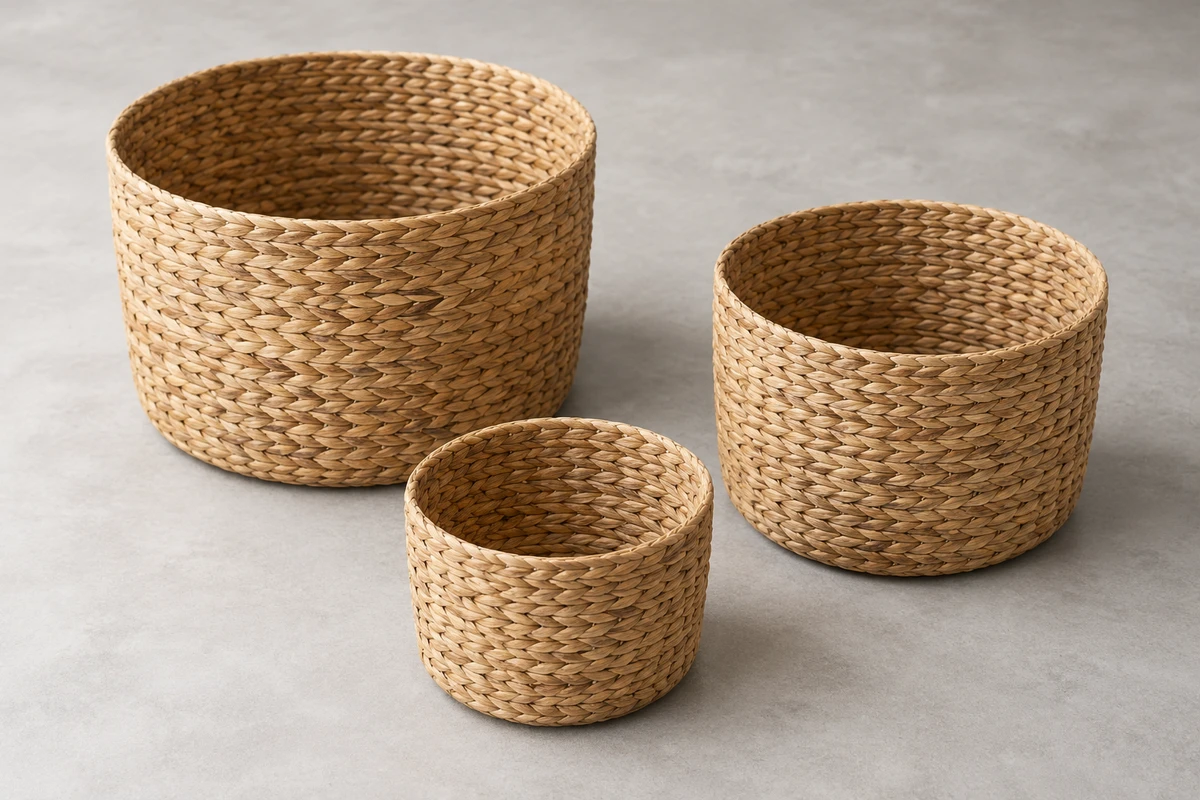
The smallest basket shipment may still buy the wrong assortment. A fixed set containing small, medium and large baskets can look economical because the products are presented together. If the buyer needs only the smaller sizes, the large baskets remain part of the purchase and its transport decision.
Compare the cost of supplying the intended size mix. Keep product fit and acceptable supplied form settled for each candidate, then request real offers for the exact quantities and permitted packing. This is a different question from packing identical baskets more closely.
Write demand by actual basket, not by set name
Give every required size its own product reference and count. Record the intended finish and whether the baskets arrive ready formed or in a supported compact state already accepted by the buyer. “Medium” alone is insufficient if two suppliers use it for different dimensions or constructions.
State how the assortment will be used. A shop selling baskets individually has a different requirement from a buyer selling a complete three-piece set. In the second case, removing the large basket changes the customer-facing product, even when current enquiries favour smaller sizes.
Ask whether the supplier’s “set” is a fixed retail unit, a wholesale assortment or merely a transport grouping. The answer controls what can be selected or separated commercially. Do not assume that a photograph of three baskets is permission to buy any one of them.
Expand every offer into purchased quantities
For a fixed assortment, list the count of each size supplied per set. Multiply those counts by the number of sets required to cover every needed size. A total basket count can hide both a shortage in one row and excess in another.
For selectable sizes, obtain the actual selling increments and minimums. Do not assume exact quantities are available simply because the page has a size selector. Confirm whether colour selection, size mix and any minimum apply independently or across the order.
| Size and exact variant | Required quantity | Units per fixed set | Quantity purchased | Surplus for this plan |
|---|---|---|---|---|
| Small reference | Buyer input | Supplier confirmation | Sets ordered × supplied count | Purchased minus required |
| Medium reference | Buyer input | Supplier confirmation | Sets ordered × supplied count | Purchased minus required |
| Large reference | Buyer input, including zero | Supplier confirmation | Sets ordered × supplied count | Purchased minus required |
If a row remains short, the offer has not yet supplied the required assortment. Do not offset a missing small basket with an extra large one unless the buyer deliberately approves a different requirement.
Compare the real mixed-size packing
Request the packing proposal for that precise size mix. Identify which basket, if any, encloses another; which components travel separately; and the approved relationship of handles, rims and surfaces. A small basket fitting within a larger outline does not establish a permitted nesting arrangement.
IKEA’s BRANÄS page gives separate product and package measurements. That named example is a reminder to ask for packed data, not permission to fold or nest a different basket. BRANÄS product and packaging information
The large basket may be part of the proposed outer geometry of a mixed set. Omitting it therefore does not imply that the same carton can travel with a lower weight. The smaller sizes need their own complete packing proposal, including required protection. Likewise, separate-size cartons might be larger or smaller in total; only the actual proposal answers that question.
Obtain the outer measurements, gross weights and carton counts for each permitted option. DHL’s UK guidance illustrates why actual and volumetric weight can both matter in a named parcel service. It supplies no price or general saving for a basket assortment. DHL weight and dimensions guidance
Put assortment cost beside transport cost
Create two complete quote columns: fixed set and selectable sizes. Add a third only for a real alternative, such as an acceptable smaller fixed assortment. Do not combine the lowest goods price from one offer with the smallest package reported for another.
| Buyer worksheet | Fixed assortment and selectable-size entries |
|---|---|
| Requirement covered | Exact sizes, variants and quantities fulfilled |
| Purchased surplus | Extra units by size; no assumed recovery value |
| Supplied form | Approved ready-formed or compact state for each model |
| Transport pack | Actual mixed-size or separate-size configuration and revision |
| Complete quotation | Goods, quoted packing, transport and identified completion work |
| Quote boundaries | Currency, destination, validity, exclusions and unresolved charges |
| Surplus consequence | Confirmed storage or handling work; unpriced constraints stated |
Keep an unexplained charge open. Confirm applicable import and destination amounts separately rather than borrowing a rate from a basket material description. Compare totals in an agreed currency basis only after relevant inclusions match.
A fictional ten-small, ten-medium requirement
Imagine a retailer needs ten small and ten medium baskets of two approved references, with no current demand for the large size. Supplier F offers only sets containing one of each size. Supplier S is being asked for the two selected sizes. All counts and supplier references are fictional.
F requires ten sets to meet the small and medium requirements. The purchase contains 30 baskets: 20 needed now and ten surplus large baskets. Dividing F’s eventual total by 30 would describe purchased pieces, not the cost of meeting the present 20-piece requirement.
Let CF be F’s complete quoted cost and CS the complete cost of an actual selectable-size offer. Compare CF with CS for the same intended assortment. CF divided by 20 and CS divided by 20 can express cost per basket needed now, provided both totals cover that requirement. Neither is a forecast of accepted units after arrival.
If S cannot supply the needed quantities, its apparent unit prices are not an available alternative. Ask for its actual pack increments and recalculate purchased quantities. If F can omit the large baskets, obtain a fresh pack and offer; do not deduct one-third of CF. With no complete selectable offer, the decision is whether to buy F’s known surplus-bearing assortment or keep sourcing, not whether an imaginary exact-quantity offer is cheaper.
Make future demand an explicit second decision
A confirmed use for the large size may change the comparison. Name that need and its period, then recalculate the assortment rather than crediting speculative resale. Keep the current plan without that assumption available for review.
See Homeware baskets and storage for category context. Through the Homeware sourcing page, send the required size counts and ask which fixed or selectable assortment is actually offered. A supported product link, concise description or permitted image can start that enquiry; the decisive response is a complete purchase-and-pack proposal for the mix you need.
Worked comparison: nested or formed in the carton
Assume a fictional order of 12 small and 12 medium baskets, with the same 420 CNY goods cost. Quote N packs them nested into two cartons. Quote F packs them formed into four. For the arithmetic, each packed carton measures 60 × 40 × 45 cm. Ask the actual seller to verify external dimensions, gross weight and finish protection.
In this scenario N totals CNY 546 after the quoted transport and expected reshaping work. It is CNY 22.75 per basket if all 24 recover. With three held for shape problems, the same subtotal is CNY 26.00 for 21 accepted units. F totals CNY 600, or CNY 25.00 if all 24 pass. The held units still leave three unfilled positions, so ask for a revised fulfilment option before comparing a complete order.
| Decision line | Nested N | Formed F |
|---|---|---|
| Packed volume | 2 × 0.108 = 0.216 m³ | 4 × 0.108 = 0.432 m³ |
| Goods + transport + reshaping | 420 + 96 + 30 = 546 | 420 + 180 + 0 = 600 |
| Subtotal if 24 are accepted | 22.75 per basket | 25.00 per basket |
| Size split and inspection | Check the accepted quantity by size after unpacking. | Check protective packing and edge shape on arrival. |
Frequently asked questions
Is a nested three-size basket set automatically the cheapest option?
No. First establish the exact small, medium and large baskets needed, then expand the fixed set into purchased quantities. Obtain a quotation for the permitted packed assortment. Nesting, protection and the ability to sell pieces separately require their own confirmation; a compact photograph does not resolve them.
How do I count useful baskets in a fixed assortment?
Count each actual size and variant against its own requirement. Extra large baskets do not fill a shortage of small baskets. Keep required units, purchased units and surplus in separate columns, and distinguish a supplier transport assortment from a retail set that the buyer must keep together.
Can I remove the unwanted large basket and deduct its freight?
Only ask for a revised offer if the supplier actually permits that purchase. Removing the largest item can change the smaller baskets’ support and outer packing, so the former carton is not a valid freight basis automatically. Obtain the new packed arrangement and complete quote rather than subtracting one-third of a set charge.
When should surplus baskets receive a value in the comparison?
Use a separate scenario when there is evidenced demand for the exact surplus size, finish and period. Record any associated selling, storage or handling work rather than assuming full recovery. Keep the present purchase comparison visible without that credit so future demand cannot silently justify today’s excess stock.
Sources
Discuss a sourcing request related to this article.Mixed-Size Woven Baskets: Cost per Usable Basket