
Reorder Felt Pads by the Size That Is Actually Wearing Out
Check the count of each felt-pad size before reordering an assortment, and compare coverage of the depleted size with the leftovers it creates.
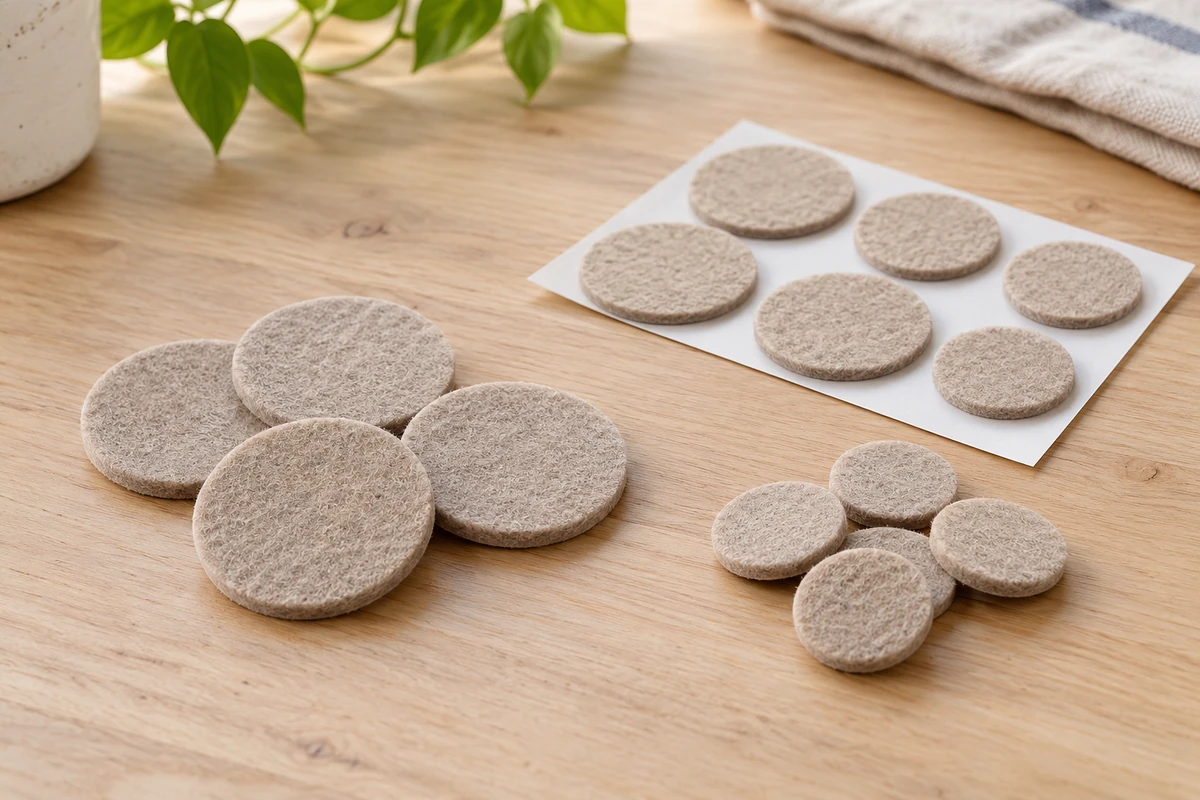
A felt pad assortment with twenty pieces does not necessarily supply twelve replacements of the size the household needs. Before reordering, obtain the count of each size in the actual pack and compare those counts with the already identified replacement positions. The largest headline total may hide a shortage in the size that is being depleted.
Start from established product and application references. This article helps select a replacement assortment; it does not determine whether a pad is suitable for a particular floor, finish, object or load. It supplies no lifting, adhesive, cutting or attachment instructions.
Count the replacement positions already identified
Record the approved pad reference and contact size for each group of positions due for replacement. Use an existing responsible decision about which pads need changing. Do not infer a fixed wear interval from the date of the previous purchase or assume that every pad beneath one object has the same condition.
Keep different approved applications separate where their pad requirements differ. A larger pad used for one established position cannot automatically be replaced by several smaller pads simply because the total area seems similar. Likewise, a pad sold for a broad category of household objects does not establish suitability for every individual surface combination.
Use existing records and safe, ordinary authorized information. Do not lift heavy furniture, tip objects, peel pads or disturb an uncertain item merely to complete a shopping worksheet. If the replacement requirement cannot be established within permitted handling, leave that question with the responsible person.
The result should be a short list of actual replacement sizes and counts. A general statement such as need more felt pads is not yet enough to choose an assortment.
Read the assortment split rather than the total
IKEA’s TRIXIG 805.732.26 is named as a twenty-piece set, and its product text lists two sizes, three-quarters of an inch and one-and-five-eighths inches. The text reviewed does not state how many of each size are included. The page also discusses replacement of thinner worn protectors and names household applications including lamps, pots and bowls. These are scoped product descriptions, not a suitability guarantee for another item. TRIXIG product information
The missing size split matters directly to a reorder. Knowing that both sizes are present does not answer whether one pack supplies twelve large pads. Do not infer the count from generated image descriptions, remembered older products or an apparently symmetrical arrangement in a picture.
Ask the actual seller for counts by size for the selected item and pack. If the reply says assorted sizes, ask again for the numerical breakdown. A total count can reconcile the answer once supplied, but it cannot substitute for it.
Treat leftover sizes as a purchasing consequence
A recurring shortage of one size can coexist with a drawer full of another. Before repeating the same assortment, record the usable retained quantity of each relevant size and the established replacement need. The purchase should address the actual short size without pretending the other remainder has vanished.
A leftover small pad may have a later approved purpose, but that purpose should be identified separately. Do not assume all small pads can be used under any small object or apply them somewhere simply to consume surplus. The buying comparison creates no new application approval.
If a same-size refill pack is actually offered, compare it with the mixed assortment. If it is not offered, the honest alternatives may be to accept known leftovers, seek another verified format or defer an optional purchase. An imaginary exact-size offer cannot prove that the current assortment is poor value.
Build a size-depletion worksheet
Complete this original worksheet for an established application and current offer. Keep unknown fields visible; the sheet is not a physical test or product-selection standard.
| Decision field | Entry to make | Question it answers |
|---|---|---|
| Approved application and pad | Existing item reference and permitted use basis | Which exact replacement is being considered? |
| Required contact size | Established size reference for this group | Which part of the assortment can answer the need? |
| Pads due for replacement | Actual identified count, not a universal interval | How many replacements are required now? |
| Retained eligible spares | Known matching pieces already available | How much of that requirement is already covered? |
| Offer contents by size | Seller-confirmed quantities of every size | How many useful replacements does one pack provide? |
| Packs and remainder | Packs required; surplus by size | What extra pieces does the purchase create? |
| Surface suitability question | Unanswered application issue, if any | What must be resolved before purchase or use? |
Once the contents are known, divide the uncovered count for each required size by that size’s pieces per pack and round to the offered whole-pack increment. Where several sizes are required, the selected number of identical packs must cover every required row. Calculate leftovers separately for each size.
If one required size has no confirmed count in the offer, the pack requirement remains unknown. Entering zero or assuming an even split would change an unanswered question into a false calculation.
Fictional decision for twelve large pads
Imagine a household has twelve established large-pad replacement positions and no eligible matching spare pads. Small pads have no current purchase requirement. A seller proposes a twenty-pad, two-size assortment but has not stated its split. All household facts here are fictional, and the seller’s pack is not asserted to be the named TRIXIG pack.
At this stage, one pack is not confirmed to cover the requirement. The total twenty exceeds twelve, but the unknown large-pad count controls the result. The buyer’s decision is to request that count before choosing the number of packs.
Consider two explicitly fictional replies. In reply A, each pack contains eight large pads and twelve small pads. Two packs provide sixteen large pads and twenty-four small pads. After covering the twelve large positions, the purchase leaves four extra large pads and twenty-four small pads with no current assignment.
In reply B, the pack contains six large pads and fourteen small pads. Two packs provide exactly twelve large pads and twenty-eight small pads. Both replies require two packs for this requirement, but their leftovers differ. Neither split should be attributed to a real product without actual evidence.
A third fictional offer provides twelve of the approved large pads in a same-size pack. It supplies the exact stated requirement without a small-pad remainder. The buyer prefers to obtain a complete current quote for that candidate, while retaining the two mixed-pack alternatives if they are genuinely available.
This is not a finding that the same-size format is cheaper or that surplus pads have no value. Actual price, availability and the buyer’s intended future uses remain to be considered. The arithmetic reveals what each purchase contains; it does not assign a resale credit or a floor-protection performance score.
If the seller never answers the split, the twenty-piece offer stays incomplete for this decision. Buying extra packs just in case may still fail to establish the required size coverage and should not be represented as a resolved comparison.
Preserve the size history for the next reorder
After the chosen purchase, record the actual received size breakdown separately from the offer. If it differs, retain the discrepancy rather than changing the original requirement to match the contents. A product title is not a receipt count.
At the next shortage, return to the specific depleted size and retained remainder. Repeating the same mixed pack without checking that remainder can steadily accumulate unused sizes. A changed approved application may create a legitimate use for them, but the application decision must come before they are counted as useful coverage.
See Homeware decor and ceramics for category context. A Homeware sourcing enquiry can state the established replacement size, count and missing assortment split using supported links, text or permitted images. Ask for the actual number of each size, and keep surface suitability or permitted handling questions separate from the pack calculation.
Frequently asked questions
Does a twenty-piece felt-pad pack cover twelve large replacements?
Not unless at least twelve compatible large pads are actually included or enough confirmed packs are purchased. The total twenty does not reveal the size split. Request the exact count of each size for the chosen offer and keep the comparison unresolved until that information is available. Do not infer the split from an older product or image description.
How do I calculate the number of mixed felt-pad packs needed?
Use the established uncovered requirement for each approved size and divide by the seller-confirmed count of that size per pack, rounding to the offered whole-pack increment. The selected number of packs must cover every required size. Calculate surplus separately by size; an extra small pad cannot numerically offset a missing large one.
Should I use leftover small felt pads somewhere else?
Only an independently established suitable application can make them useful coverage. Do not invent a new use to justify a mixed-pack purchase or assume that several small pads replace one larger pad. This article provides no surface, adhesive, loading or attachment approval. Record unmatched leftovers without assigning them a speculative financial credit.
How often should household felt pads be reordered?
There is no fixed interval in this comparison. Begin with replacement positions already identified under applicable product guidance and responsible review, then check matching spares and real pack contents. A past purchase date or recurring shortage of one size does not establish every pad’s condition, a universal useful life or permission for additional handling.
Sources
Discuss a sourcing request related to this article.Reorder Felt Pads by the Size That Is Actually Wearing Out