
Adding Handled Boards: Compare the Revised Cartons with the Original Order
Price handled-board additions from their complete shape, revised pack and with-and-without quotes, rather than the freight average for flat boards.
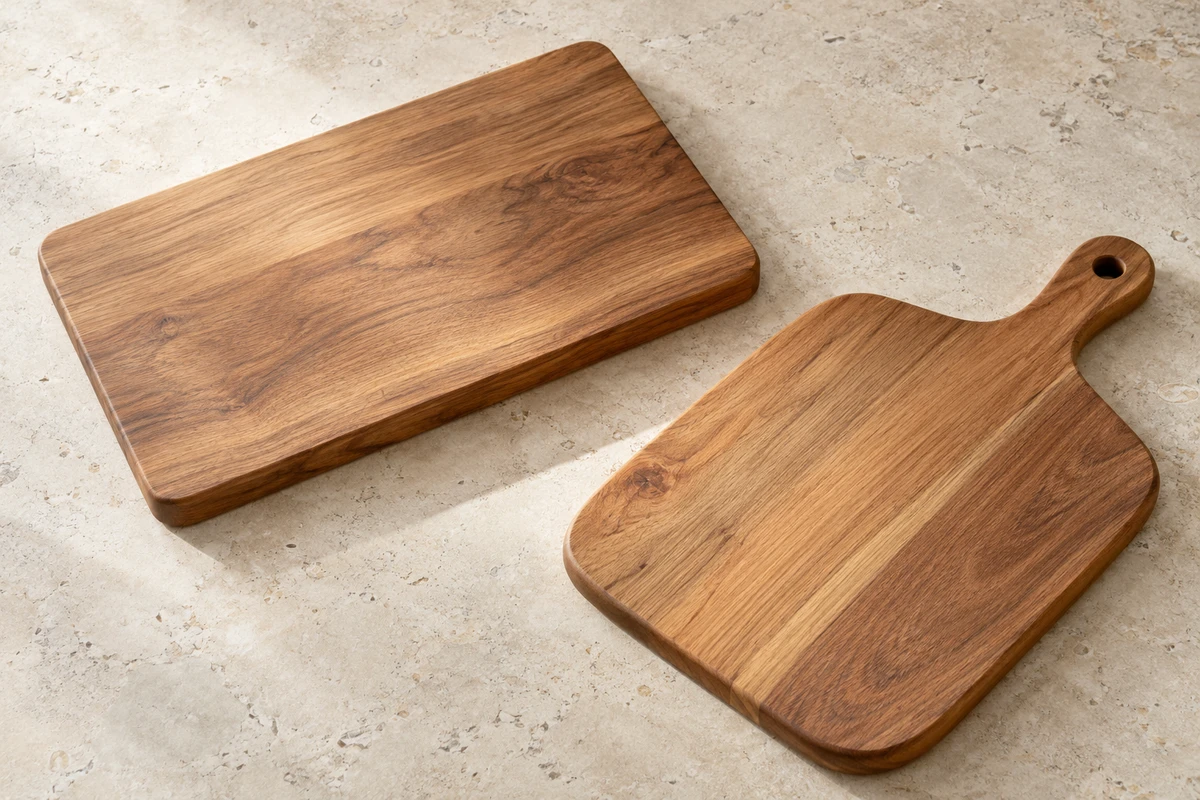
A handled board can add more to an order than its own weight. Its projecting end may change the carton length, the position of neighbouring boards or the work needed to reopen an existing bundle. Compare the original shipment with a specific revised shipment before deciding whether to add it.
Start with boards already selected for their intended use. This decision concerns the additional spending caused by adding another approved variant. It does not reopen the cutting-area specification or prescribe how a packer should arrange food-contact surfaces.
Preserve the order you could still buy without the addition
Record the flat-board references, quantities, approved packing revision and actual quotation. Identify which cartons are already packed and which are only proposed. A change before packing and a change after cartons are closed can involve different work; ask the provider rather than assuming either is free.
State why the handled variant is wanted. It might complete a particular retail assortment or answer a buyer’s separately approved serving requirement. If it is merely an optional extra, retain “do not add it” as a real alternative. Otherwise an attractive per-board figure can obscure a purchase with no defined need.
Keep the original quote’s endpoint, currency, validity and inclusions beside the baseline. If that quote has expired, request a refreshed baseline as well as the addition quote. Comparing an old rate with a new shipment does not isolate the board’s effect.
Give the packer the whole board
Describe the added board’s maximum envelope, including its handle or projecting edge, thickness and confirmed feet or raised features. Identify the measurement state and exact size variant. The cutting surface alone leaves out the very feature that may alter the pack.
OXO’s Carving and Cutting Board illustrates the distinction between faces and edge features: its description identifies a solid face, a grooved face, tapered handle edges and feet. These are features of that named product, not packing instructions for another board. OXO product details
For the proposed addition, show where the extended handle lies relative to the flat-board bundle and carton boundary. Ask the responsible packaging owner to explain the permitted configuration with required protection retained. Do not assume that a narrow-looking handle occupies usable empty space between other items, or that reversing a board resolves its contact questions.
A layout sketch can reveal an omitted projection. It cannot establish protection, support or material compatibility. The price comparison begins once the candidate arrangement is sufficiently defined for those responsible to assess it.
Request two practical ways to include the variant
One option is an approved mixed arrangement that redistributes existing boards and the additions. Ask which cartons change, whether all original units remain included, and what reopening, repacking or new materials are proposed. A longer mixed carton can affect the quote even if the number of boxes stays constant.
Another option keeps the original board cartons and places the handled variants in a separately approved package within the same proposed shipment. That preserves the baseline packing scope but adds a piece whose dimensions, gross weight and quoted work must be counted. A separate dispatch is a third alternative only if actually offered; it is not the same as another carton in one dispatch.
UPS’s measurement guidance addresses package dimensions and actual weight, with shipment-specific limits. Use the actual provider’s assessment of the finished packages, not an assumed universal threshold for a protruding handle. UPS dimensions and weight guidance
Build the with-and-without worksheet
Use a column for the baseline, the mixed-carton proposal and the separate-carton proposal. Complete these rows for each; leave missing answers visibly unresolved.
| Comparison field | What to record |
|---|---|
| Board assortment | Flat-board and handled-board references and counts |
| Geometry affecting packing | Complete added envelope, faces, feet and projections |
| Pack reference | Owner-approved revision and cartons changed or retained |
| Measured shipment | Outer dimensions, gross weights and count for every actual package type |
| Packing work | Reopening, materials and other quoted changes; included or separate |
| Transport response | Dated complete quote, endpoint and actual provider acceptance |
| Other spending affected | Added goods and identified changes outside the transport quote |
| Buyer decision | Need served, chosen proposal and outstanding conditions |
Let T0 be the current baseline shipment quote, TM the complete mixed-arrangement quote and TA the complete separate-carton quote. TM minus T0 and TA minus T0 show the respective transport differences only when their service scopes match. Add separately quoted incremental packing work and added goods once. Do not add a packing charge again if it is already inside TM or TA.
Any import-cost consequence remains a separate verified input. No tariff, fee or allowance can be inferred from “cutting board” or supplied by this worksheet.
Work through two fictional additions
Suppose a fictional order contains 24 flat boards in three approved cartons of eight. The buyer wants to add two handled boards. These counts and arrangements are invented; there are no freight amounts or completed physical assessments behind them.
The first reply says the two boards can go “in the same cartons” but shows only their cutting faces. Leave that reply incomplete because the extended ends and revised interfaces are absent. It supplies neither a quote-ready packing arrangement nor evidence of zero added spending.
Ask for proposal M, showing all 26 boards in an owner-reviewed mixed arrangement, and proposal A, retaining the three baseline cartons plus a defined package for the two additions. Neither candidate has an assumed saving. Request TM and TA, along with any excluded changed work.
If only A becomes fully documented and priced, the buyer can decide whether its known increment is justified by the need for the two handled boards. M stays pending rather than being treated as a cheaper offer. If the need is optional and no complete increment is acceptable, keep the original 24-board order. If both candidates become comparable, choose between their complete additional spending and accepted packing scopes.
Record the addition separately from margin allocation
After choosing, identify the revised assortment and pack in the approval. Keep any later product-margin allocation separate: redistributing an unchanged bill among boards does not change what adding them cost.
For category context, see Homeware kitchenware. A Homeware sourcing enquiry can include the board reference and a concise request for baseline and revised packing quotes, with supported images showing the full shape. Confirm the actual provider’s packing and quotation scope before relying on the response.
Frequently asked questions
Can handled boards use the freight allowance for flat boards?
An average from the flat-board order does not establish the spending caused by the addition. Preserve the original pack and quote, then obtain a revised proposal covering the handled boards, their full envelope and any changed work. Compare complete with-and-without totals on the same service scope before assigning a cost to the addition.
What if the added boards appear to fit an existing carton?
Apparent space is only a reason to ask for an owner-approved packing proposal. The handle, feet, raised edges and adjacent faces still need to be represented with the required protection. Use measured final outer dimensions and gross weight for pricing; an unchanged carton count does not prove an unchanged charge or acceptable product contact.
Should I compare a mixed carton with a separate handled-board carton?
Yes, if both are real permitted proposals for the same board quantities and delivery endpoint. The mixed option may change existing cartons; the separate option may leave them intact while adding another package. Ask for complete revised totals and repacking scope rather than assuming either arrangement is cheaper.
How do I decide whether adding two boards is worth the extra spending?
First say what those two exact boards are needed for. Compare the additional product and other attributable spending with the difference between complete shipment quotes, without counting included packing twice. If a necessary pack or price remains unresolved, retain the original order and seek the missing response before authorizing the addition.
Sources
Discuss a sourcing request related to this article.Adding Handled Boards: Compare the Revised Cartons with the Original Order