
Compare Both Curtain Panels Before Altering Them
Compare both received curtain panels from a common header reference and preserve their unchanged condition before deciding on a mismatch or alteration.
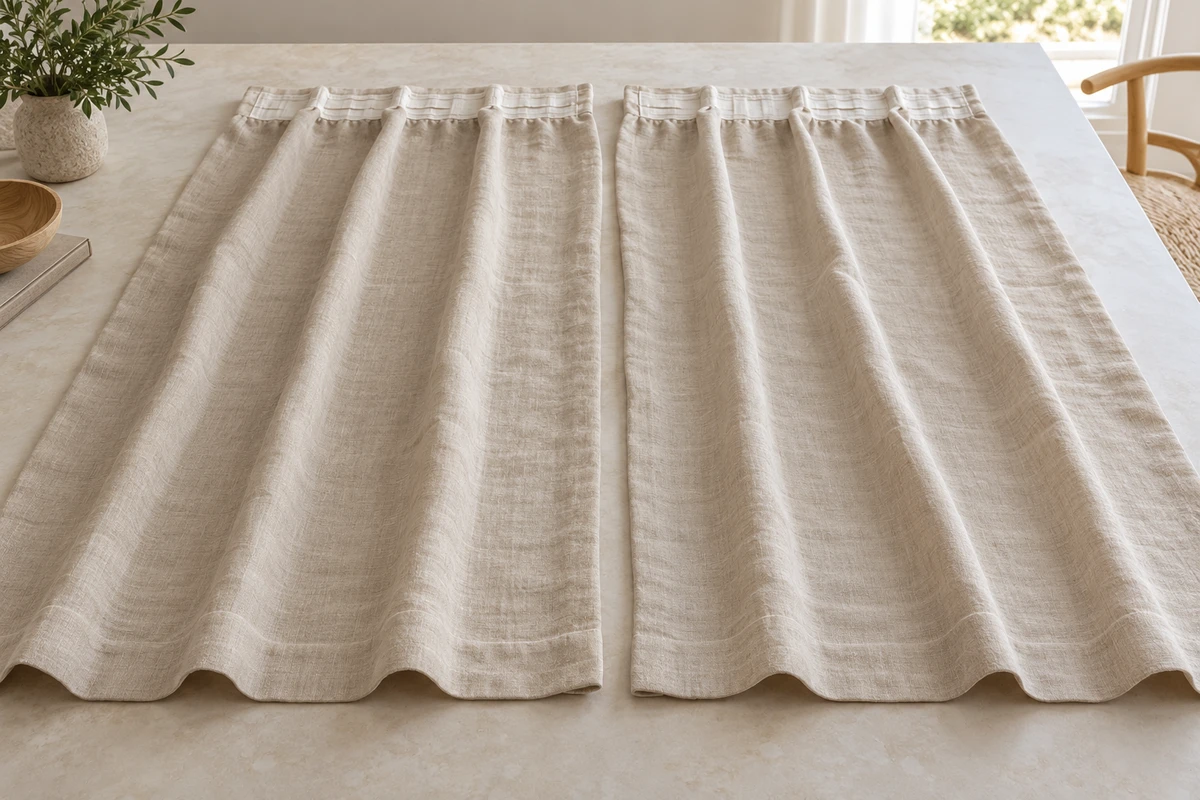
Before altering a newly received curtain pair, compare its two panels in the same condition using the same defined measuring points. A reported length difference may reflect unlike starting points, an actual panel difference, or an unresolved combination of the two. The buyer needs to distinguish those possibilities before deciding what the pair requires.
Keep the panels together in the record. Two individually plausible dimensions do not show that the received pieces form the agreed pair, especially when their header construction or attachment layout differs.
Preserve the pair that arrived
Identify the package, the pair reference and each member before similar panels are mixed. Simple receiving IDs such as panel A and panel B are enough if they remain connected to that package and order variant. Do not quietly exchange one panel with a member of another pair to obtain a better-looking match.
Record the received condition: unwashed, untrimmed and otherwise unchanged where that is known. If one panel has already been altered or treated, identify the difference and keep it out of an equal-condition comparison unless the responsible reviewer explicitly addresses the limitation.
Use accessible ordinary handling within the product instructions and the agreed receiving scope. This review does not require installing a rod, drilling, climbing, overhead hanging or pulling the fabric under tension. If the available space or product condition prevents a safe, meaningful comparison, record the limitation and arrange an appropriate review.
The original pair relationship matters even when the buyer ultimately accepts a replacement panel. It lets the supplier understand what was supplied and prevents the replacement from erasing the reason the pair needed attention.
Make the starting line explicit
Find the measurement definition in the approved order or drawing. “Length” needs both a starting point and an endpoint. A top fabric edge, a named line on heading tape and a defined attachment location are not interchangeable starting points.
Call that starting line the datum, then describe it in everyday terms on the record. For example, “top fabric edge to lower hem edge, as marked in drawing H3” is more informative than “drop.” Do not choose a convenient new datum after seeing the two values. If the order is unclear, have the responsible buyer or design owner establish the basis before judging conformity.
IKEA’s DYTÅG 606.078.02 page separately identifies a curtain pair, width per curtain and options associated with its heading tape. This named product illustrates why pair identity, panel dimensions and header arrangement deserve separate attention. It does not provide a tolerance or a measurement rule for another supplier’s panels. IKEA DYTÅG product details and measurements
Keep any attachment-based dimension distinct from overall fabric length. Two panels can have the same overall length while the relevant attachment features are in different positions. Conversely, different numbers taken from different start lines may say nothing about whether the actual panels match.
Compare like positions on both panels
Use the agreed ordinary measurement method and state its units, start and end points, and panel condition. Keep the same orientation for both members. If the agreed scope records both sides of each panel, distinguish its left and right edges on a sketch; do not average the sides into one number that hides a difference.
Where an edge is folded, obscured or cannot be located without stretching or corrective treatment, mark the observation as limited. Do not iron, wash, pull or trim a panel to obtain a cleaner measurement. The purpose is to describe the received condition, not to produce the finished installation.
Compare the accessible header construction and attachment layout with the approved reference. Note the type and position of the specified tape, pockets, tabs or other actual features, using only those present in the supplied design. If two different constructions arrived, matching hem positions alone will not resolve the pair.
This is not an installation compatibility assessment. A visible header comparison does not establish that a rail, rod or fixing is suitable, or that hardware was included. Keep any project-specific installation question with the responsible person rather than improvising a hanging demonstration.
Use a paired-panel comparison sheet
Complete a shared header with the order, package and pair IDs; the approved drawing/reference; unwashed condition; observer; and permitted comparison method. Enter both panels beside one another so the basis of each number remains visible.
| Field | Panel A | Panel B | Pair question |
|---|---|---|---|
| Received identity and condition | ID; known treatment or alteration, if any | ID; same information independently | Are these the intended two members in comparable states? |
| Length start and endpoint | Exact agreed reference points | Exact agreed reference points | Were like points actually used? |
| Left-side length, if in scope | Value and unit, or observation limitation | Value and unit, or observation limitation | Does any difference remain on a common basis? |
| Right-side length, if in scope | Record independently | Record independently | Is a difference hidden by a single average? |
| Header construction and layout | Actual features and photo reference | Actual features and photo reference | Does each match the approved pair arrangement? |
| Outstanding decision | Panel-specific question | Panel-specific question | Named owner, applicable criteria and scope of decision |
This original editorial worksheet is not a dimensional standard or a universal tolerance. Use the order’s criteria. If there is no agreed allowable difference, retain the measurements and ask for a decision; do not invent a percentage to make the pair pass.
A fictional mismatch with two different explanations
Imagine an invented pair P6, with panels A6 and B6. The agreed receiving basis is length from the top fabric edge to the lower hem edge in the unchanged, unwashed condition. For clarity, this example follows one specified side on each panel. The figures, references and events are fictional, not recommended dimensions or tolerances.
The first report gives A6 as 240 cm from the top fabric edge and B6 as 238 cm from a line 2 cm below its top fabric edge. Subtracting those two numbers would suggest a 2 cm pair difference, but the starts are unlike. That first report cannot establish the claimed mismatch.
The reviewer then records both members using the agreed top-edge basis, without altering either panel. A6 is recorded as 240 cm and B6 as 240 cm. The first apparent length difference is resolved as a comparison-basis issue for those particular observations. Keep the original entry and the corrected basis so the change in conclusion is understandable.
Now suppose the header images show that B6 has a different attachment layout from the approved reference, while A6 matches that reference. The common overall length has not resolved the header question. The buyer asks the supplier to address B6’s actual construction rather than accepting the pair solely because the numbers now agree.
In a different outcome, a common-basis observation might still show unlike lengths. Record the actual values and return to the agreed criteria; neither the arithmetic nor this article declares the difference acceptable. Ask for a pair-specific disposition before any trimming, replacement or proposed alteration.
Keep adjustment proposals separate from receipt acceptance
A supplier might suggest shortening one panel, changing the header arrangement or washing before deciding. Those are proposed changes to the received condition. Do not carry them out as an informal way to close the initial comparison. Obtain an authorized scope and retain the original evidence first.
If a replacement panel is proposed, identify which member it replaces and compare the resulting pair under the agreed basis when available. If the supplier instead proposes a complete new pair, retain that as a different remedy. Neither option is assumed available, and either still needs a clear decision on the resulting combination.
A receipt comparison does not establish post-care dimensions, installed drop, shrinkage, light control or long-term appearance. It answers only the specified questions about the identified pair in its recorded state.
For sourcing coordination, browse Homeware textiles and use the Homeware sourcing page with the pair reference and the exact unresolved measurement or header question. A permitted image preview can show the two marked reference points; arrange original drawings separately. Confirm the actual physical-review and reporting scope before relying on any service.
Frequently asked questions
Do matching overall lengths prove the curtain pair is correct?
They resolve only that measured dimension on the recorded basis. Compare the actual header construction and attachment layout with the approved pair reference as well. If those features differ, equal fabric lengths do not settle the pair. The observation also does not establish installed drop or the suitability of a particular rail or fixing.
What should happen when two length reports use different starting points?
Keep both original entries but do not subtract them as though they were like measurements. Identify the order’s agreed start and endpoint, then obtain a comparable ordinary observation where safely possible within scope. If no basis was agreed, ask the responsible owner to clarify it before deciding that one panel is nonconforming.
Can I trim the longer panel so the pair matches?
Do not alter the received pair merely to make the initial comparison pass. Record the unchanged evidence and obtain a specific buyer-approved disposition first. A proposed alteration may affect the product or available commercial remedy, and this article gives no trimming instructions or assurance that alteration is suitable.
What if panels from several packages have already been mixed?
Use the identifiers and records that actually remain and state which original pair relationships are unknown. Do not invent package pairings or silently exchange members to improve the result. The buyer can authorize a newly defined pairing, but that is a separate decision with its own panel identities and comparison evidence.
Sources
Discuss a sourcing request related to this article.Compare Both Curtain Panels Before Altering Them