
Separate Mop-Pad Laundry Rotation from Replacement Demand
Compare ready pads, confirmed laundry returns and retired pads before buying rotation additions, replacements or an unnecessary complete mop.
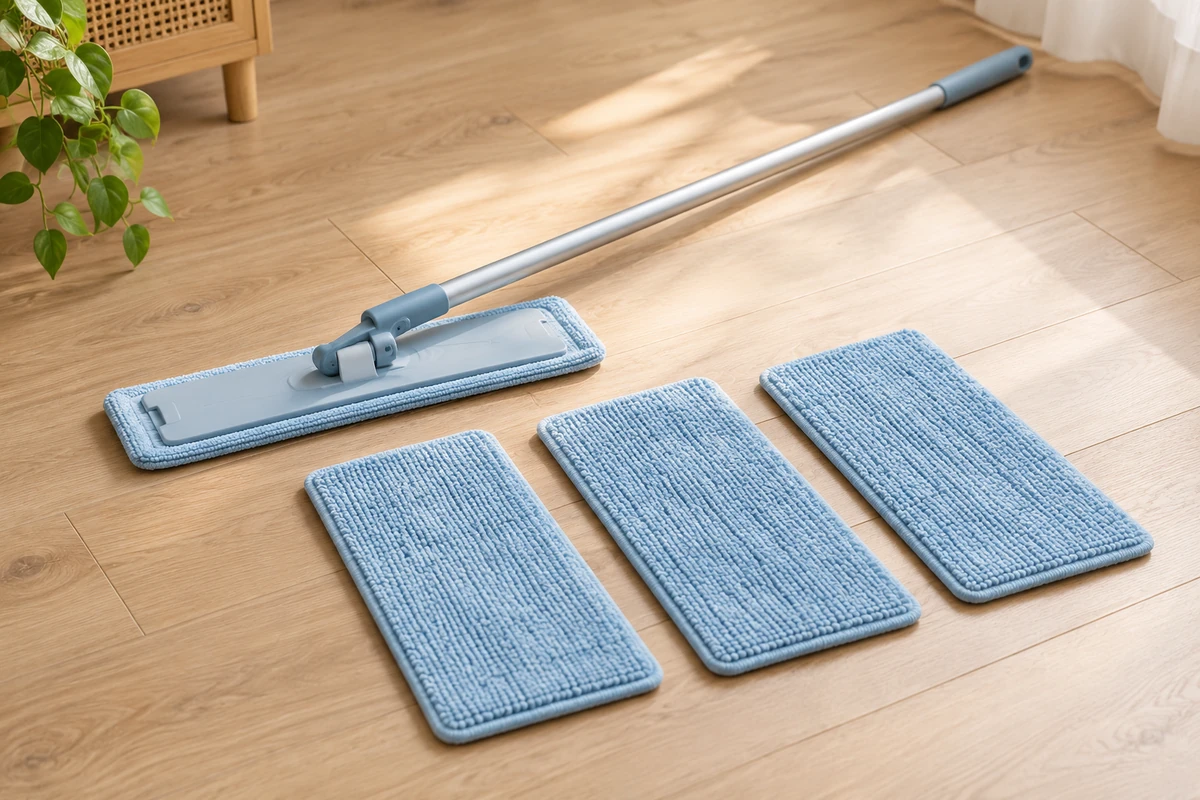
A shortage of ready washable mop pads does not automatically mean the household has worn out that many pads. Some may be in an authorized wash-and-dry process and expected to return. Before ordering, decide whether the gap is temporary rotation capacity, replacement of pads already retired, or a need that can be avoided by changing the timing of a permitted task.
This distinction can prevent a complete-mop purchase when the retained head and handle are still the intended equipment. Begin with the actual pad-to-head pairing, then compare what will be ready for the next planned task. The worksheet supplies no cleaning, infection-control or floor-treatment procedure.
Keep the pad attached to a specific mop-head identity
Record the retained mop-head reference and the approved replacement pad. Do not use the name microfiber pad as the entire specification. Similar-looking pads or products from a broad shared range can represent different intended heads.
IKEA’s PEPPRIG pad 005.676.15 is listed as a refill for the PEPPRIG flat mop head and supplied as a two-pad pack. Its care information permits machine washing and excludes tumble drying. These statements concern that exact item; they provide no drying-time estimate or approval for another pad/head combination. PEPPRIG pad and care information
For the actual household, retain the matched current instructions with the pad reference. If identification or care guidance is missing, resolve it before treating the pad as available for the planned process. A convenient laundry method cannot be assumed just because another microfiber item uses it.
Do not adapt an uncertain pad to a head or use a hurried cleaning trial as a purchasing test. Keep product suitability and ordinary authorized handling as prerequisites to the quantity comparison.
Name the next task before naming a stock target
Write the actual upcoming household task and the number of approved pads it requires under the chosen routine. That number is a planning input from the responsible person, not a universal recommendation supplied by this article.
A simple total such as five pads owned conceals whether any are ready when needed. Instead, distinguish pads already ready, pads in an authorized care process, and pads already retired by an appropriate decision. Keep uncertain cases separate. The useful question is what can support the next task, not how many pad-shaped objects are present.
For pads being washed or dried, ask whether return before the task has actually been confirmed. The existence of a laundry cycle is not an availability promise. Do not invent a drying duration, shorten the process or select an unapproved method to make the timing fit.
Timing may offer a genuine alternative to buying more. If the task can appropriately be moved and the responsible person accepts that change, a confirmed later return may resolve the temporary gap. If the task cannot move, the buyer needs an available, matched replenishment option rather than an assumption that laundry will finish in time.
Distinguish rotation additions from retirement replacements
A rotation addition increases the number of pads the household can alternate between use and authorized care. A retirement replacement restores the count after a pad has already been removed from the intended service. Both may be purchased as the same physical article, but they answer different reasons for buying.
Keep those reasons visible. If two pads are temporarily washing, buying two more raises the total retained pad population when the original two return. If two were genuinely retired, two new pads may restore the previous population instead. Calling both cases two replacements hides the future spare quantity.
This worksheet does not decide retirement criteria. Use the applicable product information and responsible household decision. Age, a missed laundry return or an empty ready-pad shelf is not, by itself, a finding that the absent pads are unusable.
Likewise, buying another complete mop solely to obtain its pad adds a head and handle that may not be required. Compare a pad-only offer where it is genuinely available, while preserving any separate need for new equipment.
Use a next-task rotation worksheet
Make one sheet for an established pad/head pairing. The fields below connect the purchase to a concrete task without imposing a minimum stock level.
| Field | Entry to make | Effect on the decision |
|---|---|---|
| Approved pad and head | Exact paired references and care source | Define which pads can answer this task |
| Next actual task | Planned event and required pad count | Establish the immediate requirement |
| Pads already ready | Identified available count | First coverage for the task |
| Pads in authorized care | Count and present wash/dry stage | Keep temporary absence separate from retirement |
| Confirmed timely returns | Supported return before the planned task | Additional coverage only if timing is established |
| Retired pads | Existing retirement decision and quantity | Explain true replacement demand |
| Purchase or timing choice | Matched pads, revised permitted task time or unresolved gap | State the selected route and open conditions |
| Population after return | Retained pads plus additions, excluding retired pads | Reveal the resulting rotation capacity |
Do not subtract the same returning pad from the purchase requirement twice. A pad listed as already ready should no longer remain in the expected-return count. The purpose is a physical rotation picture, not an elaborate inventory system.
Fictional decision with one ready pad and two washing
Suppose a fictional household task requires three approved pads. One is ready. Two matching pads are in an authorized wash-and-dry process, but neither has a confirmed dry return before the task. The retained mop head and handle are suitable for the established routine. All task requirements and circumstances here are invented.
For the scheduled task, confirmed coverage is one pad, leaving a two-pad gap. The washing pads have not been discarded and are not counted as failed. They remain part of the household’s retained population, with uncertain timing for this specific event.
The buyer considers two routes. One is to move the task, if that is an acceptable household decision, and obtain a confirmed return for the existing pads. The other is to obtain two matched rotation pads that will actually be ready in time. Neither route is deemed available merely because it appears in the worksheet.
Assume the fictional buyer cannot move the task and a confirmed offer provides two suitable pads in one pack before it. The buyer selects that two-pad rotation addition. Once the original washing pads return through their authorized process, the household will retain five pads: the original three plus two additions. The purchase has increased rotation capacity by two; it has not replaced two retired pads.
If only one existing pad later becomes ready before the task, refresh the immediate gap to one. Then compare the real pack choice again. A two-pad pack would add one more pad than the newly reduced immediate gap, but it may still be the only offered format. Record that consequence instead of rewriting the task to require four pads.
If timely supply is unconfirmed, the gap remains unresolved. The buyer must obtain a supported alternative or revisit the task plan. The worksheet cannot authorize tumble drying, chemical treatment or another shortcut to manufacture readiness.
Let the next purchase reflect the actual rotation
After the event, record which pads returned and which additions were actually bought. A later buyer should be able to see whether the household now owns a larger rotation pool or merely restored retired items.
Do not repeat this purchase at a fixed interval based on the fictional example. A different task schedule or care return may remove the need for another addition. A confirmed retirement may create a new replacement requirement, but it needs its own count.
See Homeware textiles for broader category context. Through a Homeware sourcing enquiry, identify the retained head, requested pad and actual pack question using supported product links, descriptions or permitted images. This household cleaning-textile example does not promise a laundry service, pad performance, floor compatibility or a particular supply lead time.
Frequently asked questions
Do pads in the wash count as replacement demand?
They are temporarily absent unless an appropriate decision has actually retired them. Keep their expected return separate from pads already ready, and count them toward the next task only when timely readiness is established. Buying extra pads while retaining the washing pads increases rotation capacity; it does not automatically replace discarded items.
How many washable mop pads should I keep in rotation?
There is no universal number in this method. Start with the approved pads needed for actual tasks and the supported timing of their authorized care process. Compare a permitted task-time change with an available matched-pad purchase. Record the resulting retained population so a one-time timing gap does not become an unexplained permanent stock rule.
Can I assume washed pads will be dry before the next task?
No. Obtain an actual supported return expectation for the chosen care process and task time. A wash cycle does not establish dry readiness, and this article supplies no drying duration. Follow the exact product instructions; an urgent shortage cannot create permission for tumble drying or another unapproved method.
Should I buy a complete mop when only pads are short?
Compare a matched pad-only offer when the retained head and handle remain the intended equipment. Complete mops add components that may have no separate requirement. Keep any genuine new-equipment need on its own line, confirm the actual offered pack and availability, and avoid treating a similar pad from another system as an approved substitute.
Sources
Discuss a sourcing request related to this article.Separate Mop-Pad Laundry Rotation from Replacement Demand