
Buying Fitted Sheets: Quote Mattress Depth, Not Just Queen or King
Match wholesale fitted sheets to actual mattress dimensions and topper depth, then compare documented stock fits with separately quoted custom options.
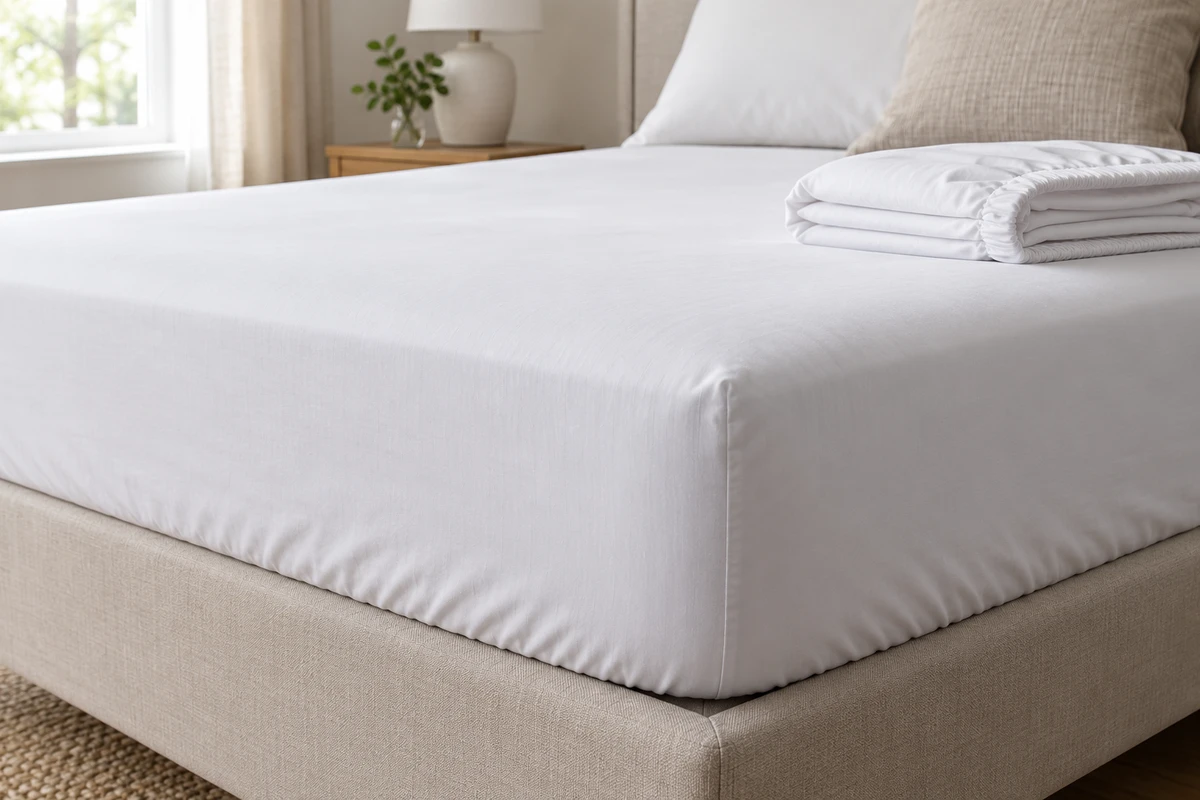
Build a fitted-sheet RFQ around the mattresses the sheets will actually cover. Record length, width and the intended covered depth, including any topper under the sheet. Keep a regional name such as Queen or King as a reference, but ask the supplier to quote an explicit fit range for the actual bed configuration.
For an accommodation buyer, the useful purchasing choice is often whether one stock sheet can serve the whole bed inventory or whether the deeper beds need a separate variant. Combining the quantities too early can conceal that difference.
Inventory the beds before selecting the sheet size
Give each mattress configuration a reference. Record its length and width in stated units, its depth, and whether a topper or other substantial layer will remain beneath the fitted sheet. Measure the intended arrangement using an agreed method and retain the supplier or mattress-model information where available.
Group beds only when the relevant configuration is the same. Two beds described as doubles may have different dimensions; two mattresses of the same model may have different covered depths if only some use toppers. If the arrangement will vary, list the configurations the proposed sheet must accommodate rather than describing only the shallowest one.
Keep the number of beds separate from the number of sheets to buy. The buyer decides how many changes and spare sheets each bed needs. A room inventory tells the supplier the fit requirement, while the order quantity tells it how many finished sheets to price. Neither should be inferred from the other.
Ask for intended fit depth, not just pocket depth
A product page can describe these fields separately. IKEA’s DVALA fitted sheet 704.824.63 lists length, width and a maximum mattress thickness of 10 inches, and describes elastic around the edge. This is one named product’s stated fit description, not a depth allowance for other fitted sheets. IKEA DVALA measurements and product details
For the proposed supplier item, ask whether a stated depth is the sheet’s finished pocket measurement or the mattress depth it is intended to fit. Those statements answer different questions. A pocket dimension by itself does not specify the intended fit across different mattress lengths, widths and depths.
Ask the supplier to identify the elastic arrangement, such as the locations where elastic is present, and to explain the fit range it is quoting. Preserve the supplier’s description without assuming that an elastic edge accommodates any depth. If the reply says “deep pocket,” request the actual dimensions and the corresponding mattress configuration.
Do not add a universal number of centimetres to the mattress depth to create the sheet pattern. The supplier’s construction and the buyer’s fit requirement need to be reconciled explicitly. The inquiry should state the bed to be covered; any proposed finished dimensions or construction allowance should be identified as the supplier’s proposal.
Use a bed-to-sheet fit schedule
Complete this schedule before collecting quantity-tier prices. It lets a supplier return a stock match, an explicit deviation or a separately priced custom option for each bed group.
| Field | Buyer entry | Supplier response needed |
|---|---|---|
| Bed group and quantities | Bed reference, number of beds and separately chosen sheet quantity | Quoted sheet variant and quantity tier |
| Mattress plan dimensions | Length and width with units | Intended matching mattress length and width |
| Covered depth | Depth of the intended arrangement; identify any topper | Stated mattress-depth range and its basis |
| Sheet construction | Required corner/edge features, if already specified | Finished sheet dimensions and elastic arrangement |
| Care and measurement basis | Agreed condition in which fit will be reviewed | Whether quoted dimensions refer to that same condition |
| Stock or custom decision | Which deviations the buyer may consider | Exact deviation, alternative variant and separate commercial quote |
| Open fit question | Unconfirmed configuration or dimension | Named answer and sample combination proposed to resolve it |
Avoid placing the sheet’s measurements in the mattress column. Keeping both sets of dimensions visible prevents a seller’s standard pocket specification from overwriting the deeper-bed requirement.
For the broader fabric and care review, use the Homeware textile sourcing guide. This schedule needs the agreed measurement condition, but it does not replace that guide with another wash-test checklist or invent a shrinkage allowance.
A fictional guesthouse with two covered depths
Imagine twelve beds with the same 200 by 150 cm mattress plan dimensions. Eight have an intended covered depth of 24 cm. Four have toppers, and the buyer records their complete covered depth as 30 cm. The buyer chooses two replacement fitted sheets per bed. These dimensions, quantities and supplier responses are fictional planning inputs.
| Bed group | Beds | Covered depth | Requested sheets | First supplier proposal |
|---|---|---|---|---|
| Standard arrangement | 8 | 24 cm | 16 | Stock variant stated for this plan size and mattress depths up to 28 cm |
| Topper arrangement | 4 | 30 cm | 8 | Same stock variant, with no explanation for the deeper arrangement |
The total order is 24 sheets, but the first response does not resolve all 24. Its stated depth range does not cover the 30 cm requirement. The buyer should not remove the toppers from the brief, increase the sheet size in another direction by guesswork, or treat the eight deeper-bed sheets as confirmed.
Ask for an alternative that explicitly addresses the 30 cm arrangement. The supplier may offer another stock variant or a custom-depth proposal; neither is assumed available. Keep the quote split into 16 sheets for the standard group and eight for the deeper group until there is evidence to support combining them.
Suppose a second proposal states a fit range covering both arrangements. The buyer now has a candidate for a common variant, but should still review a labelled sample on each relevant bed configuration under the agreed conditions. A depth range covering both numbers does not by itself record how the corners sit on the two beds.
The commercial decision follows that review: one accepted common variant, two accepted variants, or further clarification. Compare the actual prices and terms for those resolved options. There is no assumed saving from a larger combined quantity and no reason to pay for customization if an acceptable stock option is documented.
Review the corners on the intended arrangement
Identify the sample sheet and the bed configuration together. Ask the reviewer to observe whether the sheet can be fitted as intended, how the corners and edge sit, and whether the supplied dimensions and construction match the proposal. Record the observations against the buyer’s agreed fit criteria rather than saying only that the fabric feels good.
If the sample is reviewed without the topper, that observation leaves the topper arrangement unanswered. If an accessory is added to make the sample work, record the changed setup and decide whether it belongs in the purchase requirement. Do not silently turn a sheet-only quote into a different product combination.
Keep the care condition clear. A sample evaluated in one condition should not be described as having established fit after a different care process. Where a later review is required, keep that question open without inventing a guaranteed result for the production order.
Turn the chosen fit into the order lines
Ask the quotation to identify the accepted mattress envelope, sheet variant, elastic arrangement and any custom changes. Separate stock and custom pricing, sampling charges and stated timing where those options are offered. Keep the supplier’s actual response visible rather than adding an assumed minimum or lead time.
A short starting request is: “Quote fitted sheets for bed groups [references]. The mattress length/width and covered depths are listed separately, including toppers. State the exact mattress fit range, finished sheet dimensions and elastic arrangement for each proposed variant. Identify any uncovered requirement and quote stock or custom alternatives separately.”
Explore Homeware textiles, then send the identified product and bed requirements through the Homeware sourcing page. Use a concise description or permitted image preview for the initial request; arrange any separate technical document exchange if needed. Keep the bed groups distinct until the fit decision supports combining them.
Frequently asked questions
What mattress depth should I include in a fitted sheet RFQ?
State the depth of the complete arrangement the fitted sheet will cover, using an agreed measurement method. Identify the mattress and any topper separately so the supplier understands the configuration. Keep length and width alongside depth. Ask for the supplier’s intended mattress fit range, not just an unexplained pocket-depth number.
Does a Queen fitted sheet fit every Queen mattress?
The name alone is not sufficient for a purchasing decision. Match the actual mattress length, width and covered depth to the supplier’s stated fit description for the exact sheet variant. Retain the regional name as a catalogue reference, but resolve any dimensional difference before combining several bed groups into one order line.
Should topper thickness be included when ordering fitted sheets?
Include a topper when it is part of the arrangement beneath the fitted sheet. Record the complete covered depth rather than asking the supplier to infer it from a mattress-only figure. If some beds use a topper and others do not, keep both configurations visible and review whether one proposed sheet actually meets both requirements.
When should I request a custom-depth fitted sheet instead of stock?
Request a separate custom proposal when the available stock specifications do not address the intended mattress arrangement. First ask for any documented stock alternative. Compare the actual fit proposal, sample result, price, minimum and timing returned by the supplier; do not assume customization is available or that a deeper standard pocket automatically resolves every fit issue.
Sources
Discuss a sourcing request related to this article.Buying Fitted Sheets: Quote Mattress Depth, Not Just Queen or King