
Expandable Drawer Organizer RFQ: Check More Than the Width Range
Compare adjustment range, fixed depth, loaded height and compartment layout against the drawer and utensils the buyer actually uses.
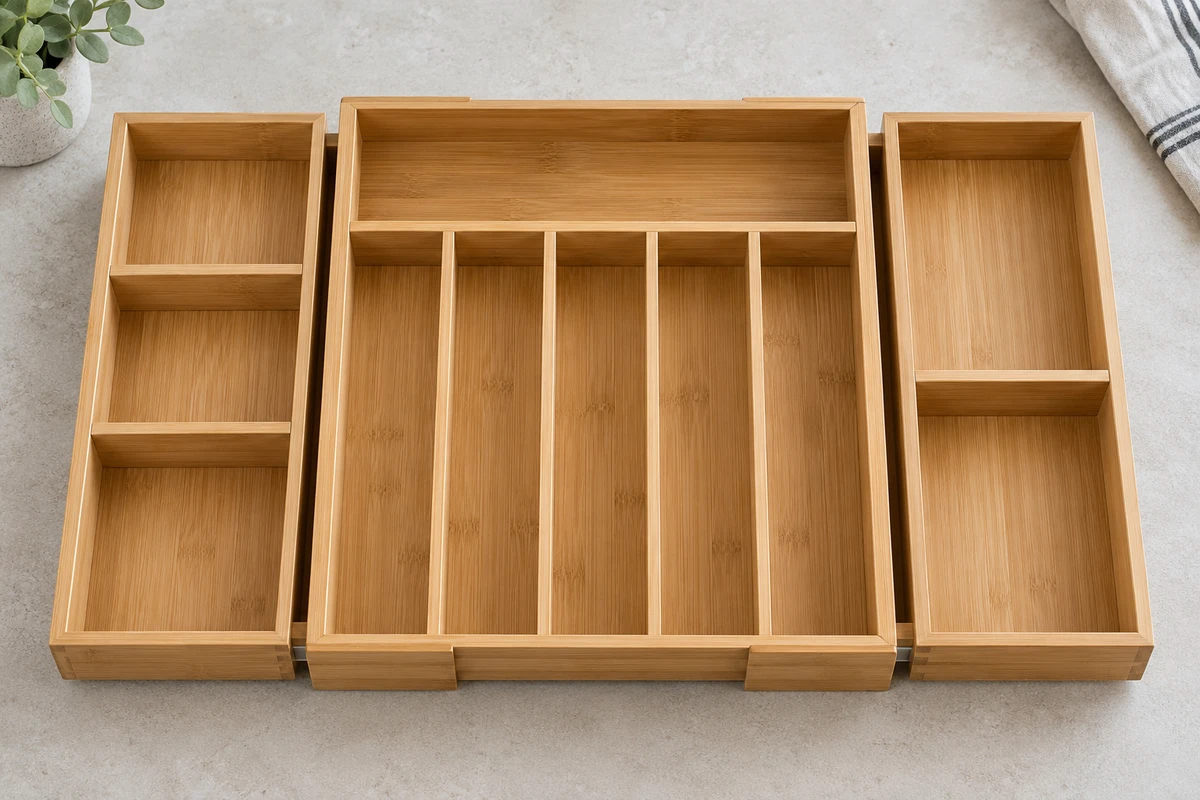
An expandable drawer organizer can have the right width range and still be the wrong tray. Ask for its fixed depth, height and compartment layout as well as the adjustment range, then compare those with the drawer’s usable space and the utensils the buyer wants to store.
For a retailer choosing a small stock range, the aim is to describe which drawer arrangements each model can reasonably be evaluated for. “Universal fit” should not replace an actual dimensional answer. A wider adjustment range solves only the dimension it changes.
Start inside the drawer
Record usable internal width and depth with the drawer in its normal configuration. Note any internal sides, curves, runners or other features that reduce the relevant space. The cabinet’s nominal width is a different measurement and should stay outside the organizer fit calculation.
Identify the available vertical space when the drawer is closed. The organizer body is only part of the loaded arrangement: the intended utensils may project above its compartments. Ask the buyer to identify the actual utensil layout or representative items for the review. Do not treat an empty tray sliding into an open drawer as proof that the loaded drawer can close.
Keep the buyer’s required handling and clearance allowance explicit. If that has not been decided, record it as an open fit question rather than subtracting an invented standard amount from every drawer dimension.
Separate the moving dimension from the fixed ones
Joseph Joseph’s DrawerStore Gray Expandable Cutlery Tray provides a named example. Its published compact and expanded specifications change the width from 29 to 48 cm while retaining 38 cm depth and 5.3 cm height. Its description also identifies adjustable halves and a movable dish. These are specifications for that product, not fit or locking evidence for a proposed supplier tray. Joseph Joseph DrawerStore details and specifications
For the offered organizer, request a compact envelope, a fully expanded envelope and the permitted adjustment direction. Ask which figures stay fixed. If the seller supplies only a range such as “30–46 cm,” have it name the dimension and provide the other dimensions before adding the model to the shortlist.
Ask how the selected position is retained and request the applicable product instructions or construction description. Is the offered position continuous, limited to defined increments or otherwise constrained? Record the supplier’s answer without turning it into a promise that the tray cannot move during use. This RFQ does not prescribe locking-force or durability tests.
Lay out the utensils at the intended position
A compartment count can hide a layout mismatch. Identify which sections are intended for the buyer’s table cutlery, serving utensils and small loose items. Ask for usable compartment dimensions rather than the outside width of the whole tray. A divider, curved end or sloped wall may matter to the particular item being stored.
Request a plan of the organizer at the width the buyer expects to use. If expansion adds a side section, confirm the usable dimensions of that section at that position. The largest product photograph may show more room than the buyer’s narrower drawer permits.
List any movable dish, removable divider or separate insert included in the quote. Ask what space it occupies in the intended arrangement. Do not count the area under a dish and the dish itself as simultaneously available for the same utensil layout. If the buyer would remove it, confirm whether that configuration is within the product’s stated use and record the resulting layout.
Build a drawer and utensil worksheet
Use one record for each drawer arrangement and quoted organizer model. For a retail range, retain the arrangements as separate use cases instead of publishing an unsupported fit claim covering every drawer.
| Question | Buyer input | Requested organizer response |
|---|---|---|
| Width | Usable drawer width and chosen working position | Compact/expanded width and permitted intermediate positions |
| Depth | Usable front-to-back space | Fixed or adjustable depth, including projections |
| Closed height | Available vertical space and intended loaded arrangement | Body height and any raised features |
| Position retention | Intended use and open questions | Identified adjustment/retention construction and instructions |
| Long utensils | Actual item envelope and preferred orientation | Usable length and width of assigned compartments |
| Small-item layout | Items to separate and retrieval preference | Dish/divider dimensions, locations and included parts |
| Review configuration | Drawer reference and representative utensil set | Exact model at the intended expansion position |
The worksheet should show whether a problem belongs to drawer fit or compartment fit. A tray that fits the drawer may lack a long compartment. A tray that holds all the utensils may be too deep to enter the drawer. Changing the width is not a general solution to either problem.
A fictional width match with a depth mismatch
Consider a fictional drawer with 42 cm usable width and 36 cm usable depth. The buyer wants to evaluate a tray around 40 cm wide, with final clearance and loaded height still to review. Candidate T1 adjusts from 30 to 46 cm wide but has a fixed depth of 38 cm. These are invented dimensions, not specifications of the named manufacturer example.
The desired 40 cm position is within T1’s stated width range. Its 38 cm depth nevertheless exceeds the drawer’s 36 cm depth by 2 cm. Leave T1 unsuitable for that stated front-to-back arrangement rather than marking it as a fit because the width answer was positive.
Ask for a shorter stock model and repeat the compartment comparison. If the supplier proposes rotating T1, treat that as a different layout requiring all the relevant checks again. Do not assume the utensils, adjustment direction and access remain suitable after rotation. Cutting the tray or changing the drawer is outside this stock-product request.
Suppose a fictional T2 is then offered with a shorter depth. It can proceed to the remaining review, but the buyer should still check the needed long-utensil compartment and closed loaded height. Passing the first dimensional screen does not establish that T2 meets the whole household use case.
Request the model that answers the layout
A useful final response names the organizer variant, dimensions in the relevant positions, included movable parts and any unanswered compartment measurements. If the seller changes the design between the sample and the quantity quote, ask which of those fields changed rather than relying on the same generic product name.
Keep the review practical: an identified sample, the intended drawer arrangement and the agreed utensil layout. Record what was actually observed, without extending one household fit observation into a universal compatibility or long-life claim.
See Baskets and storage for broader sourcing context. In the Homeware sourcing request, give the drawer’s internal dimensions and describe the longest or most awkward utensil. Add a labelled image preview where it makes the layout clearer; keep the complete working schedule separately.
Frequently asked questions
Will an expandable cutlery tray fit every drawer within its width range?
The range addresses only the stated adjustable dimension. Check fixed depth, the relevant height and projections as well as the drawer’s actual clear space. Then assess the intended loaded arrangement. A cabinet-size label or a positive width comparison does not complete those checks.
Which organizer dimensions should be quoted in both compact and expanded positions?
Request the complete envelope for each position and ask which direction changes. Retain unchanged depth or height explicitly instead of assuming all dimensions adjust. If the buyer intends an intermediate position, request its permitted setting and the compartment layout at that setting.
How much height does a filled drawer organizer need?
Use the actual tray and intended utensil arrangement to identify the relevant height under the drawer’s closed space. Items may project above the tray body. There is no universal allowance supplied here; leave the comparison open until the buyer’s configuration and appropriate clearance are established.
How should removable dishes and extra compartments appear in the RFQ?
List what is included, its dimensions and where it sits in the chosen layout. Ask whether moving or removing it is a stated product configuration. Check the usable space for the real items at the intended expansion position, rather than relying only on the maximum compartment count.
Sources
Discuss a sourcing request related to this article.Expandable Drawer Organizer RFQ: Check More Than the Width Range