
Count Usable Place Settings After Arrival Damage
Recount a damaged dinnerware delivery by component role, complete settings and surplus pieces, keeping held and unexamined units out of the available total.
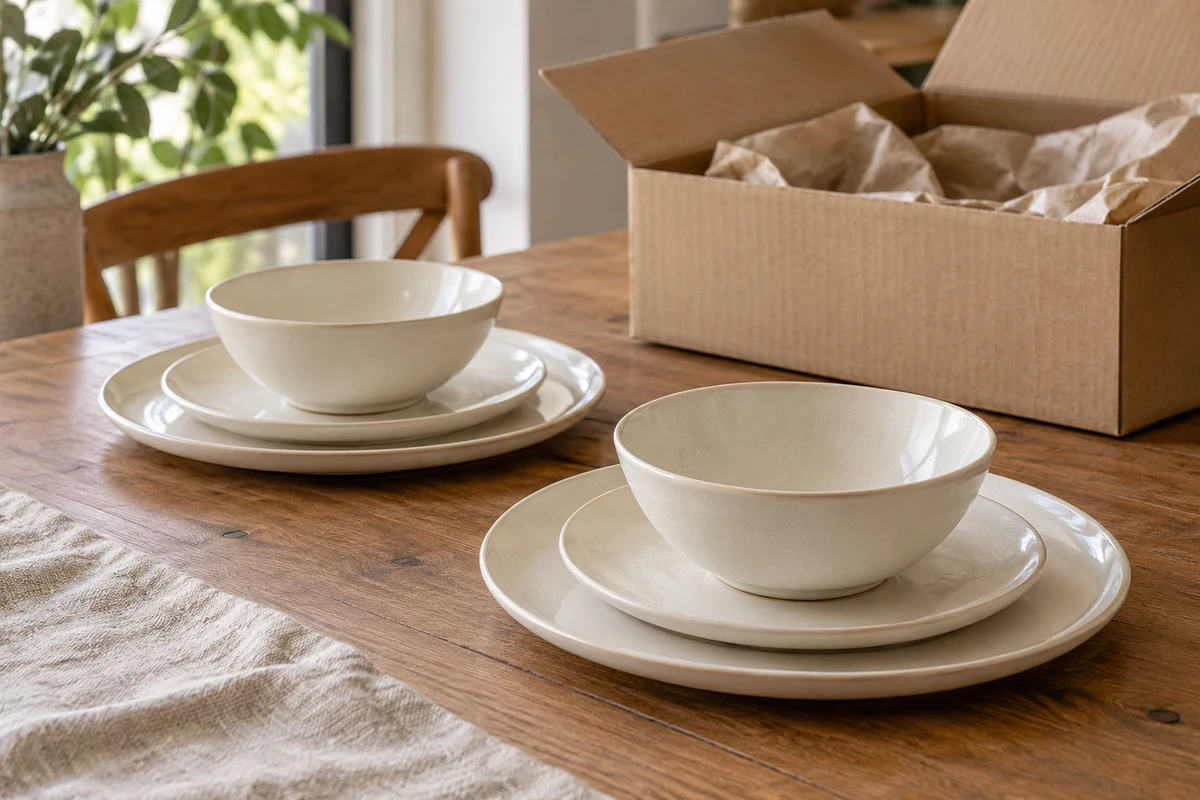
When bowls are damaged in a dinnerware delivery, the remaining piece total can make the shortfall look smaller than it is. Count the complete agreed place settings that can actually be assembled from the reviewed pieces. A spare dinner plate cannot fill a missing bowl position, even when both belong to the same series.
Start with the setting already agreed for this order. Keep damaged or unresolved pieces out of the available count, and keep unexamined stock outside the calculation. The result is a scoped quantity for planning, subject to the other required approvals; it is not food-contact clearance or permission to use damaged ceramics.
Rebuild the setting from its component roles
Read the approved contents list and identify the exact plate, bowl, cup or other piece required in each setting. Include its variant and the number needed per setting. Shared serving dishes and separately ordered spares belong outside the per-person calculation unless the order explicitly includes them in that unit.
A named manufacturer example makes the distinction concrete: IKEA lists six dinner plates, six side plates and six bowls in its FÄRGKLAR 18-piece set. That is the composition of that particular product, not a definition for all dinnerware sets. IKEA FÄRGKLAR contents
At receipt, use the actual order rather than substituting that example. If the agreed setting includes a mug, a bowl-only inventory cannot establish its completeness. If a retail unit contains multiple settings in one package, record both the setting requirement and the package requirement; loose complete settings and complete retail packs are different outputs.
Count pieces once, with a clear reason for exclusion
For each role, distinguish counted pieces, pieces reviewed under the agreed receiving scope, and pieces held. A held piece might have visible damage or another unresolved issue. If one bowl has both a rim discrepancy and a mark inside, it is one held bowl with two observations, not two unavailable units.
Identify the affected piece through the receiving reference and existing photographs where available. Do not handle sharp damaged pieces, pick through fragments or rearrange suspect ceramics for a clearer photograph. Stop any handling whose safety is uncertain and follow the responsible receiver’s procedure. Broken fragments are not additional dinnerware units; where a whole-piece count cannot be established, leave that count unresolved rather than forcing a total.
The available count should contain only identified pieces that satisfy the agreed checks relevant to this calculation. “Counted in the carton” does not mean “reviewed and available.” If only part of a delivery has been examined, label that part explicitly and leave the rest unassessed. Do not subtract two observed damaged bowls from a shipment total and assume every other bowl is usable.
Let the limiting role determine the complete count
Within a fully defined, compatible pool, divide the available count for each role by the number required per setting. Take only whole settings from each role, then use the smallest result. This is ordinary inventory arithmetic, not an acceptance or sampling standard.
When one of each component is required, the smallest available component count is the limit. If an agreed setting requires two identical small dishes, five available dishes support only two complete settings for that role, with one dish left over. Fractions should never appear as usable place settings.
Calculate compatible variants separately. If a setting must contain one particular bowl and matching plates, another size or unapproved colour is not automatically a substitute. Cross-carton pooling also needs to respect the approved product and sales configuration. A buyer may authorize a different assortment, but that decision changes the configuration and should be shown explicitly.
Keep the scope narrow even when the arithmetic is simple. A count of complete settings says nothing about unreviewed chemical, care or intended-use claims. It also does not establish that missing pieces will be available to order individually.
Use a setting-recovery worksheet
Place the approved setting reference, compatible variant, reviewed scope and counting date above the sheet. Enter one row per required component role. Where pieces remain unexamined, show them separately rather than including them in the available column.
| Component role | Required per setting | Received counted units | Identified held units | Available within reviewed scope | Complete-setting limit and surplus |
|---|---|---|---|---|---|
| Exact dinner-plate reference | Order quantity per setting | Count and defined scope | Unique pieces and reasons | Reviewed pieces meeting this scoped requirement | Whole settings supported; remainder after allocation |
| Exact side-plate reference | Order quantity per setting | Count and defined scope | Unique pieces and reasons | Keep other sizes separate | Same calculation |
| Exact bowl reference | Order quantity per setting | Count and defined scope | Unique pieces and reasons | Keep unresolved bowls excluded | Same calculation |
| Any other required role | Order quantity per setting | Count or unresolved | Piece references, not defect-event totals | Do not infer from the other rows | May become the limiting role |
This original worksheet supports the buyer’s allocation decision. It does not prescribe how many units to inspect or set acceptable damage levels. If an essential count is unknown, the complete-setting result remains unknown for that population. The worksheet should make that gap obvious, not hide it behind a percentage.
A fictional delivery with two held bowls
Suppose an invented receipt contains six dinner plates, six side plates and six bowls, all individually counted and reviewed within the agreed scope. The approved setting requires one of each. Two identified bowls are held for visible damage; the other pieces satisfy the checks covered by this fictional review. No actual supplier or shipment is represented.
| Role | Required per setting | Counted | Held | Available for this calculation | Allocated to four settings | Surplus |
|---|---|---|---|---|---|---|
| Dinner plate | 1 | 6 | 0 | 6 | 4 | 2 |
| Side plate | 1 | 6 | 0 | 6 | 4 | 2 |
| Bowl | 1 | 6 | 2 | 4 | 4 | 0 |
The result is four complete settings, four surplus plates and two held bowls. There are sixteen available pieces, but dividing sixteen by three and rounding down to five would be wrong: the fifth setting would have no bowl.
Now suppose the supplier proposes two replacement bowls. Until the correct bowls arrive and satisfy the applicable checks, the available-setting count remains four. A promise is not inventory. If only one acceptable matching replacement arrives, the new count becomes five settings, with one dinner plate and one side plate still surplus. Retain the original two held-bowl entries and record the replacement separately so the receipt history stays understandable.
If the order must be supplied as one six-setting retail pack, four loose settings do not fulfill that pack requirement. The buyer needs a decision about the incomplete pack, even though four settings can be counted within the reviewed stock.
Request the missing role and the commercial decision together
Describe the outcome in product terms: which exact component limits the count, how many complete settings remain, which pieces are surplus and which remain held. Then ask for the proposed resolution under the actual order terms. Replacement, credit, return or an approved revised assortment each needs its own agreement; this calculation creates no remedy entitlement.
Keep the role-specific request separate from an assumption about the cause of damage. A photograph and a count may document an arrival discrepancy without establishing where it occurred or who is liable. Record any agreed remedy, affected references and outstanding requirements before updating the available stock.
For broader category context, see Kitchenware. A Homeware sourcing request can describe the agreed setting and the role-specific shortfall. Use supported product references, text or image previews; confirm any additional receiving or resolution work and its scope rather than assuming a replacement service is included.
Frequently asked questions
Can I divide the remaining piece total by the number of pieces in a setting?
Only when the required component quantities are also satisfied. Six dinner plates, six side plates and four bowls support four one-of-each settings, even though sixteen pieces remain. Calculate the whole-setting capacity of every role and use the smallest result, within the exact reviewed and compatible stock.
What if the order includes spare bowls?
Keep the spare requirement visible and ask whether the buyer authorizes those pieces to complete the main settings. Using them may solve the setting shortage while leaving the agreed spare allocation unfilled. Do not count one bowl in both places or treat an available spare as a supplier replacement.
Does a complete setting count mean the dinnerware is ready for food use?
No. The count addresses component availability within the checks explicitly covered. Product identity, food-contact evidence and any other required use approvals remain separate. A piece can look intact without those questions being resolved, and damaged or uncertain pieces should not be put into use to investigate them.
Can complete settings be combined from different cartons or colour variants?
Keep the approved configuration and sales unit controlling. Matching components from identified cartons may be pooled if the buyer permits that arrangement, but another colour, size or series is not automatically interchangeable. If goods must remain in complete retail packs, record pack completeness separately from the count of loose settings.
Sources
Discuss a sourcing request related to this article.Count Usable Place Settings After Arrival Damage