
Specify Cookware Base Dimensions Before Comparing Induction Quotes
Separate advertised pan size from base geometry, tie drawings to the quoted model, and keep induction compatibility pending the actual hob requirement.
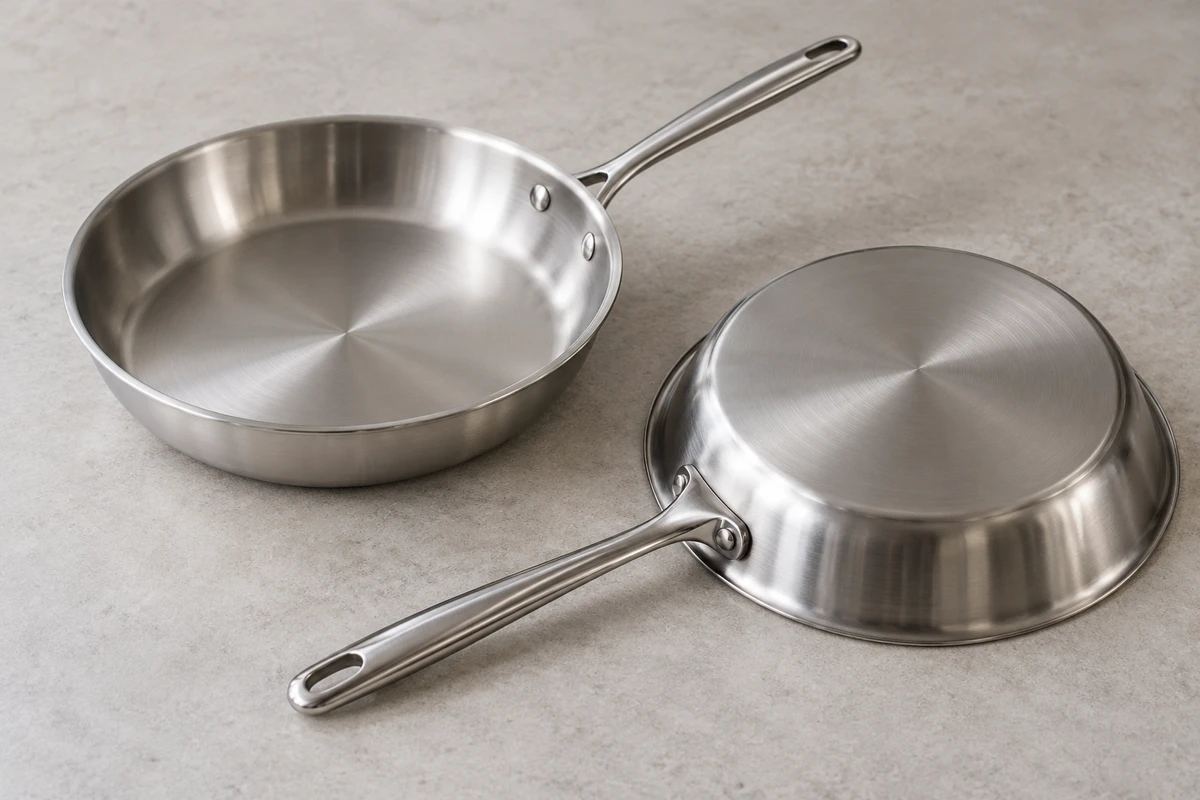
A pan advertised as 24 cm still needs a separate base specification before you can compare it for an induction-cookware order. Ask what the advertised size measures, obtain the underside dimensions for the exact quoted variant, and identify the hob requirement the buyer intends to meet. Keep the compatibility decision open until those records can be read together.
This is a purchasing decision about geometry and evidence. The aim is to prevent two nominally equal pan sizes from becoming interchangeable quotation lines when their bases have not been identified.
Give the advertised size a defined location
Preserve the listing’s size description, then ask the supplier to label the corresponding dimension on a drawing. Does “24 cm” describe the upper opening, the outside rim, the bottom, or simply a catalogue size name? Do not convert an unexplained number into a base diameter in your comparison sheet.
A manufacturer’s own catalogue shows why the distinction matters. Bosch’s German page for cookware set 17005722 identifies one frying pan with an upper diameter of 24 cm and a lower diameter of 18 cm. Those figures belong to that named product; they are neither a conversion rule for other 24 cm pans nor dimensions to copy into your order. Bosch 17005722 product details
Ask for an underside view as well as the side profile. On your worksheet, distinguish the stated outside base dimension from any separately described plate, ring or induction-related area. If the supplier uses “base” for more than one feature, have each feature labelled. A photograph of a circular mark is not enough to establish which feature a dimension measures.
For a non-circular pan, request the actual outline and the relevant dimensions rather than forcing the item into a single diameter field. The supplier should identify the geometry being quoted; the buyer’s appliance reviewer can then decide which information is relevant.
Put the intended hob beside the pan specification
Record the hob manufacturer, full model identifier and intended cooking zone or configuration, together with the applicable manufacturer instructions. If the cookware will be sold for several named appliances, keep those requirements separately identifiable. One appliance reference should not silently become evidence for the whole range.
Le Creuset’s enameled-cast-iron instructions expressly address matching the product base to the hob zone, including induction. This is a useful example of a maker distinguishing the bottom of its cookware from the product’s overall size. It does not establish compatibility for a proposed supplier’s pan. Le Creuset care and use, Heat Zones
Carry the actual appliance requirement into the inquiry without rewriting it as a universal rule. Record its source and the dimension it refers to. If it is unclear whether a requirement concerns the full underside or another defined area, ask the appliance manufacturer or responsible reviewer to resolve that point before accepting the supplier’s answer.
When the target hob is not yet known, say so. You can still collect pan dimensions and compare the completeness of quotations, but you cannot close a named-appliance compatibility question with missing appliance information. A marketplace induction icon does not fill that gap.
Use a base-to-hob worksheet
Create one row for each quoted pan variant. The six columns below keep the product identity, geometry and unresolved appliance decision in the same record. Attach references to the actual documents rather than copying only their conclusions.
| Worksheet column | What belongs in it | What makes the row incomplete |
|---|---|---|
| Quoted model and variant | Supplier model, selected size option and quote reference | A family name covering several pan sizes |
| Advertised size meaning | Original size wording and the labelled feature it measures | “24 cm” with no measurement location |
| Base drawing and dimensions | Underside outline, dimensioned features, units and drawing revision | An upper-rim dimension presented as the bottom size |
| Buyer hob requirement | Full appliance model, intended zone/configuration and manufacturer reference | “Works on induction” without the intended appliance context |
| Supplier evidence for this configuration | Model-specific drawing and explanation addressing the named requirement | A generic illustration or a statement for another variant |
| Open decision and owner | The missing answer, who must provide it and who will review it | “Approved” while geometry or applicability is unresolved |
Use the worksheet to ask one precise follow-up at a time. “Please identify the feature measured by 190 mm in drawing B2” gives the supplier a clearer task than “Please confirm good induction performance.” Keep requested dimensions and returned dimensions distinct, so a supplier response cannot overwrite the buyer’s original requirement.
If dimensional tolerances matter to the intended selection, obtain an agreed specification and method for that review. Do not turn a rounded catalogue size into an inspection limit or invent a tolerance from the apparent accuracy of a photograph.
Work through two fictional 24 cm quotations
Imagine a buyer comparing two invented frying-pan proposals for a named hob. The appliance review has not yet been completed. All codes, dimensions and supplier replies in this example are fictional; they are not measurements of real cookware.
| Entry | Quote A: FP-A24 | Quote B: FP-B24 |
|---|---|---|
| Advertised description | 24 cm induction frying pan | 24 cm induction frying pan |
| First dimensional response | Upper rim: 240 mm; underside not stated | Drawing B2: upper rim 240 mm; labelled outside base 190 mm |
| First comparison decision | Base geometry missing | Base geometry documented for appliance review |
| Follow-up response | Drawing A3: upper rim 240 mm; labelled outside base 170 mm | Supplier confirms B2 applies to the quoted variant |
| Revised comparison decision | Keep as a distinct 170 mm-base proposal | Keep as a distinct 190 mm-base proposal |
At the first pass, Quote A cannot be treated as geometrically equivalent to B. At the second pass, the missing base figure has been supplied, and the buyer can see that the proposals differ by 20 mm in stated outside base diameter. That arithmetic explains the quotation difference. It says nothing about which pan the hob will recognize or how either pan will cook.
The buyer now sends both identified drawings and the actual hob reference to the responsible reviewer. If the appliance documentation needs a different base feature, both suppliers must answer that question. If only one proposal meets the buyer’s reviewed requirement, compare its commercial terms with other qualifying proposals. If both qualify, retain their distinct geometry rather than changing the records to “same 24 cm pan.”
If a supplier offers another bottom design in response, give it a separate variant or revision. Otherwise a quote for the original pan can become attached to the revised drawing without anyone knowing which product the price covers.
Ask the sample to answer a defined dimensional question
If a sample is requested, identify the pan model and the drawing revision it is meant to represent. Ask the agreed reviewer to record the relevant dimensions against those labelled features using an appropriate method. A top-view photograph or a measurement across the rim cannot answer an underside-diameter question.
Keep dimensional observations separate from appliance suitability. Even a sample that matches the drawing has answered only the checks actually performed. Do not use a magnet demonstration or an improvised heating exercise as a replacement for the required product-and-appliance assessment.
Before accepting the quote as a basis for an order, resolve conflicts between the listing, drawing and supplier reply. Retain the chosen geometry with the quoted model, and require a fresh review if a later proposal changes the underside design. An unchanged catalogue size does not make that change immaterial.
Send a focused cookware inquiry
Use this wording as a starting point: “For [supplier model and size option], identify what the advertised size measures. Provide the current underside and side-profile drawing, with units and all relevant base features labelled. Our intended appliance is [full model and zone/configuration]; the requirement reference is [document/section]. Explain how your evidence applies to this exact quoted variant and list any unanswered points.”
For related product context, see Homeware kitchenware. Start the request through the Homeware sourcing page with a supported marketplace link, a concise description or image previews. The form accepts up to five PNG, JPEG, WebP or GIF images, limited to 10 MiB each and 20 MiB in total. Arrange any original PDF or other technical-file exchange separately; the image field is not a document-upload channel.
Keep the quote conditional wherever the base specification or appliance requirement is unresolved. The useful outcome is a clearly identified pan proposal that can be reviewed against the intended hob, with the remaining decision visible to everyone comparing the prices.
Frequently asked questions
Is the advertised pan diameter normally enough for an induction RFQ?
It is enough to identify a catalogue size only when its meaning is clear. It does not replace a base dimension. Ask the supplier to label the advertised measurement and the relevant underside features on the same model-specific drawing. Then relate those features to the intended hob manufacturer’s requirements. Do not assume a fixed difference between rim and base across pan shapes or sizes.
What if the supplier sends a photograph with a ruler across the pan?
Check which feature the photograph actually measures and whether it identifies the quoted variant. A rim measurement leaves a base question unanswered. A useful image can support a labelled dimension, but perspective, feature definition and the measurement method still matter. Ask for the applicable drawing or a clearly specified dimensional record; keep appliance suitability separate from that dimensional evidence.
Can I shortlist cookware before choosing the hob model?
Yes, for the limited purpose of collecting clearly identified cookware proposals. Record the stated base geometry and keep the appliance field open. Do not label the shortlist as approved for a particular hob or all induction appliances. Once the intended appliance and configuration are known, review the relevant requirements against each exact pan variant before making that claim.
Should a different base diameter automatically disqualify a pan?
No. First determine whether it conflicts with the buyer’s reviewed requirement. Different bases mean the proposals are not geometrically identical, but this article supplies no universal acceptable range. Keep each proposal distinct and let the responsible reviewer decide its applicability using the actual appliance documentation. If a changed base is offered after approval, obtain the new variant or drawing reference and review the change before accepting it.
Sources
Discuss a sourcing request related to this article.Specify Cookware Base Dimensions Before Comparing Induction Quotes