
Reorder Lamp Shades with Their Required Fitting-Ring Contents
Compare shade-only offers for retained lamp bases after establishing the exact shade arrangement, fitting-ring contents and any separate complete-lamp need.
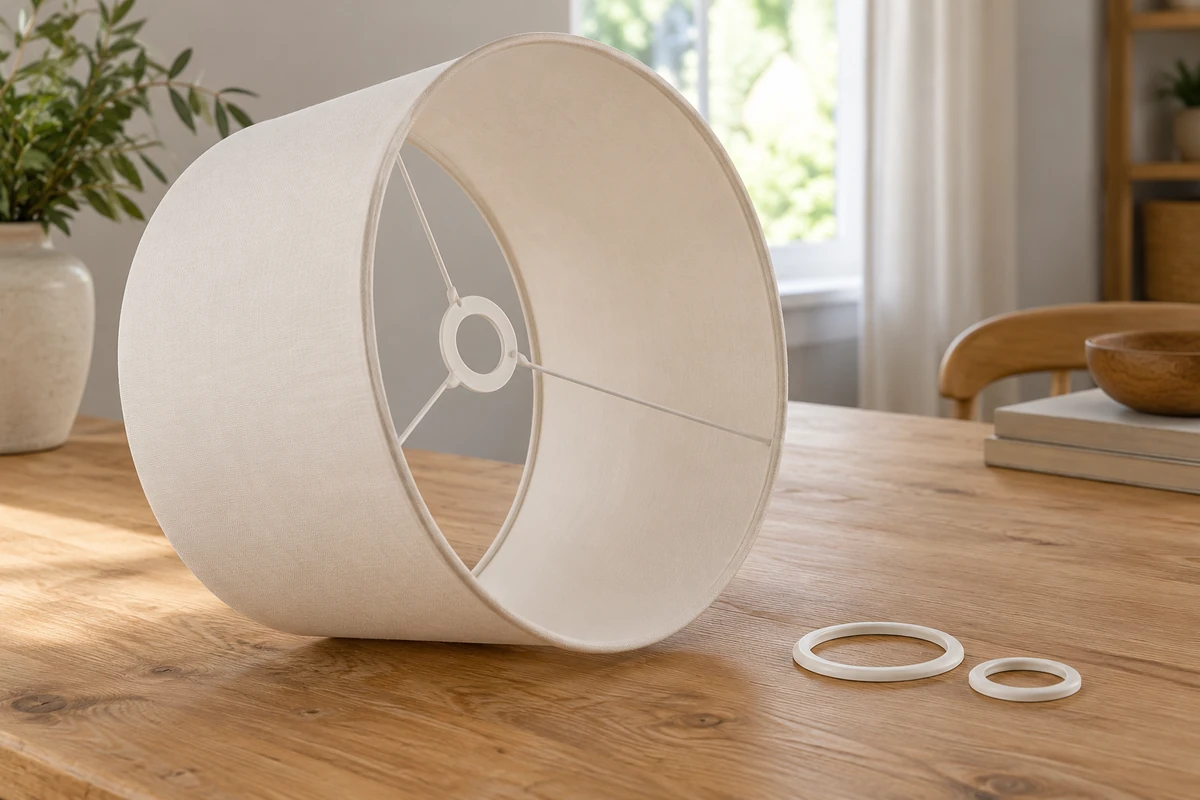
When suitable lamp bases are being retained, request the shade and the required fitting arrangement as one complete replacement supply. A shade-only listing with a familiar outside diameter may omit the ring or interface information needed to identify the actual replacement. Buying more complete lamps is a separate alternative, not the default answer to that omission.
A shade-and-fitting-ring reorder concerns supply completeness for an already established lamp arrangement. It does not choose bulbs, set clearances, prescribe assembly or assess electrical suitability. Keep any unresolved product question with the appropriate responsible reviewer before treating a candidate as the replacement to buy.
Start with the bases the buyer intends to keep
List the exact retained lamp-base or cord-set references, with the applicable regional product information. State how many need replacement shades and why the purchase scope is shade-only. The reason can be an appearance refresh or an identified missing shade; it need not become a claim that every retained lamp is in usable condition.
Keep retention eligibility as an established prerequisite. If the condition or suitability of a base is unresolved, buying a new shade does not answer that question. Separate such items from the bases already covered by the replacement plan.
Count complete lamps required for new positions or separately approved whole-unit replacements on another line. A shade for a retained base and a complete lamp for an additional room position produce different supplied goods. Combining them under “three lamps” makes later quotations difficult to interpret.
Ask what comes with the exact shade
IKEA’s RINGSTA 104.053.64 page describes an included extra shade ring for the large/small cap arrangements stated there, while the lamp base and cord set are separately sold. This provides a named example of why a shade’s component contents matter. It is not a universal interface rule or approval for another lamp. RINGSTA product and included-ring information
For the actual proposed replacement, ask the seller to identify the shade reference, its supported arrangement and the ring or other relevant supplied component. Keep that answer tied to the retained base reference and applicable instructions. A general “universal shade” description leaves the question unresolved.
Outside width and height may help the owner recognize the intended appearance, but they do not establish the mounting interface or full suitability. A product photograph can show an object without confirming what the seller includes in the selected purchase option. Request a written contents answer for that option.
Do not infer a separate ring-only spare offer merely because a ring is included with a shade. If the buyer only lacks that component, ask whether an identified replacement is actually offered and whether the responsible review supports it. The existence of one bundle does not prove every component can be bought independently.
Compare complete shade-only supply with complete lamps
Once the exact shade arrangement is established, ask for an actual offer covering the required shade count and all specified included components. Keep any unresolved ring line open. Treating a missing component as a zero-cost extra would make an incomplete offer look artificially attractive.
A whole-lamp alternative may contain another base and other items the buyer does not need. Show those additions explicitly and check the actual supplied contents. Do not assume that a styled image includes a bulb or that an extra base has resale value. Its usefulness is a buyer decision separate from the shade shortage.
Compare current totals only when both alternatives answer the chosen replacement scope. If one offer remains an unidentified shade of similar diameter, it is not yet a comparable lower-cost replacement. If the buyer deliberately selects a different complete lamp, record that change instead of calling it the same shade-only order.
Keep appearance choices separate from the fitting answer
The owner may want several shades to look alike in one room. Record that requirement and ask what the actual offer establishes about the supplied variant. Do not promise matching colour, texture or light appearance from a shared range name.
An appearance change can be acceptable while the fitting question remains unresolved; the reverse can also be true. Preserve those two decisions. A seller’s statement that the shade looks similar cannot close the interface row, and a confirmed interface does not force the owner to accept an unwanted appearance.
No physical improvisation belongs in this comparison. Do not bend fittings, add an unapproved adapter, alter a ring or energize a candidate to settle purchasing uncertainty. The task is to obtain the correct product-specific answer and complete offer.
Use a shade-replenishment worksheet
| Worksheet field | Entry for the actual proposal | What it settles |
|---|---|---|
| Retained base or cord reference | Exact identified variant and applicable information | Which existing product remains in the plan |
| Established shade arrangement | Exact shade and responsible product-specific basis | Whether this candidate answers the replacement scope |
| Required fitting-ring contents | Named component and inclusion answer | Whether the offer supplies the stated arrangement |
| Actual shade purchase unit | Shade count and all included pieces | How many complete replacement supplies are bought |
| Appearance requirement | Owner’s selected variant and unresolved match question | Whether the proposed look is acceptable |
| Complete lamps separately needed | New positions or approved whole-unit changes | Prevents shade demand becoming unnecessary base demand |
| Quote and unresolved scope | Actual total, exclusions and unanswered components | Supports an honest comparison |
This original worksheet ends at a purchasing decision. Its completed cells do not certify a lamp, establish operating readiness or provide an assembly instruction.
Fictional example: three retained bases, two different answers
Suppose three identified bases are retained under an existing product-specific approval. Each needs one shade of the approved arrangement. Fictional Offer A identifies the required shade and confirms its required ring is included. Offer B shows a shade of similar outside diameter but gives no interface or ring-contents answer. All counts, approvals and offers in this example are invented.
A can proceed to comparison of its actual three-shade commercial offer. B remains a candidate awaiting the missing information; multiplying its displayed shade amount by three would not establish a complete equivalent. The buyer asks B for the retained-base match and exact included contents rather than guessing that rings can be transferred.
Offer C proposes three complete lamps. For this example, its documented contents include three new bases and three identified shades meeting the changed whole-lamp proposal. The three bases are additional goods relative to the original requirement. The owner must decide whether to change the plan and what happens to the retained bases; the worksheet authorizes no disposal.
If the owner continues with shade-only replenishment, A’s supported supply remains the relevant route while B is clarified. If B later confirms a different ring or arrangement, it returns for its own review. A similar diameter still cannot close that new question.
No price winner follows from these facts. The useful result is a complete shade-only candidate, an incomplete candidate with a precise question, and a clearly different whole-lamp alternative. That is enough to request meaningful quotations without pretending that the electrical or installation work has been performed.
Make the replacement request specific
See Homeware decor and ceramics for category context. Through the Homeware sourcing enquiry, identify the retained base, established shade reference, required ring contents and quantity. Use supported links, concise text or permitted images; arrange technical-document exchange and specialist review separately. Ask what coordination is actually available rather than assuming the sourcing form provides electrical approval.
Frequently asked questions
Can I reorder a lamp shade using its outside diameter?
Outside dimensions alone do not establish the fitting arrangement or complete suitability for the retained base. Identify the exact base and shade, obtain the product-specific answer and confirm the relevant included ring or other component. Keep appearance dimensions separate from that interface decision.
Does a shade listing include the fitting ring, base and cord?
Read the selected offer’s actual contents. The named RINGSTA example describes an included extra ring while its base and cord set are separately sold. That scope cannot be transferred to another seller’s shade, and a pictured complete lamp does not establish bundle contents.
Can I buy only the missing shade ring?
Ask whether an exact ring-only replacement is currently offered and supported for the identified arrangement. A ring included in a shade package does not prove it is sold separately. Do not improvise an adapter or transfer unidentified parts to make an incomplete offer appear complete.
When is a whole lamp a valid alternative to shade-only replacement?
It is an alternative when the buyer deliberately accepts the changed scope and the actual product proposal has the appropriate review. Show the new base and other included goods separately from the original shade need. Compare complete offers without assuming resale value, operating readiness or a universal cost advantage.
Sources
Discuss a sourcing request related to this article.Reorder Lamp Shades with Their Required Fitting-Ring Contents