
Specify the Packed Frame Back and Included Mat
Choose one coherent packed-frame configuration, showing the included mat, backing and manufacturer-permitted support state without mixing incompatible views.
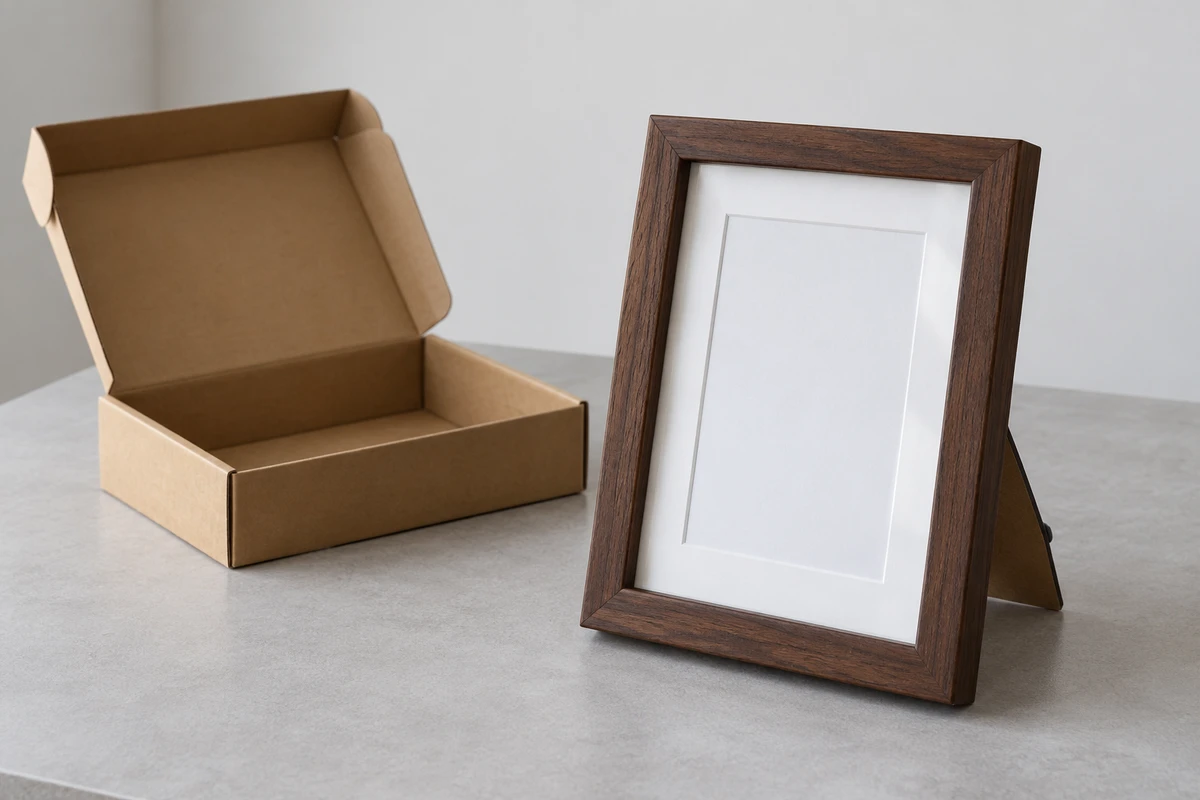
A frame can look complete from the front while its packing proposal leaves the mat, backing and standing support in conflicting states. Before choosing the pack, ask for one coherent description of what the recipient will actually receive. “Frame with mat” does not say whether the mat stays in the frame, travels separately or appears only in a display photograph.
Start with the approved frame and included components. The print format and mat opening should already be settled. This decision concerns their supplied configuration, including the support only where the chosen frame actually has one. It does not require valuable artwork, a mounting exercise or an improvised disassembly.
Name the front and the parts behind it
Give the frame and front panel their accepted references. Record the included mat, backing and any standing support separately, without assuming that every frame in the same range has the same rear construction. If a component is integral, describe its supplied state rather than treating it as a loose accessory.
IKEA’s RÖDALM example lists frame dimensions, picture dimensions with and without the included mat, and the mat opening as separate fields. That establishes that the mat is a distinct part of the named product description; it does not authorize a separate-mat packing method for another frame. IKEA RÖDALM product details
Keep display state and packed state distinct. A frame standing on a shelf illustrates a possible presentation, while a rear view lying within a package describes a different condition. Ask which view represents the proposed delivery arrangement, and which is merely explanatory background.
Compare an in-frame mat with a separate-mat proposal
An in-frame proposal keeps the mat in the identified frame configuration with the backing in its stated position. It offers a coherent starting point when the recipient expects the frame and mat together. The provider still needs to identify the actual front, rear and required layers. A neat front view does not demonstrate that the unseen backing matches the proposal.
A separately packed mat changes the delivery configuration. It may be considered only if the relevant instructions and owner decision permit it. Ask where the mat is located, how it remains associated with its frame, and what authorized work the recipient is expected to perform later. Do not silently add that work to a purchase intended to arrive in its approved configuration.
The distinction matters even when the total contents are identical. “One frame plus one mat” can describe both arrangements, yet the recipient’s starting point differs. The buyer needs to choose the intended handover before the packer repeats it.
| Component state | In-frame proposal | Separate-mat alternative |
|---|---|---|
| Mat | In the named approved frame arrangement | Identified separate position, subject to permission |
| Backing | Defined supplied state in the same configuration | State explained independently; not inferred from a front view |
| Standing support, if present | Manufacturer-permitted packed state identified | Same requirement, including relation to the separate mat |
| Recipient’s starting point | Agreed frame arrangement available as supplied | Separate mat recovery and any authorized later task explicit |
| Open question | Does the represented whole match the approved proposal? | Is the changed delivery configuration actually accepted? |
This table compares scope. It supplies no assembly sequence or material recommendation.
Keep the support in its actual permitted state
Ask the provider to describe the supplied standing support, if any, in the packed configuration. Use the manufacturer’s applicable instructions as the boundary. Do not prescribe that an unknown support should fold flat, tuck under the backing or detach to reduce space.
Where a separate mat is proposed behind the frame, its relationship to the support needs an explicit answer. A drawing that places the mat underneath an unspecified support leaves both the mat location and support state unresolved. The apparent available space is not permission to use it.
Keep required protective layers and product information in their authorized states. If a drawing hides the relevant relationship, ask for a permitted view or owner clarification. Do not remove a layer, force clips or change the product merely to make the image easier to read. Stop physical review when ordinary authorized handling is not possible.
Use a complete-configuration worksheet
A configuration reference should connect all views and component descriptions. Label separate alternatives clearly so reviewers do not accidentally combine the preferred front from one with the back of another.
| Worksheet field | Entry to record | Question closed |
|---|---|---|
| Frame and front reference | Exact approved articles and proposal issue | Which frame configuration is represented? |
| Mat supplied position | In-frame position or authorized separate location | Where does the included mat travel? |
| Backing state | Actual proposed delivery condition | Does it belong to this same arrangement? |
| Standing support state | Present or absent; permitted packed state reference | What rear projection or component is being represented? |
| Ordinary opening boundary | Applicable instruction and permitted review scope | Which observations can be made without alteration? |
| Configuration still unresolved | Missing relationship and decision owner | What prevents selecting this proposal? |
A missing support entry is not automatically “not applicable.” Use that status only once the actual frame reference establishes that there is no standing support in the supplied scope. Likewise, absence from a photograph is not evidence that a mat has been excluded from the order.
A fictional pair of inconsistent views
Consider fictional frame F1 with included mat M1, backing B1 and support S1. Its product components are already approved. The initial proposal contains a front photograph showing M1 within F1 and a rear drawing showing M1 loose behind the frame, beneath a depicted folded support. All references and provider responses here are invented.
The buyer cannot select a single configuration from these two views. They describe different mat positions, and the support drawing has no applicable instruction attached. The next request is precise: identify the proposed mat position, backing state and permitted support state in one named delivery configuration.
The provider returns Alternative A with M1 in the frame and Alternative B with M1 separately located. The buyer retains A as the preferred configuration because it matches the intended supplied arrangement. B remains an explicit alternative requiring approval of the separate-mat scope and any later recipient task. Neither is treated as a shipping-protection result.
If A’s rear information is still missing, its preference remains conditional. The buyer asks for the corresponding rear description rather than borrowing B’s support drawing. This closes the contradiction without turning the review into a crop calculation or a lesson in operating frame clips.
Hand over the whole arrangement
Preserve the selected configuration issue, component references and actual review limits. A change from an in-frame mat to a loose mat, or a change in support construction, should reopen the affected configuration fields. Keep the earlier reference as history rather than treating it as approval for the revised state.
See Home décor and ceramics for category context. In a Homeware sourcing request, identify which mat, backing or support relationship is unclear. The form supports marketplace HTTPS links, descriptions of 8–1200 characters, or up to five PNG, JPEG, WebP or GIF images, with 10 MiB per-file and 20 MiB combined limits. It is not a PDF or artwork-document channel. Confirm any further exchange and review scope separately, without assuming confidential artwork handling or specialist approval is included.
Frequently asked questions
Does a front photograph show the complete packed-frame state?
It can show the represented front appearance, but it may not establish the backing position, support state or where the included mat actually travels. Connect the front view to the same identified packing proposal and obtain the corresponding component-state information. Do not combine a display photograph with an unrelated rear packing view as if they show one complete configuration.
Can an included mat be packed separately from the frame?
Treat separate mat packing as a distinct proposal requiring applicable product instructions and owner approval. It changes how the recipient receives the frame and recovers the mat. Name the separate position and any authorized work expected later; do not assume that “mat included” means either installed or safely stored loose behind the backing.
Should the standing support be folded flat for shipping?
The actual manufacturer’s instructions and support design control the permitted packed state. This article supplies no folding angle or permission to move, detach or force a support. Ask the provider to identify the state being represented. If the instruction is unavailable or handling is uncertain, keep that part of the proposal pending.
What does approving a frame configuration establish?
It establishes only the particular arrangement and any supported observations recorded in the decision. It does not establish transit protection, archival suitability, front-material performance, artwork fit or wall-mounting safety. Keep the frame, mat, backing and support references together so later changes cannot inherit an approval for another arrangement.
Sources
Discuss a sourcing request related to this article.Specify the Packed Frame Back and Included Mat